
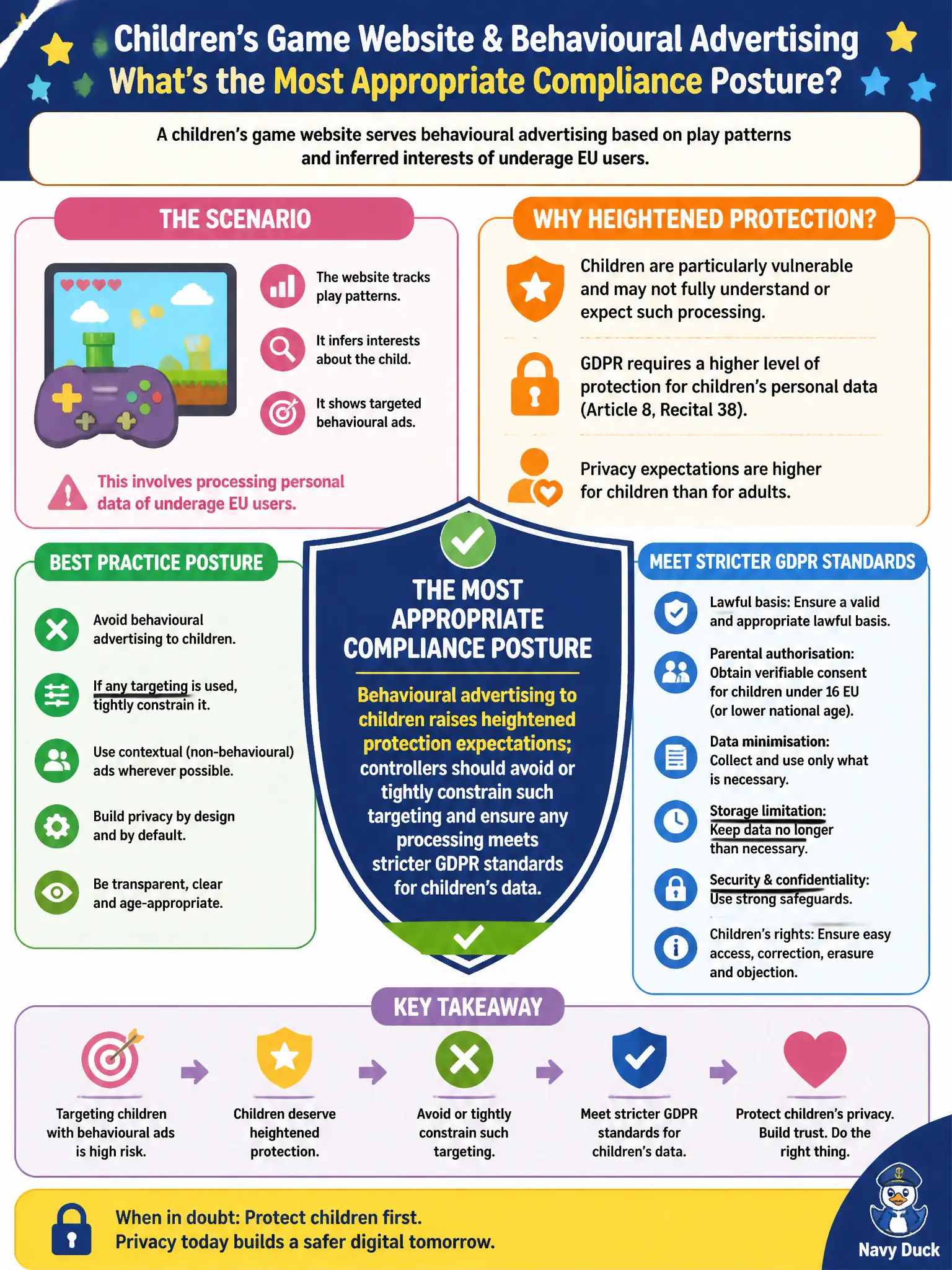
A children's game website serves behavioural advertising based on play patterns and inferred interests of underage EU users. Which compliance posture is most appropriate?
Select an answer to reveal the explanation.
Short Explanation
Kids are not just small adults in the ad auction. European privacy thinking—and common sense—says behavioural targeting of children needs a much higher bar, often meaning do not do it. Treat underage profiles as a stop sign, not a segment to optimise.
Full Explanation
A children’s game website that serves behavioural advertising based on play patterns and inferred interests of underage EU users should adopt the posture that behavioural advertising to children raises heightened protection expectations; controllers should avoid or tightly constrain such targeting and ensure any processing meets stricter GDPR standards for children’s data. Children are not just small adults in the ad auction. Saying children’s behavioural ads are encouraged if ads fund free gameplay fails fairness and special protection for minors. Claiming inferred interests of minors never count as personal data fails when inferences relate to identifiable children. Asserting parental consent is unnecessary for advertising if the game is labelled educational fails—labels do not erase heightened standards. Exam caveat: Article 8 and fairness principles weigh heavily against exploitative profiling of children; many supervisory narratives treat behavioural ads to children as inappropriate even beyond baseline adult adtech rules. Operational check: disable behavioural targeting for child users, use contextual rather than profiled ads, verify age-appropriate design, minimise tracking, and document why any residual processing meets heightened standards—or remove it.