
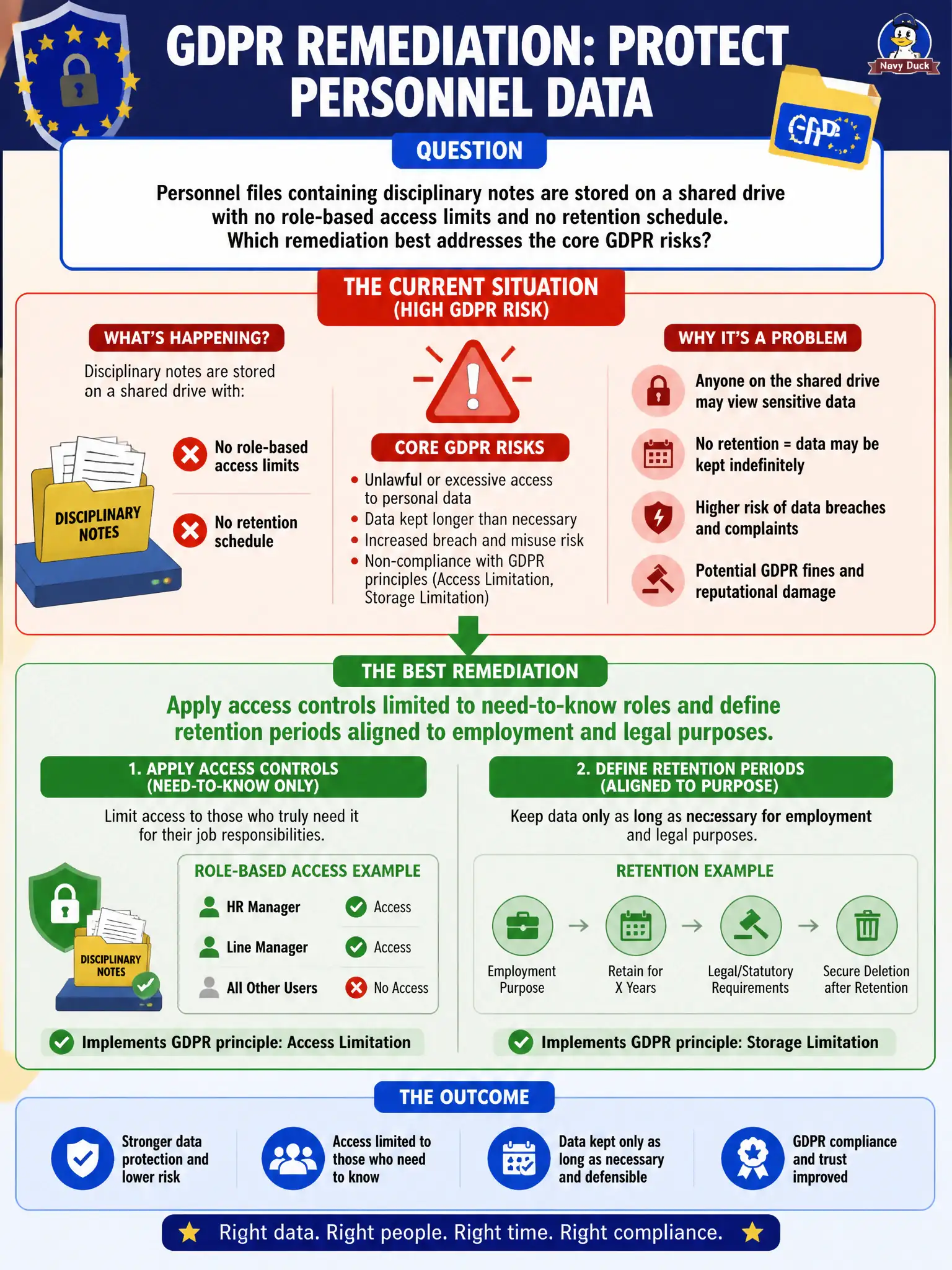
Personnel files containing disciplinary notes are stored on a shared drive with no role-based access limits and no retention schedule. Which remediation best addresses the core GDPR risks?
Select an answer to reveal the explanation.
Short Explanation
Disciplinary notes are not hallway gossip for the whole company drive. Lock them to people who actually need them, and set a clock for how long they stay. Open-forever shared folders fail confidentiality and storage limitation.
Full Explanation
Personnel files containing disciplinary notes on a shared drive with no role-based access limits and no retention schedule are best remediated by applying access controls limited to need-to-know roles and defining retention periods aligned to employment and legal purposes. Disciplinary history is not hallway gossip; confidentiality and storage limitation protect workers’ dignity and reduce insider misuse. Publishing every disciplinary note on the intranet for ‘transparency’ fails by weaponising openness against confidentiality. Keeping unlimited open access so any manager can ‘correct mistakes instantly’ fails need-to-know and security principles. Deleting all personnel records immediately after each annual review regardless of legal hold needs fails by ignoring lawful retention for claims, tax, or regulatory duties. Exam caveat: retention must be purpose-bound—neither indefinite shared-drive sprawl nor reckless early deletion that destroys records still required by law. Operational check: move personnel files into access-controlled HR systems, define role matrices, set retention/deletion schedules with legal-hold exceptions, log access, and purge orphan copies on open drives. In public-interest terms, documenting the lawful analysis, assigning owners, and retaining evidence of how individuals were protected is how organisations demonstrate accountability when supervisory questions arrive.