
An employer relies solely on employee consent for continuous badge-based location tracking across the workplace. What is the strongest privacy-compliance concern?
Select an answer to reveal the explanation.
Short Explanation
Consent at work is like “agree or lose your paycheck”—that’s not really free choice. Continuous badge tracking needs a real lawful basis and a necessity check, not a checkbox shoved at staff. Treat freeness and proportionality as first-class issues.
Full Explanation
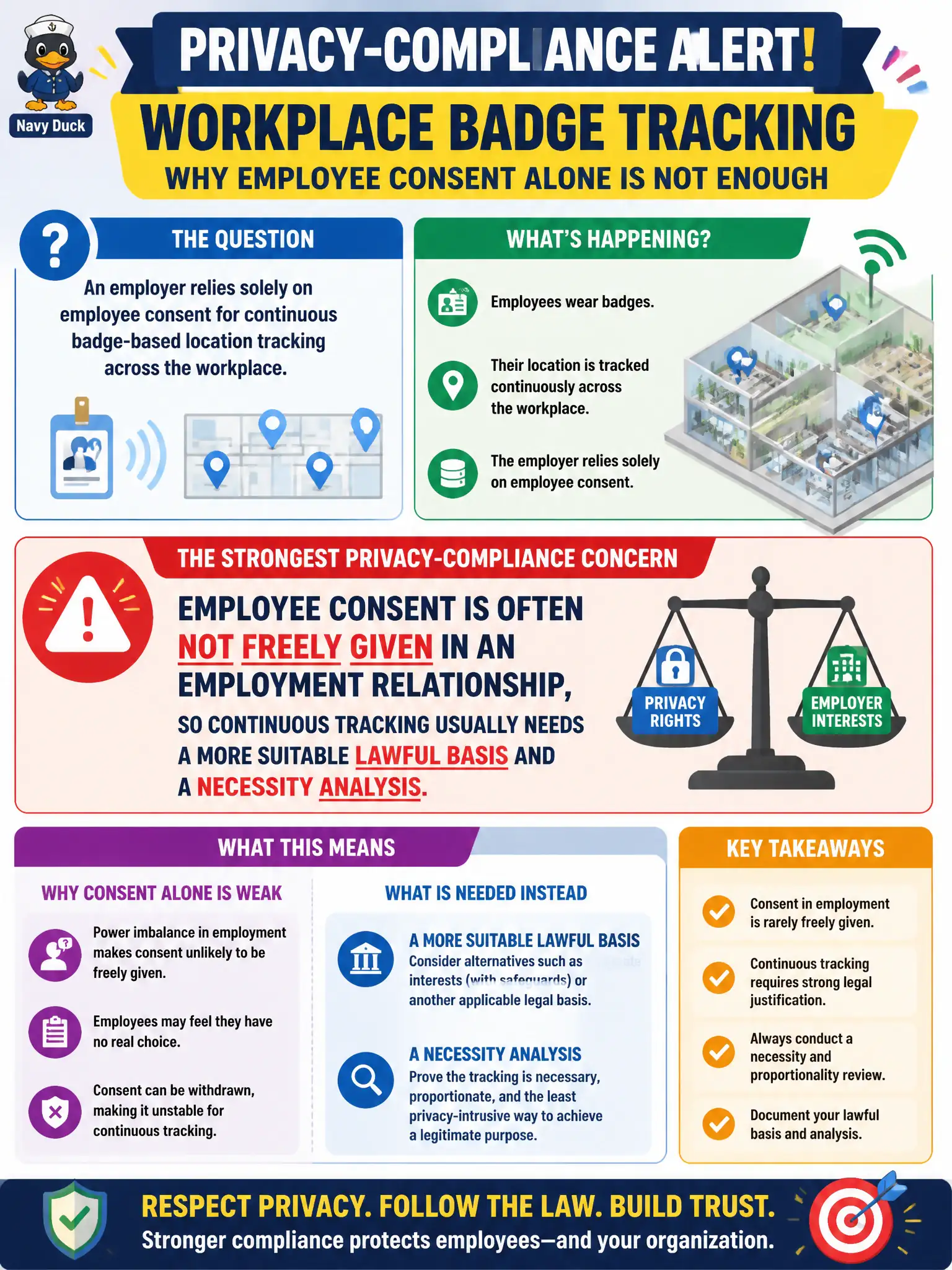
An employer that relies solely on employee consent for continuous badge-based location tracking across the workplace faces the strongest concern that employee consent is often not freely given in an employment relationship, so continuous tracking usually needs a more suitable lawful basis and a necessity analysis. Continuous location surveillance of workers is a high-intrusion civic and workplace issue; freeness of consent collapses when refusal feels like risking one’s job. Saying consent is always the only lawful basis permitted for any employment processing fails—contract, legal obligation, and sometimes legitimate interests (with care) are commonly more apt for employment contexts. Claiming badge location data is never personal data fails whenever movements relate to an identifiable employee. Asserting that signing any handbook automatically lawfully authorises all future monitoring without further assessment fails fairness, purpose limitation, and transparency duties. Exam caveat: some Member States add stricter employment-monitoring rules; even where legitimate interests is available, balancing, DPIA triggers, and less intrusive alternatives remain central. Operational check: replace consent-first tracking with a documented basis and necessity test, minimise location granularity and retention, inform staff clearly, and involve DPO/Works Council processes where required before rollout.