
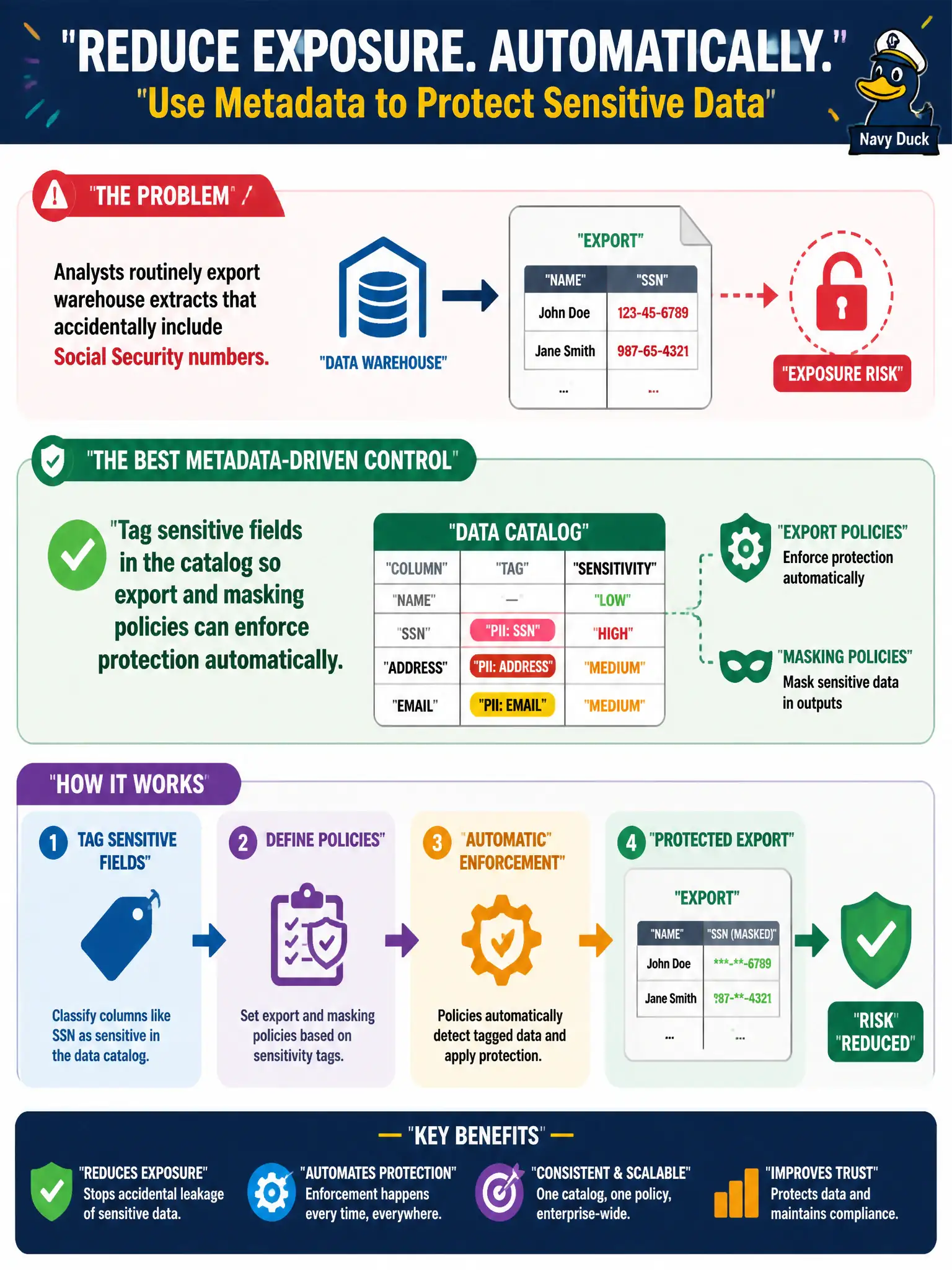
Analysts routinely export warehouse extracts that accidentally include Social Security numbers. Which metadata-driven control best reduces that exposure risk?
Select an answer to reveal the explanation.
Short Explanation
Think of sensitive-field tags as hazard stickers on chemical drums—tools can refuse to pour them into open buckets. Tag SSNs and similar fields in the catalog so extract and masking controls know what to protect. Clever renames without tags still leak.
Full Explanation
Accidental export of Social Security numbers from warehouse extracts is a classification-and-control failure. Tagging sensitive fields in the catalog so export and masking policies can enforce protection automatically reduces exposure more sustainably than hoping analysts notice. Disabling all extracts and forcing analysis only on printed PDFs over-corrects and blocks legitimate civic analytics. Renaming SSN columns to codes is obscurity, not control, and fails against determined or accidental inclusion. Training only interns on privacy while leaving production extracts ungoverned misplaces accountability. Exam answers connect sensitive-field tags to automated enforcement. Caveat: tags must be steward-confirmed and kept current when new landing zones appear; unreviewed auto-tags can miss fields or over-block. Operationally, confirm SSN and similar resident identifiers are classified in the catalog, verify export jobs read those tags for masking or blocking, and run a supervised extract test that proves sensitive columns cannot leave unprotected. After tagging, run a red-team extract attempt on a non-prod clone to prove masking or blocking fires when classified resident identifiers are requested.