
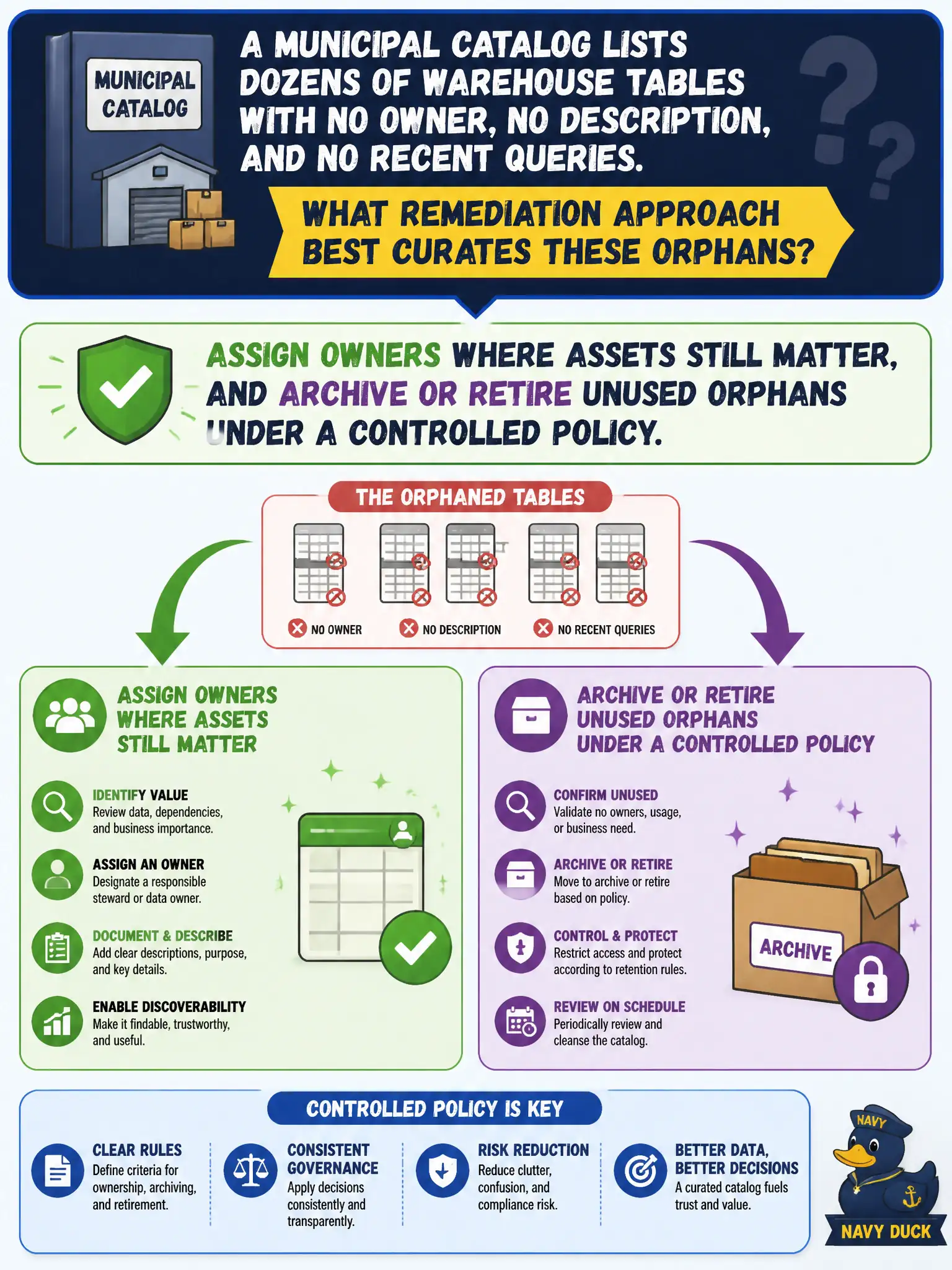
A municipal catalog lists dozens of warehouse tables with no owner, no description, and no recent queries. What remediation approach best curates these orphans?
Select an answer to reveal the explanation.
Short Explanation
Orphan tables are like abandoned storefronts cluttering Main Street—they confuse shoppers and hide the good shops. Either give still-useful assets a real owner or retire the unused ones under a clear archival policy. Leaving them forever or just hiding them from search keeps the clutter.
Full Explanation
Orphan warehouse tables with no owner, no description, and no recent queries are a curation problem, not a reason to inflate inventory forever. The best remediation assigns owners where assets still matter for municipal programs and archives or retires unused orphans under a controlled policy so the catalog remains trustworthy. Leaving every orphan forever avoids accountability and trains users to ignore search results. Duplicating orphans into a second “temporary” folder doubles clutter without deciding fate. Hiding orphans from search while leaving them fully active in production creates shadow risk: jobs and extracts may still depend on assets nobody reviews. Exam answers emphasize ownership assignment plus controlled retirement, not concealment. Caveat: retirement needs dependency and lineage checks so “unused” is evidenced, not assumed from a quiet week of queries. Operationally, rank orphans by downstream lineage and civic criticality, assign owners or archive candidates, execute policy with steward approval, and verify retired assets no longer appear as recommended sources for official reporting. Before retiring an orphan, require a lineage check and a steward sign-off so a quiet query log is not mistaken for proof that no civic process still depends on the table.