
Housing systems disagree on what "vacancy status" means, blocking shared reporting. What metadata-and-modeling response is most appropriate?
Select an answer to reveal the explanation.
Short Explanation
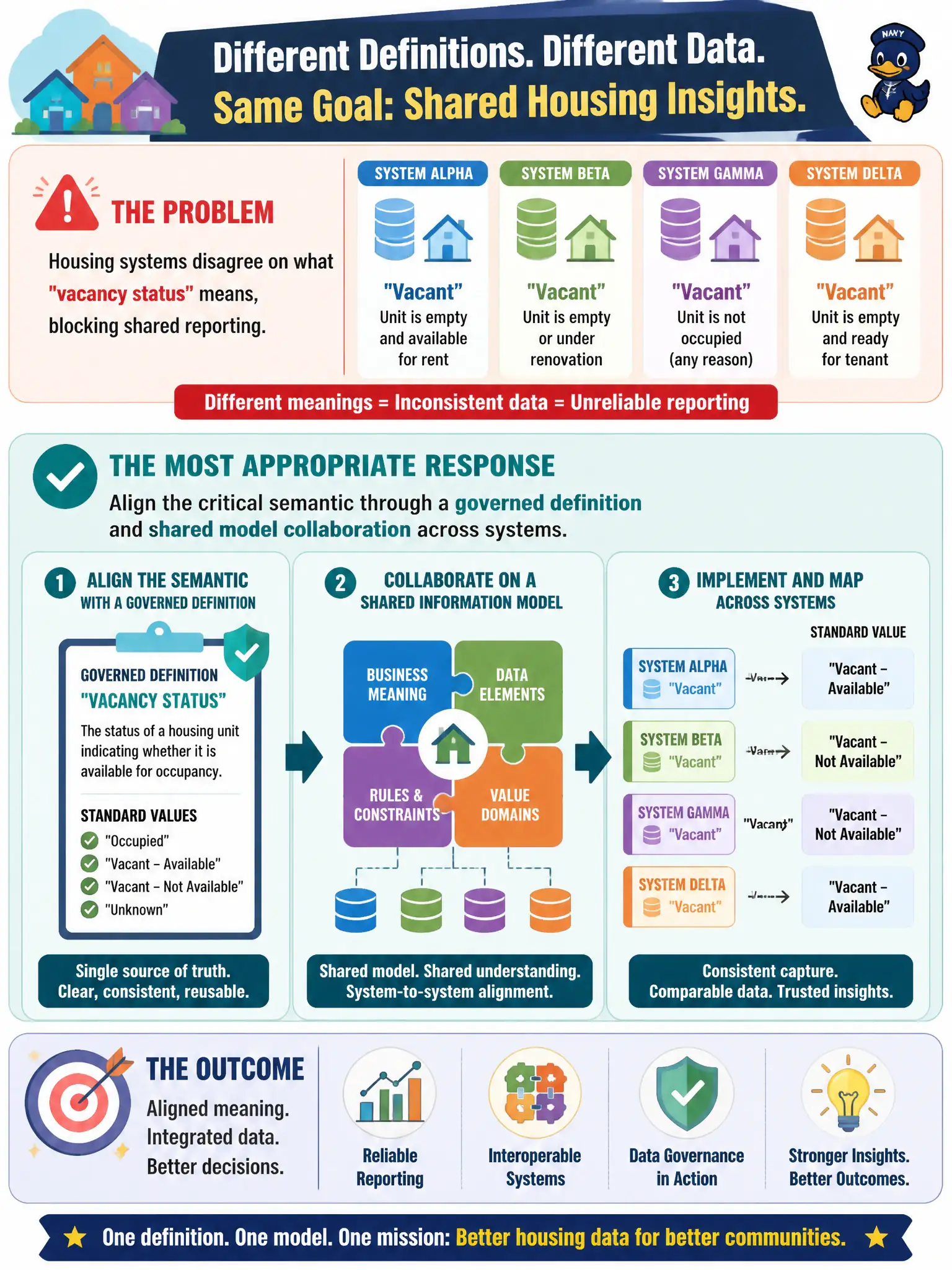
When systems argue about the same phrase, reporting lies. Bring stewards and modelers together, lock one governed meaning, and map each system to it.
Full Explanation
When housing systems disagree on “vacancy status,” shared reporting cannot be fixed by networking tricks or by deleting fields. The appropriate metadata-and-modeling response is to align the critical semantic through a governed definition and shared model collaboration across systems so each source maps to one official meaning. Letting each system keep incompatible meanings and averaging codes randomly fabricates statistics. Removing vacancy fields eliminates the conflict by destroying the business capability. Treating the disagreement as a bandwidth issue misdiagnoses a semantic problem as infrastructure. Exam focus is semantic alignment via governance and modeling. Caveat: temporary dual meanings may exist during migration if crosswalks and versioned definitions are explicit—not if conflict is ignored. Operationally, convene housing stewards, approve one glossary definition with allowed values, publish source mappings, and re-validate the shared vacancy report against the governed meaning before release. Shared model collaboration may produce a canonical vacancy attribute with explicit source mappings, which then becomes the only path allowed into enterprise housing dashboards until remaining systems conform.