
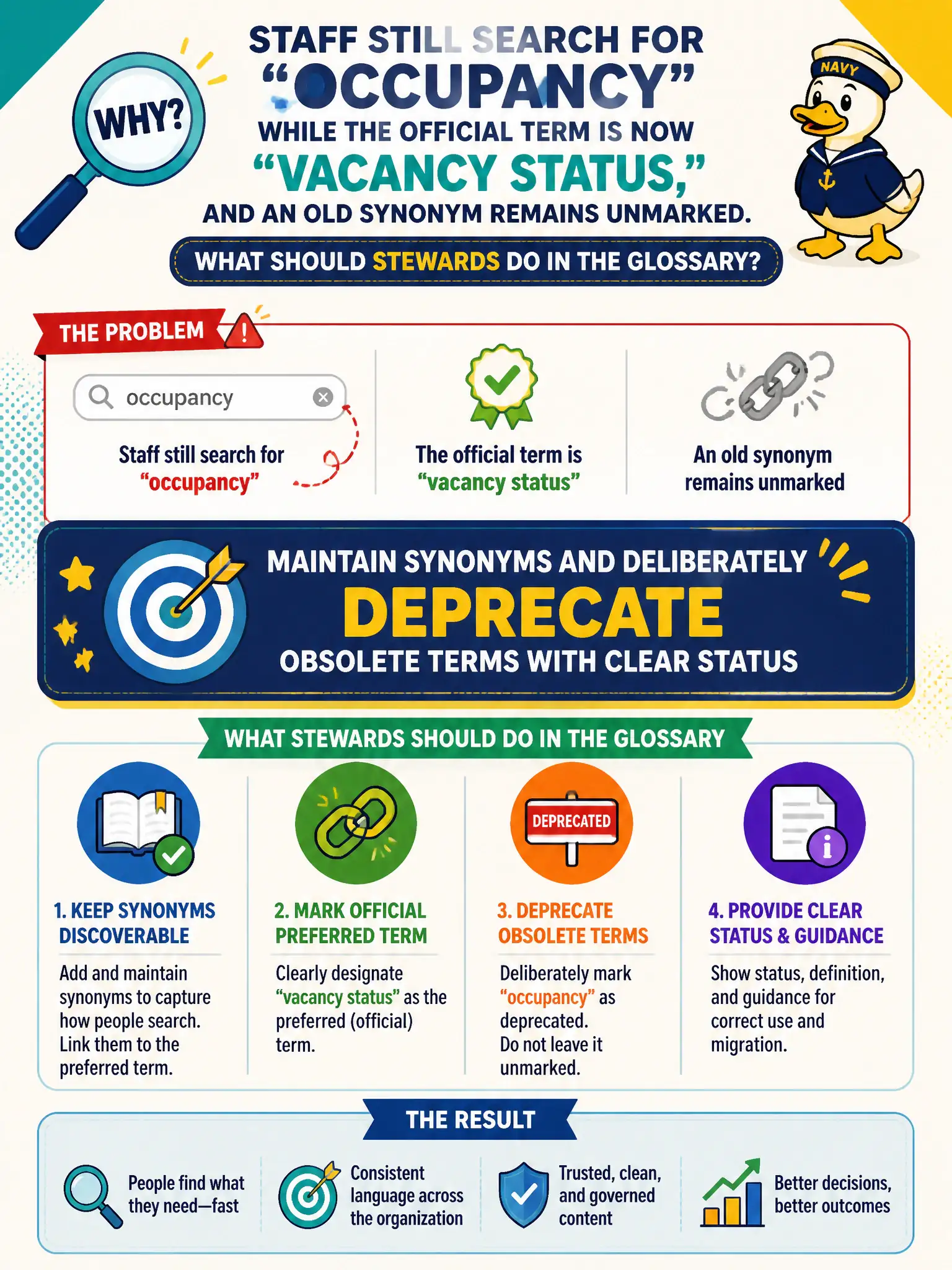
Staff still search for "occupancy" while the official term is now "vacancy status," and an old synonym remains unmarked. What should stewards do in the glossary?
Select an answer to reveal the explanation.
Short Explanation
Language drifts—people still say the old word. Good glossaries keep synonym bridges and clearly retire obsolete terms so search works without pretending yesterday’s word is still official.
Full Explanation
Language in city operations evolves, and glossaries must manage that evolution deliberately. When staff still search for “occupancy” while the official term is “vacancy status,” and an old synonym remains unmarked, stewards should maintain synonyms and deprecate obsolete terms with clear status so search works without pretending outdated language is current policy. Deleting the glossary whenever language evolves destroys continuity. Forbidding synonyms makes historical and colloquial searches fail and harms adoption. Leaving deprecated terms marked as current confuses which meaning is authoritative. Exam answers emphasize synonym management plus deprecation status, not vocabulary deletion. Caveat: deprecation needs effective dates and replacement pointers so longitudinal reporting can still interpret old extracts. Operationally, mark the obsolete term deprecated, link it to “vacancy status,” keep the synonym for search, and verify catalog queries for both phrases resolve to the governed current definition. Clear status values—current, synonym, deprecated—turn the glossary into a controlled vocabulary service for portals and warehouses instead of a static word list that fights how staff naturally search.