
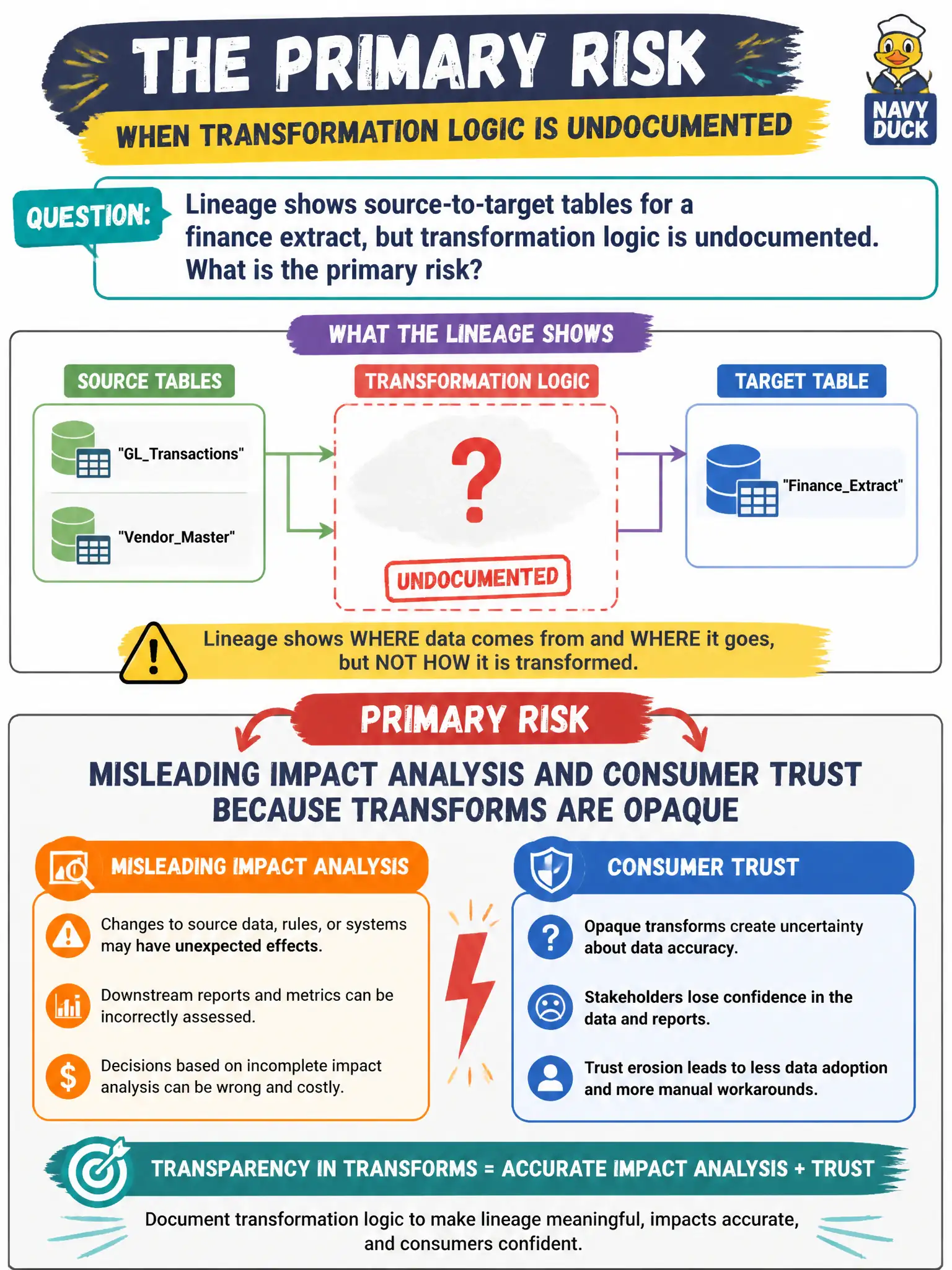
Lineage shows source-to-target tables for a finance extract, but transformation logic is undocumented. What is the primary risk?
Select an answer to reveal the explanation.
Short Explanation
Knowing packages moved from A to B is not enough if nobody recorded the recipe—filters, joins, and calculations. Incomplete transform metadata makes lineage look complete while hiding the real logic.
Full Explanation
Lineage that shows source-to-target tables without documenting transformation logic leaves civic consumers with a hollow provenance story. The primary risk is misleading impact analysis and eroded trust: teams cannot see filters, derivations, or business rules that change meaning between finance source and extract. Claiming missing transform detail always improves audit speed is false; opacity slows evidence. Automatic golden-record creation is an MDM outcome unrelated to incomplete ETL documentation. Incomplete documentation alone never guarantees GDPR compliance. Exam items separate structural lineage from transform transparency. Caveat: not every trivial cast needs a novel, but material business rules and filters that affect reported amounts must be capturable. Operationally, for the finance extract, open lineage and verify each critical transform step has readable rule or code references, then re-run impact analysis for a sample column change to confirm the path is actionable. For finance extracts used in bond or grant reporting, opaque transforms are especially risky because leadership may defend figures they cannot reconstruct when auditors ask how source amounts became disclosed totals.