
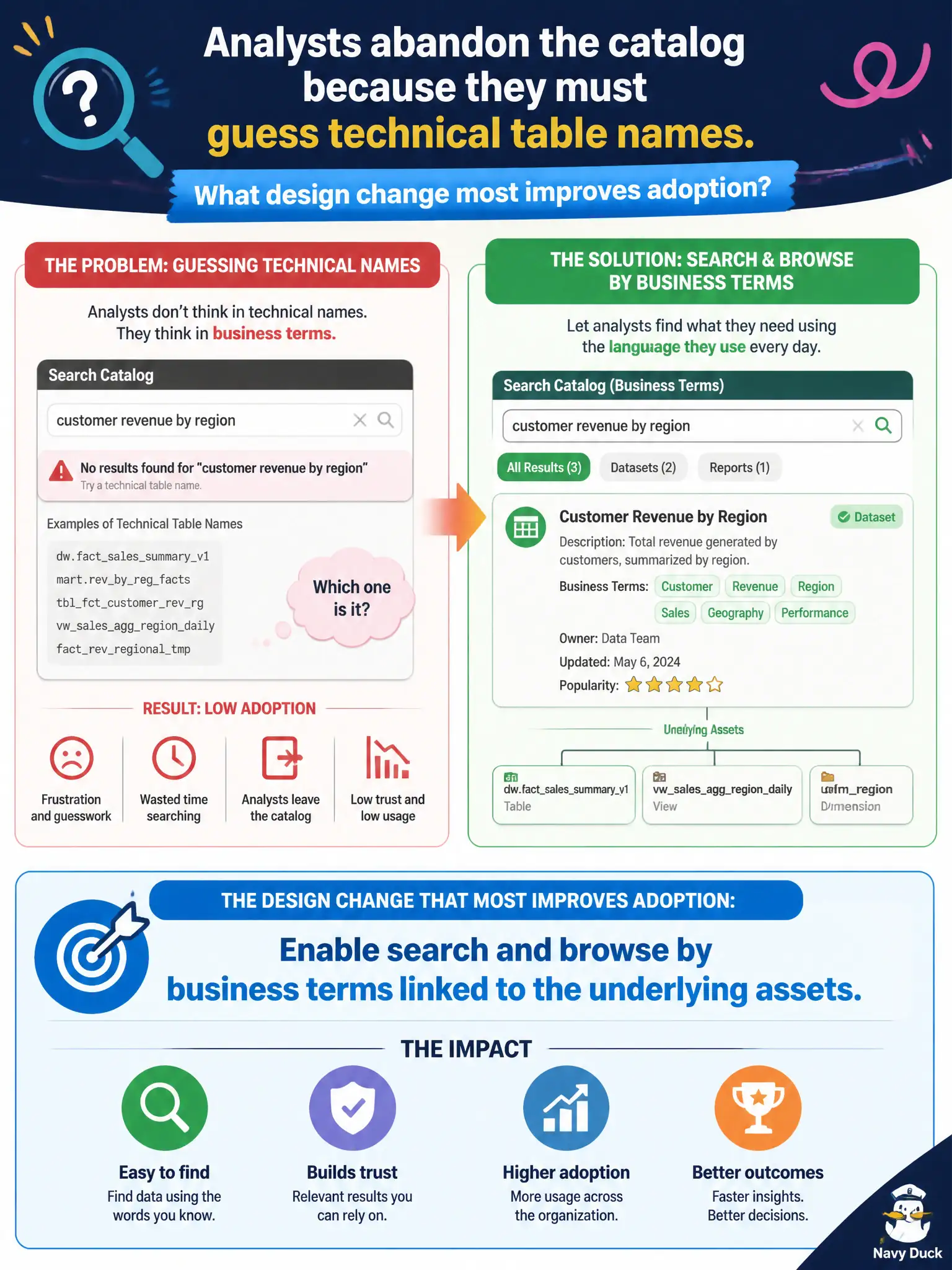
Analysts abandon the catalog because they must guess technical table names. What design change most improves adoption?
Select an answer to reveal the explanation.
Short Explanation
People search the way they talk—"active permit," not "PERM_STAT_CD_X." Wire business terms into catalog search and adoption climbs.
Full Explanation
Catalog adoption collapses when users must guess technical table names. Enabling search and browse by business terms linked to underlying assets lets municipal analysts find data the way they speak—“occupancy,” “permit,” “parcel”—while still reaching the correct physical objects. Forcing memorization of DBA abbreviations before search works is an anti-adoption pattern. Removing business synonyms so only cryptic codes remain worsens findability. Publishing the catalog exclusively as an unlabeled ERD image is not searchable and ages poorly. Exam answers favor business-term access paths over engineer-centric naming. Caveat: business terms must map to governed assets; synonym soup without linkage creates false matches. Operationally, test catalog search with common civic phrases used by analysts, confirm synonym and glossary links resolve to owned datasets, and track zero-result queries as metadata defects to fix. Pair business-term search with clear result pages that show ownership and certification status, so findability does not lead analysts into untrusted or deprecated municipal datasets by accident. Adoption metrics should include successful searches by business term and reduced tickets asking “where is the table for X,” proving the catalog serves municipal work rather than only documenting schemas.