
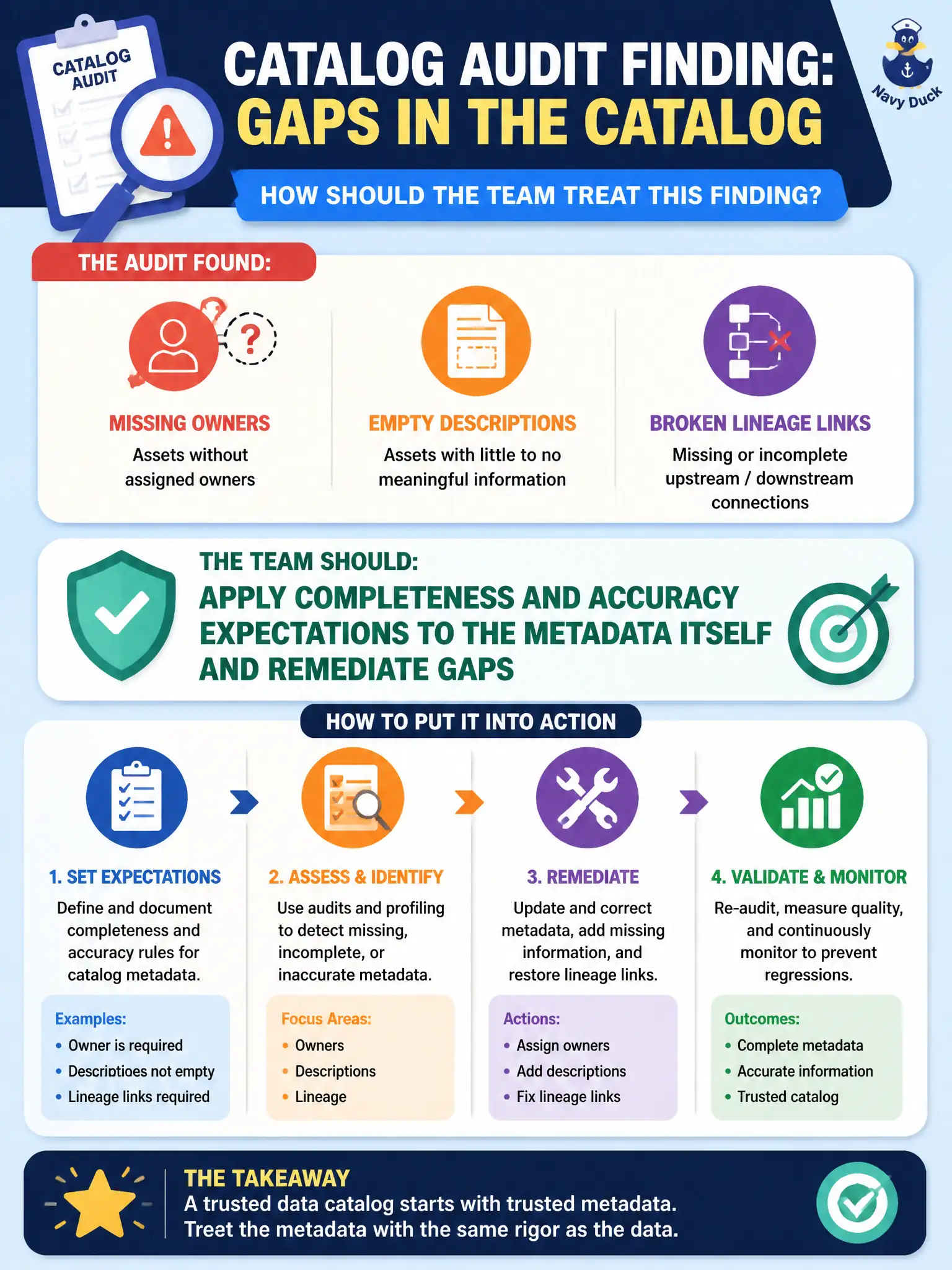
A catalog audit finds missing owners, empty descriptions, and broken lineage links. How should the team treat this finding?
Select an answer to reveal the explanation.
Short Explanation
Garbage metadata is still garbage—empty owners and dead lineage links mislead people the same way bad addresses do. Metadata needs its own quality bar and cleanup.
Full Explanation
Metadata is a managed data product and must meet quality expectations of its own. When a catalog audit finds missing owners, empty descriptions, and broken lineage links, the team should apply completeness and accuracy rules to the metadata and remediate gaps—not treat catalog defects as harmless. Poor metadata quality causes analysts to mistrust inventories, mis-handle sensitive fields, and miss upstream impacts in city operations. Ignoring metadata quality because “metadata never needs expectations” is the core misconception. Measuring only transactional dollar amounts while ignoring catalog fields leaves the discovery layer unfit. Marking every broken link as “gold standard” falsifies trust signals. Exam items increasingly test metadata data-quality thinking. Caveat: prioritize remediation by risk and usage—fix civic assets first—rather than attempting perfect completeness on every obscure table overnight. Operationally, define metadata quality rules for owner, description, and lineage link validity, score the catalog, and track closure of defects on priority municipal datasets until thresholds meet policy. Treat metadata defects like other data-quality incidents: severity, owner, due date, and verification. Cities that score only warehouse facts while ignoring catalog gaps recreate the same discovery failures the catalog was funded to prevent.