
Security wants consistent handling of sensitive resident fields discovered in the catalog. Which metadata practice best enables that?
Select an answer to reveal the explanation.
Short Explanation
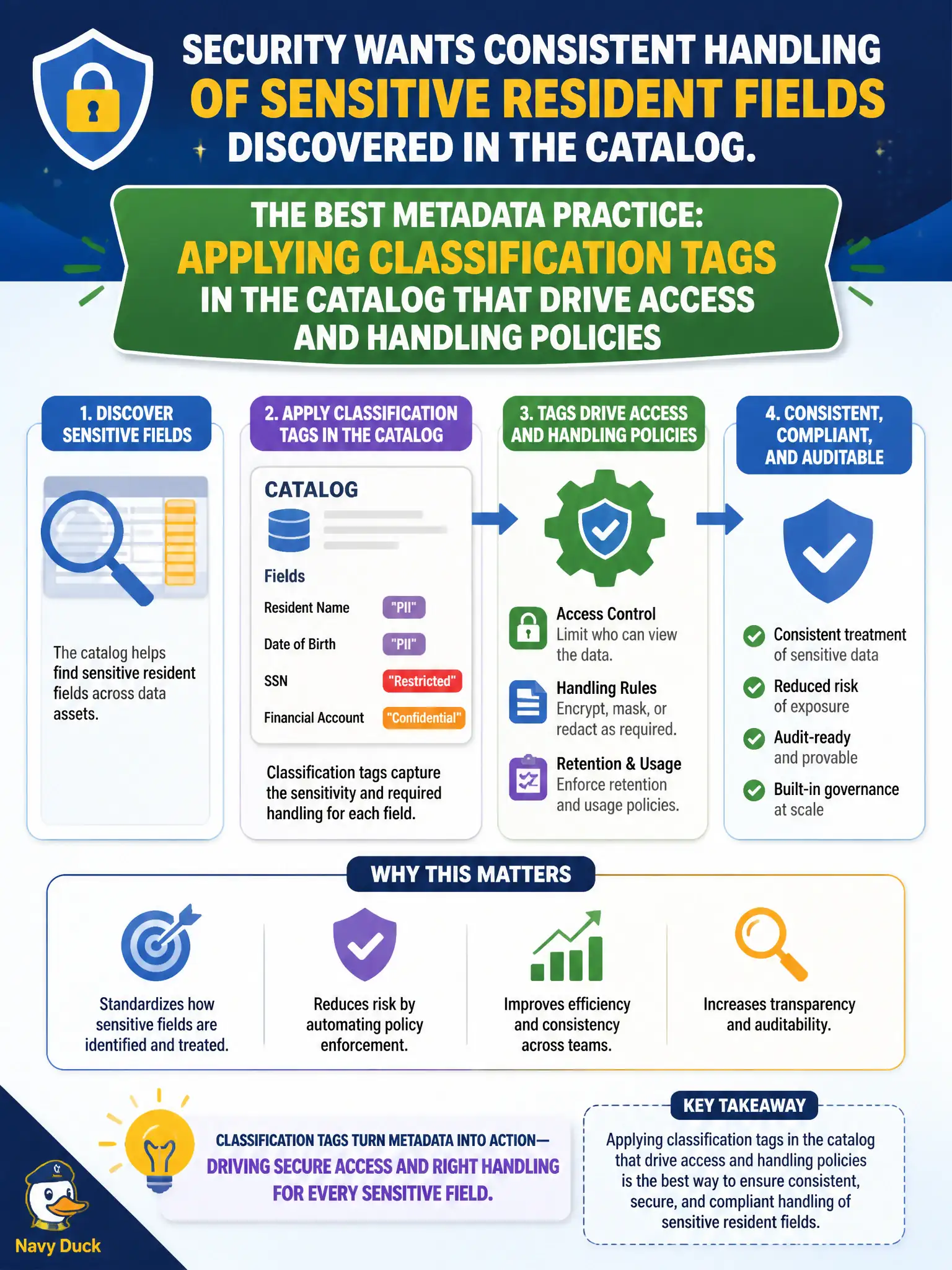
Classification tags are the "handle with care" stickers on data. Once fields are tagged in the catalog, access and handling rules can follow the sticker—not hallway rumors.
Full Explanation
Consistent handling of sensitive resident fields depends on classification metadata that policies can enforce. When security wants uniform treatment of sensitive attributes found in the catalog, the enabling practice is applying classification tags that drive access, masking, retention, and handling rules. Without tags, controls stay manual and inconsistent across civic systems. Removing classification so every field looks public by default expands exposure. Publishing sensitivity only on hallway sticky notes is ephemeral and unenforceable. Encrypting catalog UI theme colors does nothing for field-level handling. CIMP-aligned answers connect classification metadata to control automation. Caveat: tags must be accurate and steward-confirmed; wrong labels can over-restrict services or under-protect residents. Operationally, sample resident-related catalog fields, verify sensitivity classifications are present and approved, and confirm an access or export policy actually reads those tags before go-live of a new extract path. Classification should align with the city’s privacy and records policies so the same resident attribute is not treated as public in one system and restricted in another without an explicit, documented exception.