
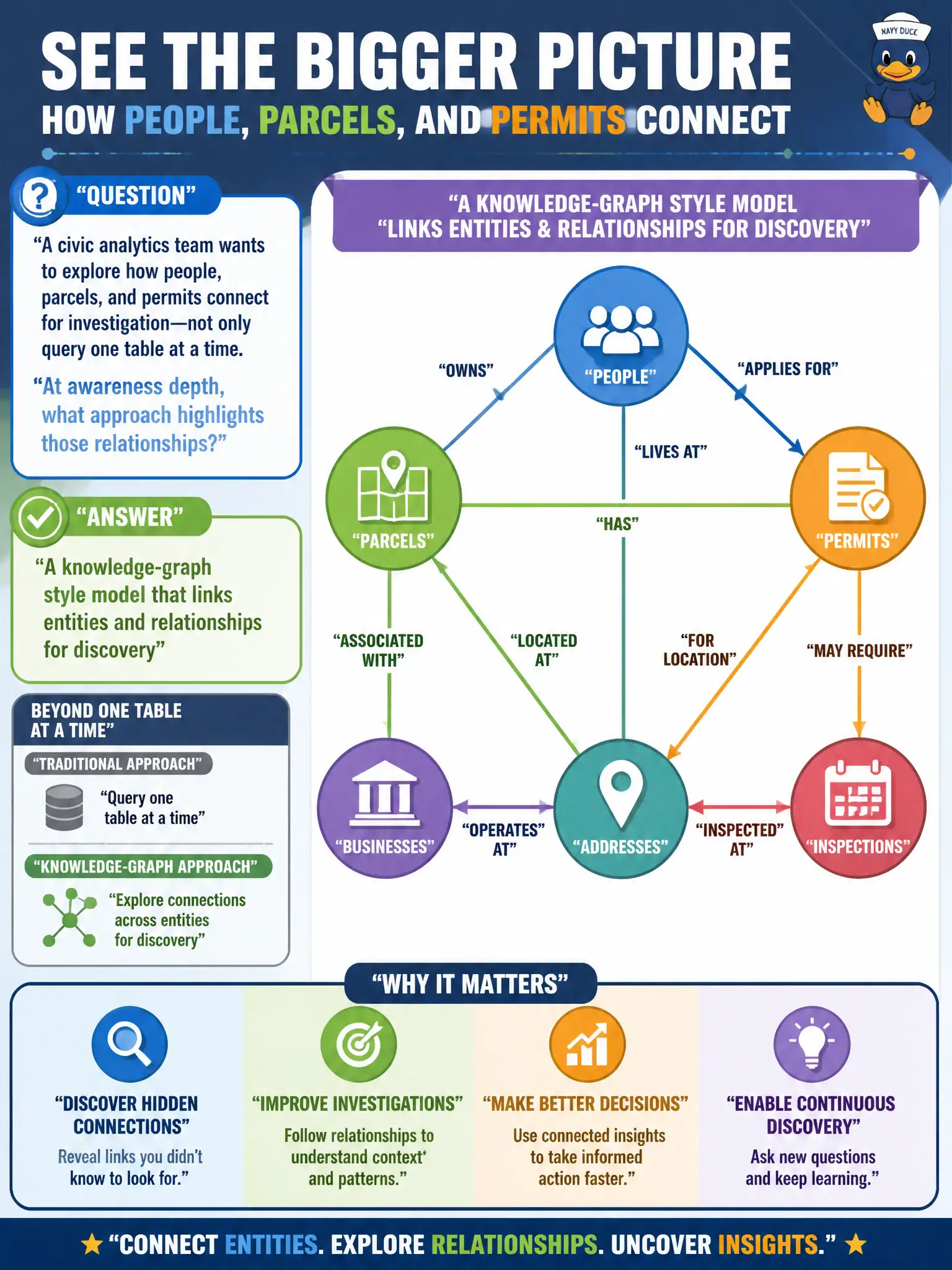
A civic analytics team wants to explore how people, parcels, and permits connect for investigation—not only query one table at a time. At awareness depth, what approach highlights those relationships?
Select an answer to reveal the explanation.
Short Explanation
Think of a map of who connects to what—people, parcels, permits—as dots and lines. Graph-style linking makes those relationships the star for exploration, not buried in one-off joins.
Full Explanation
Investigative civic analytics often needs relationship awareness, not only single-table queries. At awareness depth, a knowledge-graph style model that links people, parcels, and permits highlights connections for discovery—supporting questions about how entities relate across domains. Storing every relationship only as an unlabeled PDF scan prevents queryable traversal and version control. Deleting parcel identifiers so joins become impossible destroys linkage essential to investigation. Relying forever on one flat spreadsheet with no keys across domains does not scale and cannot express multi-hop relationships cleanly. On the exam, match “explore relationships for discovery” with graph-oriented or relationship-aware modeling rather than with document dumps. Caveat: a graph for awareness does not automatically replace operational systems of record; it complements them for exploration when governed identifiers exist. Operationally, confirm person, parcel, and permit identifiers are stable, documented, and linked in the exploratory model, then test a multi-hop civic investigation path before rolling the approach out to analysts. Relationship-aware exploration still depends on governed identifiers and access controls; graphs amplify discovery only when the underlying person, parcel, and permit keys are stewarded and classified appropriately for investigative use.