
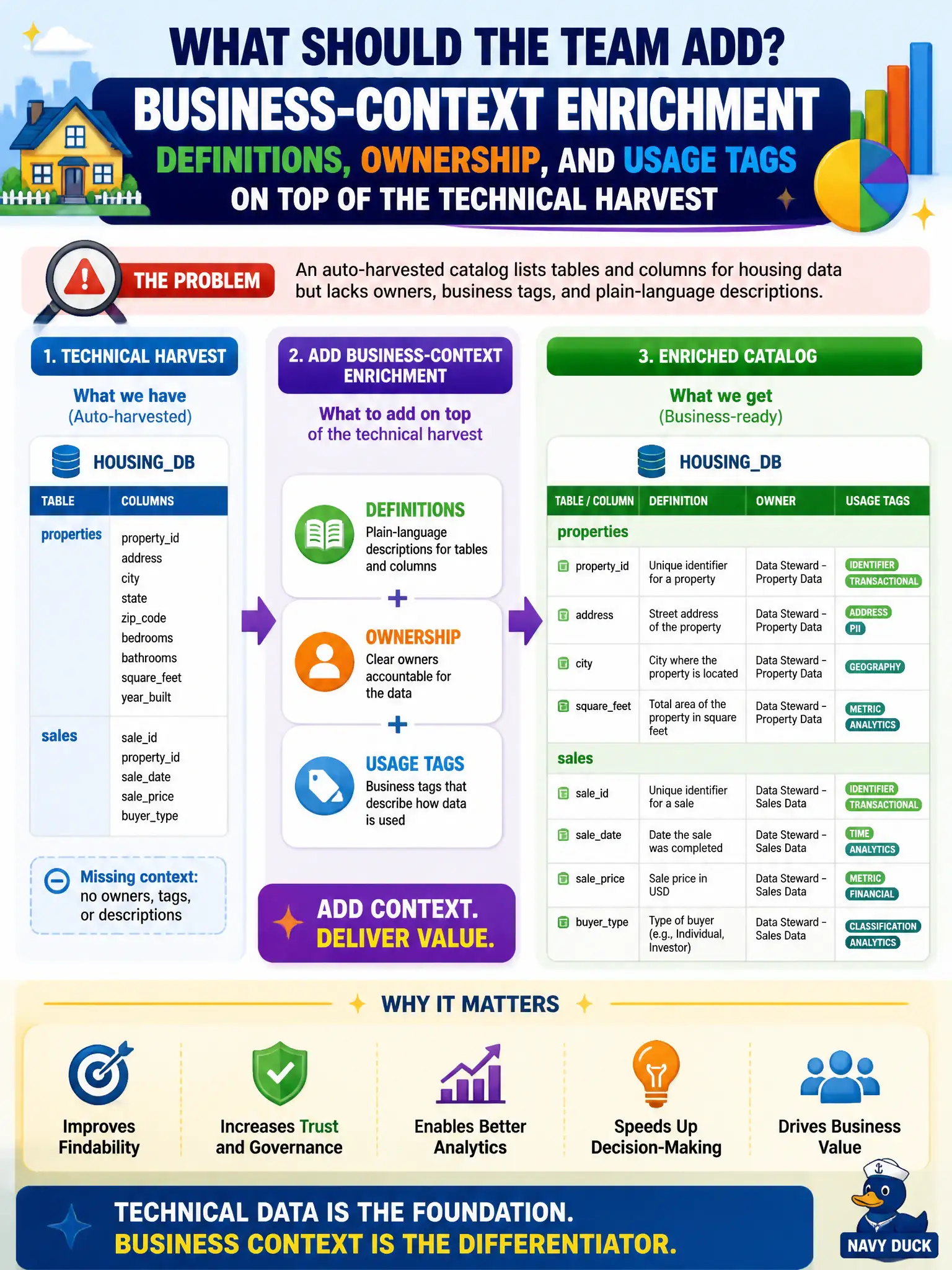
An auto-harvested catalog lists tables and columns for housing data but lacks owners, business tags, and plain-language descriptions. What should the team add?
Select an answer to reveal the explanation.
Short Explanation
Harvesting schemas is like dumping a parts list with no labels or owners. People still cannot find or trust the parts until business context and stewardship tags are added.
Full Explanation
Auto-harvested technical metadata is necessary but not sufficient for a usable municipal catalog. Listing housing tables and columns without owners, business tags, and plain-language descriptions leaves staff unable to interpret or trust what they find. The team should add business-context enrichment—definitions, ownership, and usage tags—on top of the technical harvest so assets become findable and governable. Running a second identical harvest with no enrichment only doubles noise. Printing foreign-key diagrams as posters without digital links fails accessibility and currency. Deleting all technical metadata so only slogans remain removes the structural map enrichment should annotate. Exam framing pairs harvest with enrichment: neither replaces the other. Caveat: enrichment must be stewarded; one-time tagging without owners will stale like any other metadata. Operationally, for priority housing datasets, verify each catalog entry shows a business description, named owner, and relevant tags linked to the harvested schema objects before declaring the catalog “complete.” Enrichment should be prioritized for housing datasets that support eligibility, inspections, and public reporting first, then extended outward, with periodic steward reviews so tags and definitions do not quietly diverge from how programs actually use the data.