
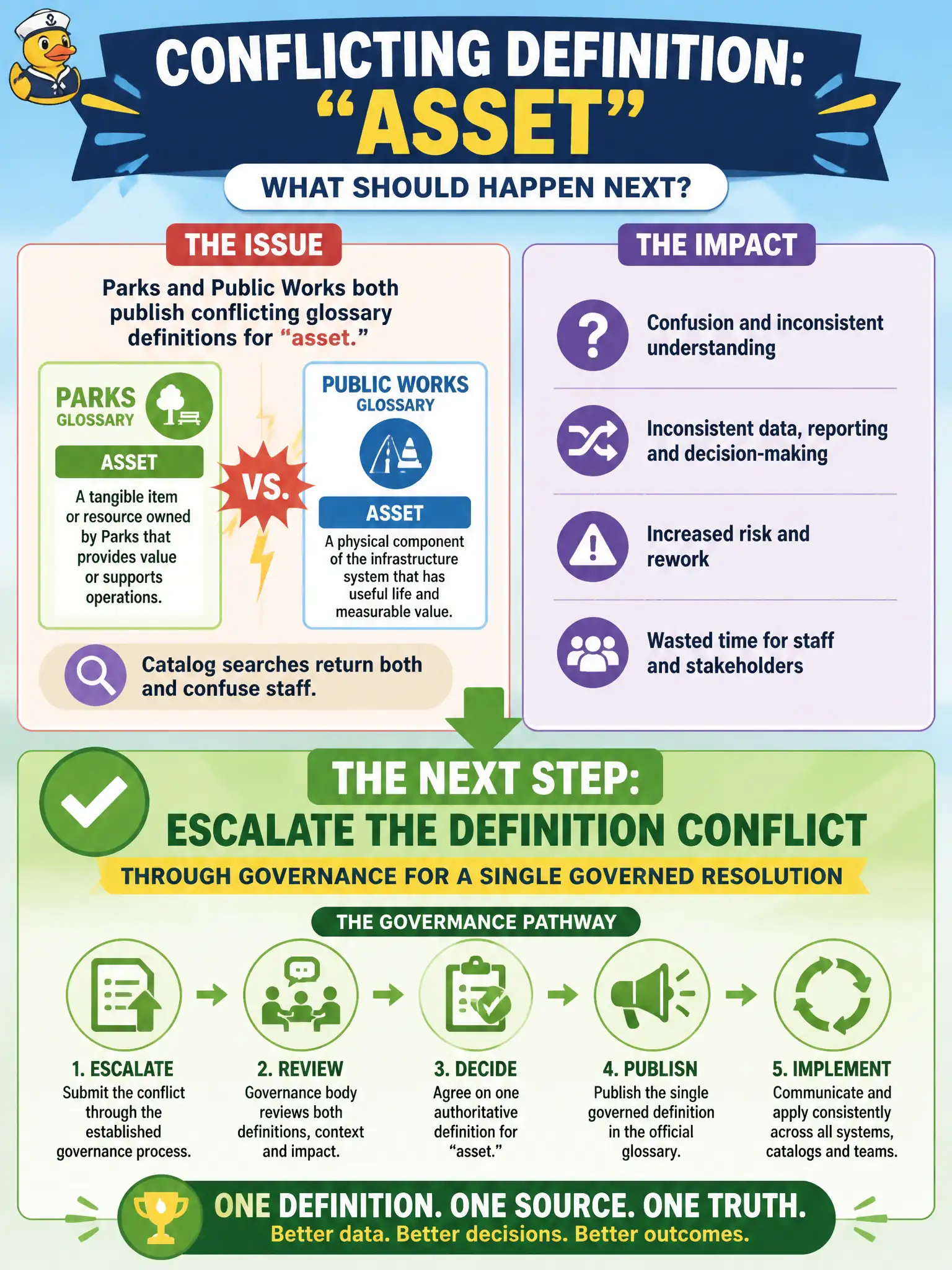
Parks and Public Works both publish conflicting glossary definitions for "asset." Catalog searches return both and confuse staff. What should happen next?
Select an answer to reveal the explanation.
Short Explanation
Two dictionaries fighting over the same word wreck findability. Critical term conflicts need a governed decision—not a coin flip—so the catalog can point everyone to one meaning.
Full Explanation
Conflicting glossary definitions for the same civic term are a governance event, not a search UI problem. When Parks and Public Works both publish conflicting meanings of “asset” and catalog searches return both, the next step is to escalate through governance for a single governed resolution—possibly with scoped variants if true contextual differences exist, but never as silent duplicates of equal authority. Hiding search until every report is rewritten blocks discovery without resolving semantics. Keeping both definitions forever and telling users to flip a coin institutionalizes ambiguity in asset inventories and budgets. Replacing “asset” with random codes overnight destroys intelligibility and breaks integrations. CIMP scenarios expect escalation and stewardship conflict resolution rather than unilateral deletion of vocabulary. Caveat: one term can have context-specific senses if governance documents the scopes; unmanaged peer definitions are the failure mode. Operationally, open a glossary conflict ticket, identify stewards from both departments, record the decided definition or scoped pair, deprecate losers with status, and re-test catalog search for a single authoritative result path.