
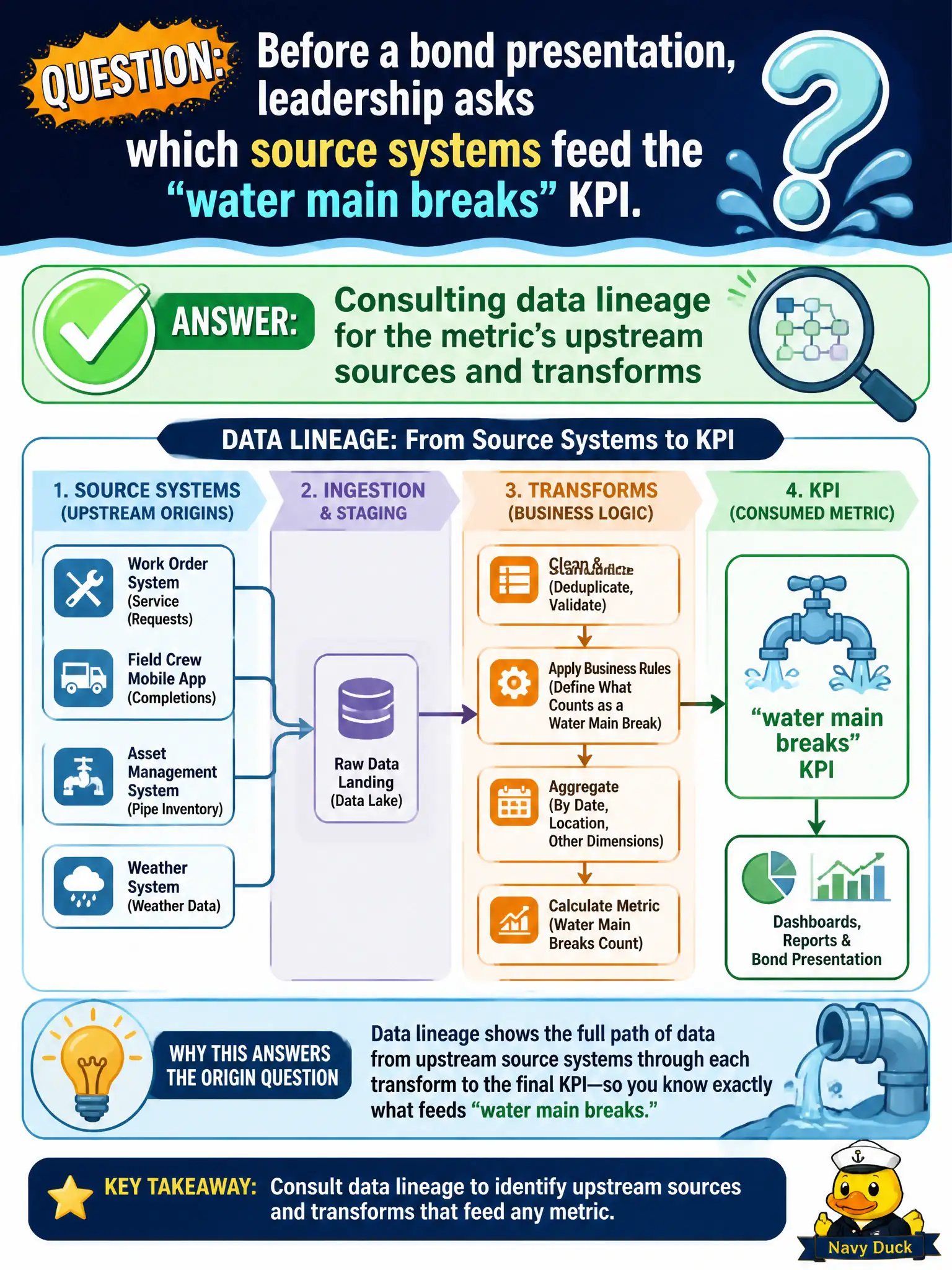
Before a bond presentation, leadership asks which source systems feed the "water main breaks" KPI. Which metadata practice answers that origin question?
Select an answer to reveal the explanation.
Short Explanation
Lineage is the "ingredients and recipe" label for a metric. When someone asks where the water-main-breaks number came from, you follow the lineage—not the font size on the slide.
Full Explanation
Origin questions for civic KPIs are answered with data lineage, not with presentation polish. When leadership asks which source systems feed the “water main breaks” KPI before a bond presentation, the metadata practice is to consult lineage for upstream sources and transforms that produce the metric. Lineage shows provenance paths so executives can defend figures, spot single points of failure, and understand whether field or warehouse systems dominate the number. Encrypting a slide deck password protects confidentiality of a file; it does not document upstream systems. Enlarging chart fonts improves readability without explaining origin. Archiving a KPI definition only as an email attachment creates fragile, unsearchable documentation and still omits transform paths. Exam framing often contrasts lineage with security or formatting distractors—choose the practice that traces data movement. Caveat: table-level lineage may be insufficient when the KPI depends on specific columns or filter logic; deepen granularity when evidence requires it. Operationally, open the KPI’s lineage view and confirm each contributing source system and major transform are listed and owned before the bond presentation uses the number.