
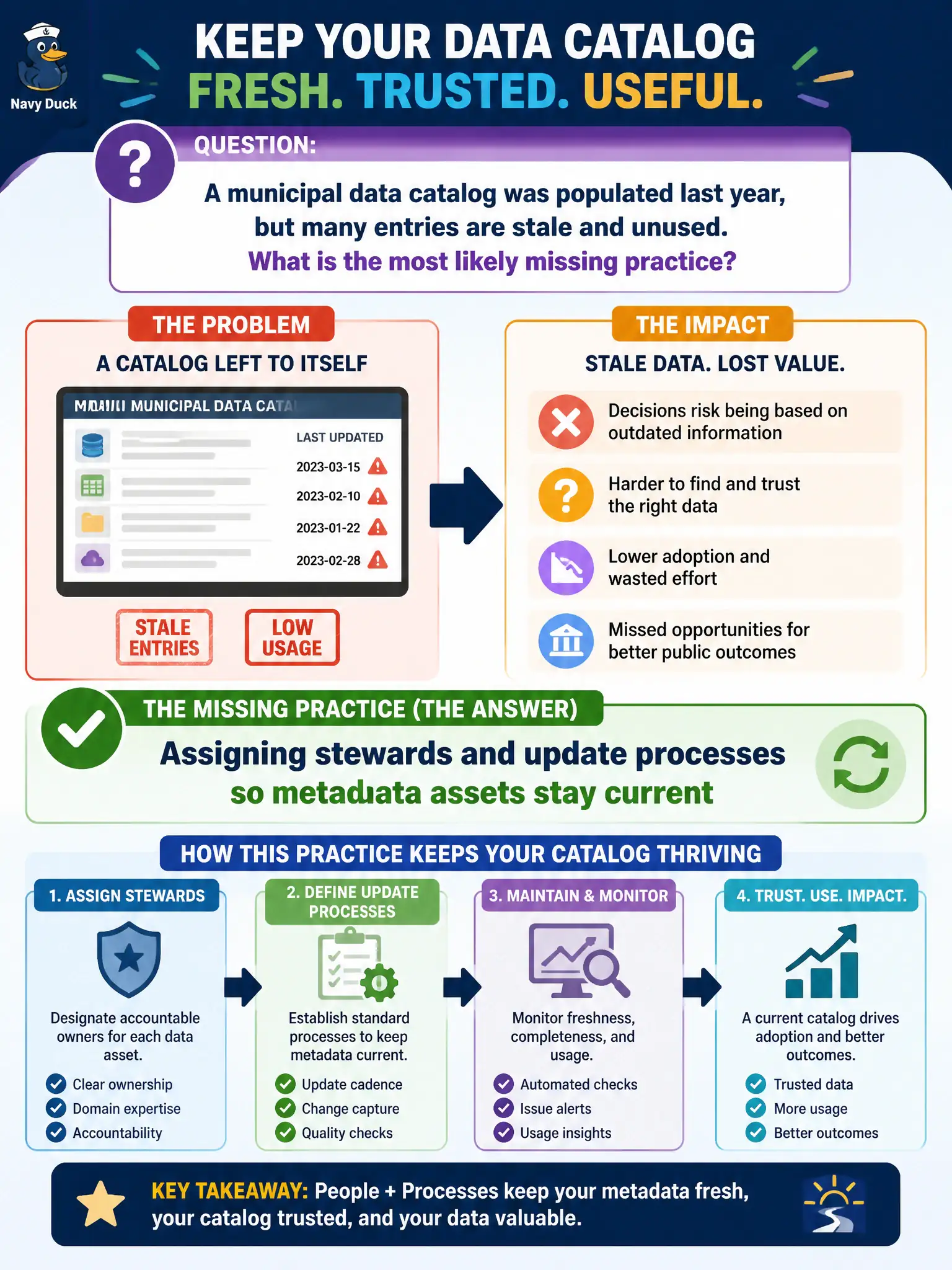
A municipal data catalog was populated last year, but many entries are stale and unused. What is the most likely missing practice?
Select an answer to reveal the explanation.
Short Explanation
A phone book nobody updates becomes useless fast. Catalogs rot the same way unless named owners and refresh routines keep definitions, owners, and lineage honest.
Full Explanation
A municipal data catalog decays without stewardship and update processes. When entries populated last year are stale and unused, the most likely missing practice is assigning stewards and defined refresh workflows so metadata assets stay current as systems change. Ownership, review cadence, and change hooks after schema or definition updates keep descriptions, tags, and lineage trustworthy for city staff. Requiring every citizen to re-register before searching does not fix internal catalog hygiene and invents an unrelated public burden. Deleting the catalog whenever any table changes destroys continuity instead of managing updates. Storing catalog URLs only inside encrypted email signatures hides the inventory from the people who need it. On the exam, stale catalogs point to operating-model failure more often than to missing encryption features. Caveat: automation and harvest help, but without human stewards and process, auto-collected metadata still ages into noise. Operationally, sample high-value civic datasets and verify each has a named steward, a last-reviewed date within policy, and a documented trigger for update when the source system changes. In civic environments, stewardship also means linking catalog updates to change tickets when permitting or utility schemas evolve, so the inventory remains a reliable map rather than a snapshot of last year’s systems.