
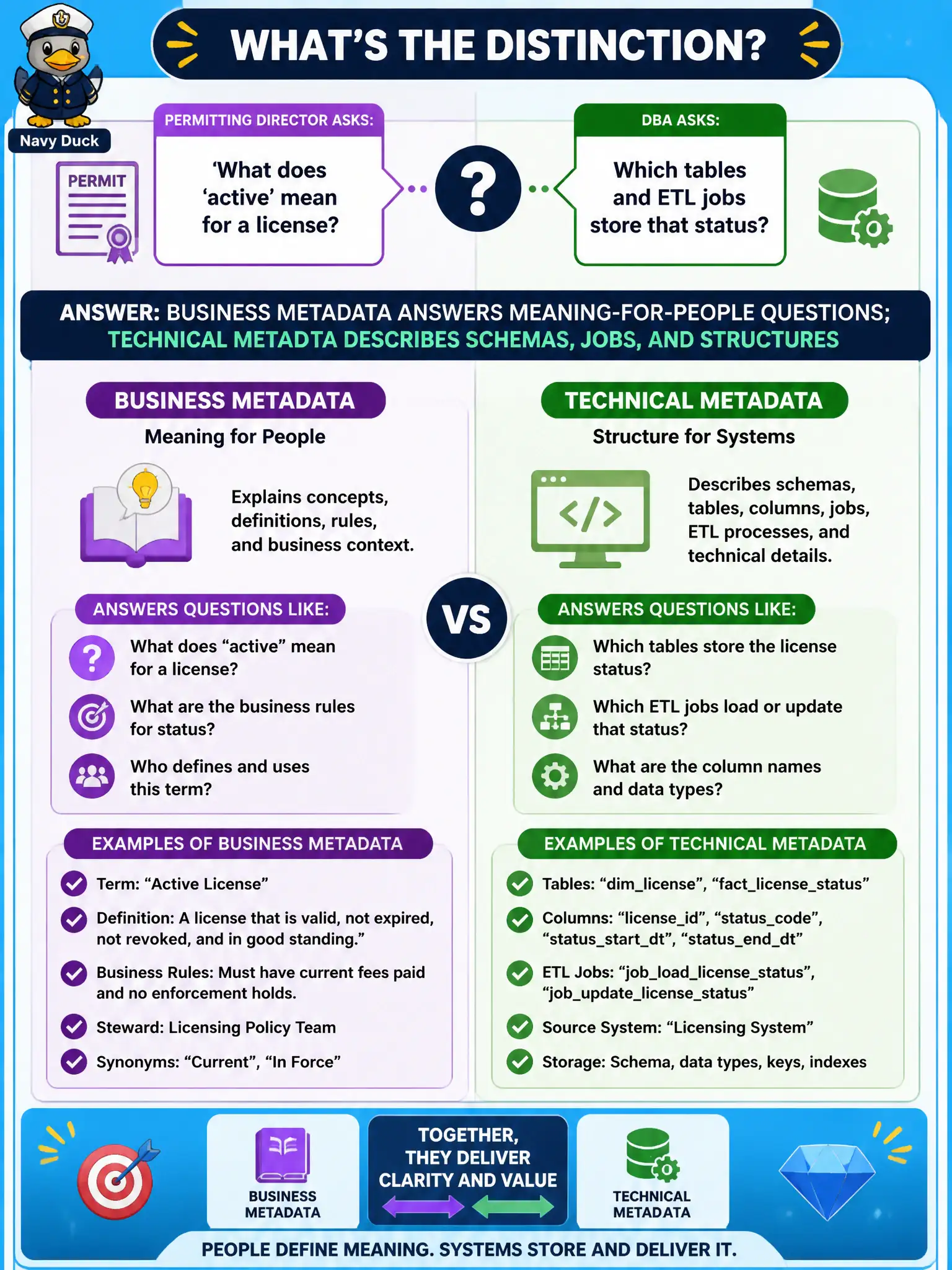
A permitting director asks what "active" means for a license, while a DBA asks which tables and ETL jobs store that status. Which distinction should the metadata lead draw?
Select an answer to reveal the explanation.
Short Explanation
One question is "what does this word mean to the business?" The other is "where does it live and how does it move?" Different questions need different metadata—definitions versus schemas and jobs.
Full Explanation
Municipal metadata programs must separate questions about meaning from questions about structure. When a permitting director asks what “active” means for a license, the answer lives in business metadata: definitions, ownership, and usage context that people use to interpret data. When a DBA asks which tables and ETL jobs store that status, the answer lives in technical metadata: schemas, jobs, lineage, and physical attributes. Drawing that distinction keeps catalog consumers from treating engineering inventory as semantic guidance or expecting a harvested column list to explain policy language. Password policies are security controls, not a complete definition of business metadata, and dashboards alone do not exhaust technical metadata. Collapsing business and technical facts into one unlabeled field erases the very classification that stewards and engineers need for workflow and permissions. Harvesting columns does not retire the need for business definitions; technical discovery without semantics still leaves directors guessing. Exam items often pair a meaning question with a location question to test this split—do not collapse them. Operationally, check that the catalog shows a glossary definition for “active” alongside the technical assets that store the status, each with the right metadata type and accountable role.