
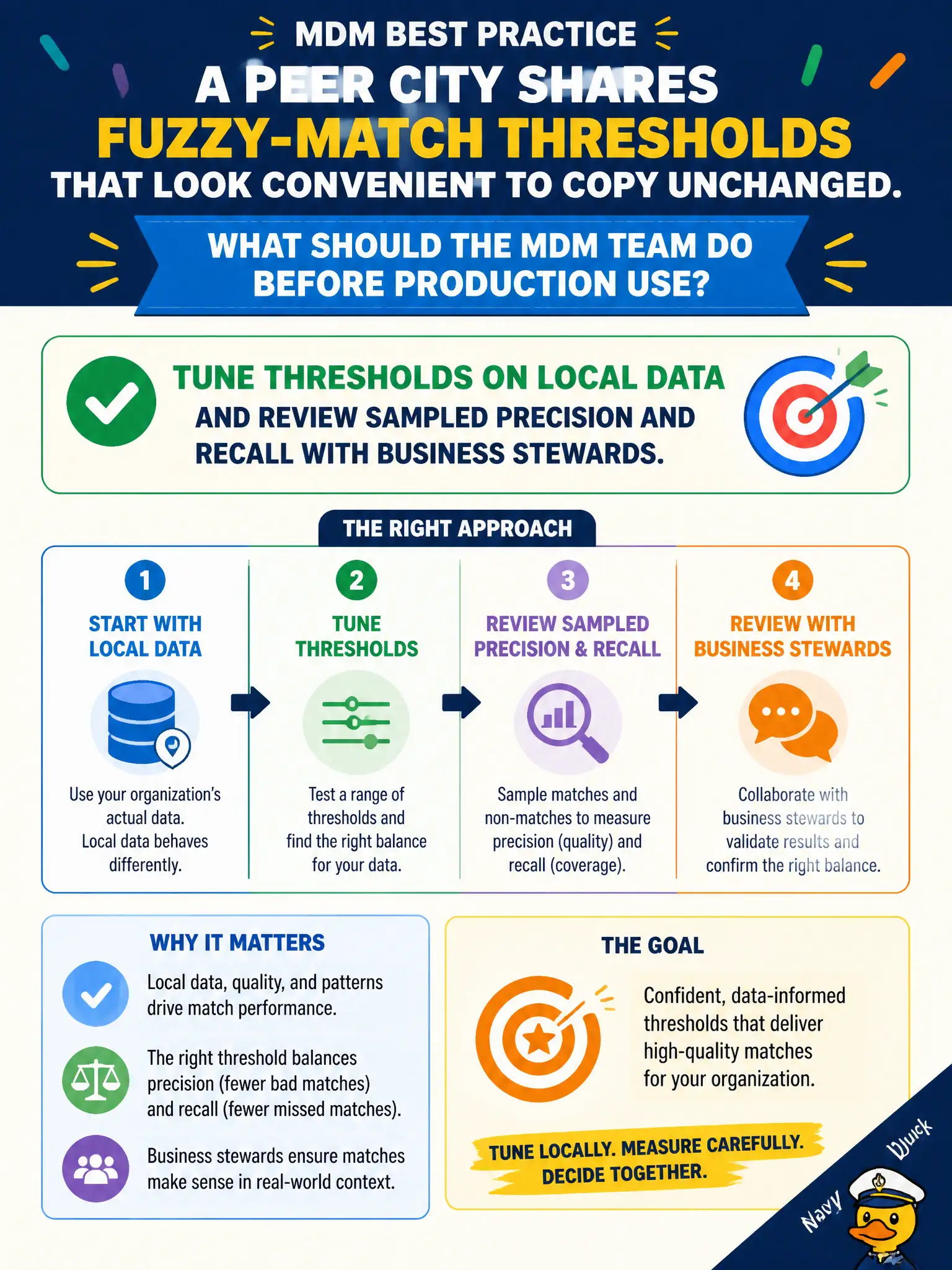
A peer city shares fuzzy-match thresholds that look convenient to copy unchanged. What should the MDM team do before production use?
Select an answer to reveal the explanation.
Short Explanation
Someone else’s dial settings won’t fit your data mix. Tune on local samples and have stewards check precision and recall before you freeze production.
Full Explanation
Fuzzy-match thresholds borrowed from a peer city must be tuned on local data with sampled precision and recall reviewed by business stewards before production use. Civic populations and data quality differ; blind copies mis-set risk. Copying thresholds blindly and skipping local sample review fails localization. Setting every threshold to zero so almost nothing matches fails utility. Disabling fuzzy matching permanently because another city used different numbers fails adaptation. Exam caveat: thresholds are local calibration parameters—validate precision/recall on your data. Operational check: run steward-labeled samples, adjust thresholds, record precision/recall, and freeze only after sign-off. Keep the calibration worksheet in the municipal match-rule repository for the next tuning cycle. Keep verification evidence with the municipal runbook so audits can prove the chosen control was applied as designed and that rejected alternatives would have left city services exposed to the failure modes described above. Keep verification evidence with the municipal runbook so audits can prove the chosen control was applied as designed and that rejected alternatives would have left city services exposed to the failure modes described above.