
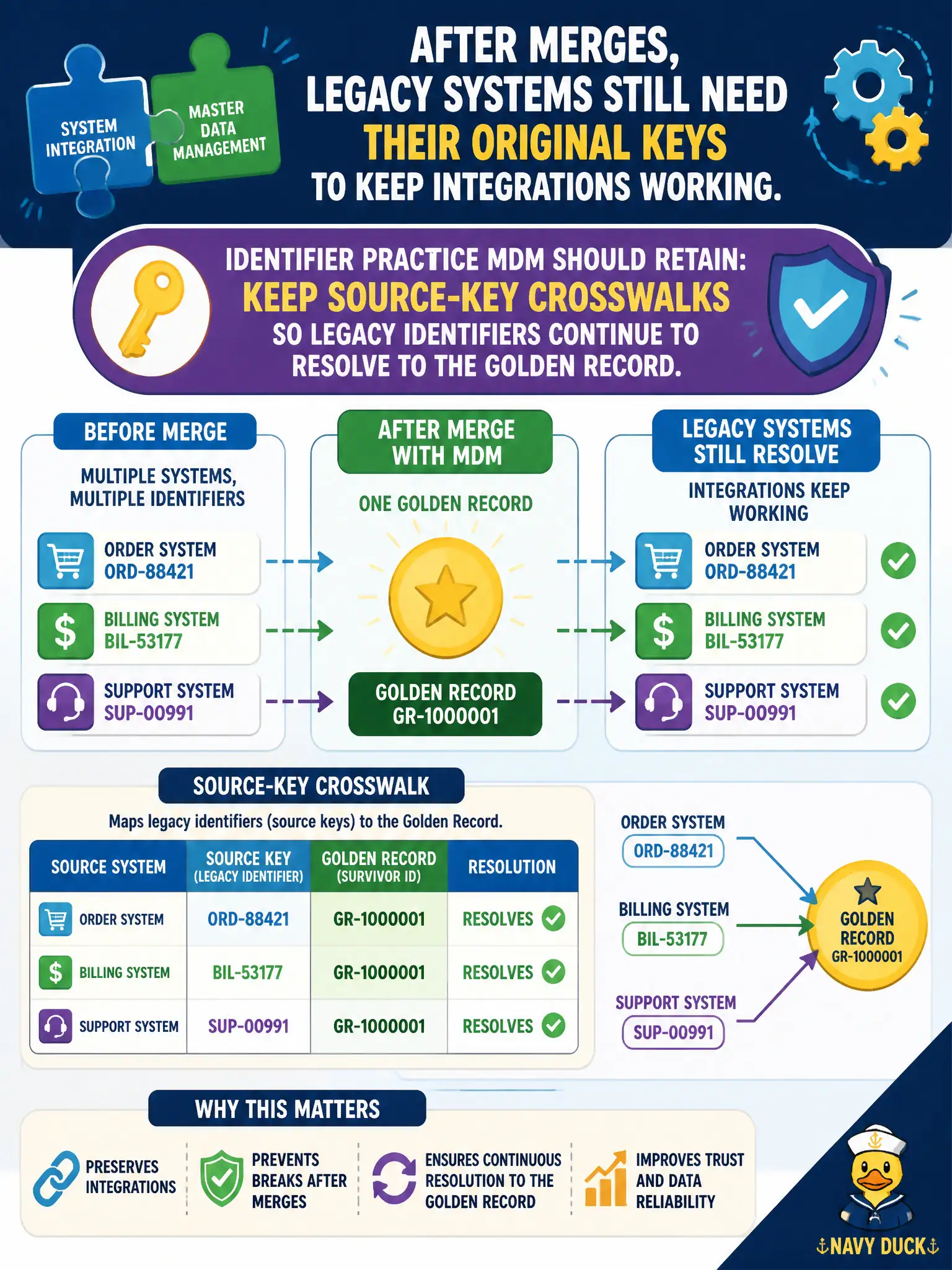
After merges, legacy systems still need their original keys to keep integrations working. What identifier practice should MDM retain?
Select an answer to reveal the explanation.
Short Explanation
Old systems still speak old IDs. Keep a crosswalk from source keys to the golden ID or integrations break overnight.
Full Explanation
After merges, legacy systems that still need their original keys require MDM to keep source-key crosswalks so legacy identifiers continue to resolve to the golden record. Civic integrations rarely flip overnight to a single new key. Erasing all source keys immediately after each merge to tidy the table breaks lineage and interfaces. Requiring every legacy system to invent new keys without a mapping table creates chaos. Printing keys once on paper and discarding electronic cross-references fails operational resolve. Exam caveat: retain source-key crosswalks for integration and lineage after golden merges. Operational check: verify each major source key resolves to the correct golden party post-merge, prohibit unchecked key purge jobs, and back up crosswalk tables. Document crosswalk retention in the municipal MDM data dictionary. Keep verification evidence with the municipal runbook so audits can prove the chosen control was applied as designed and that rejected alternatives would have left city services exposed to the failure modes described above. Keep verification evidence with the municipal runbook so audits can prove the chosen control was applied as designed and that rejected alternatives would have left city services exposed to the failure modes described above.