
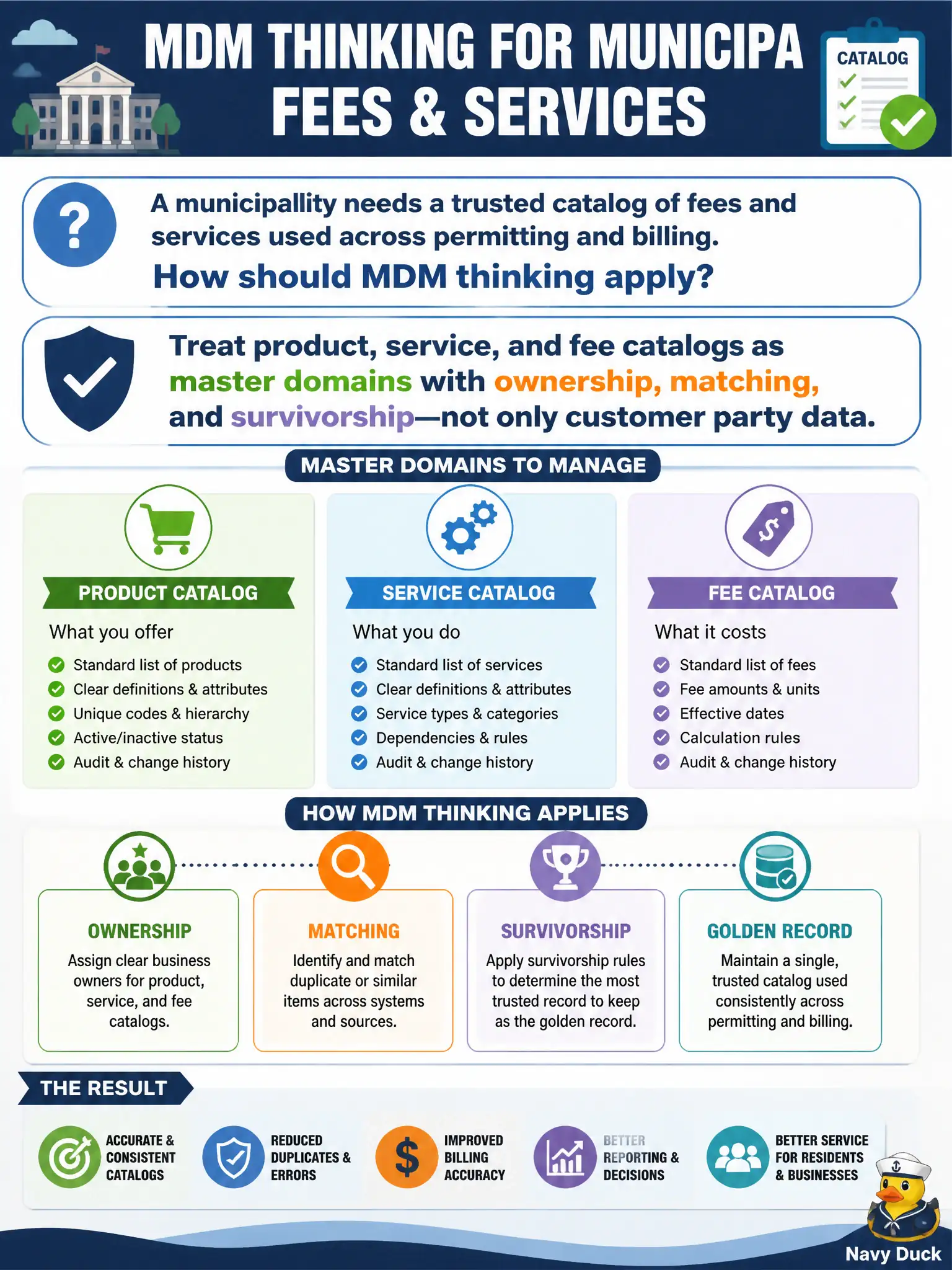
A municipality needs a trusted catalog of fees and services used across permitting and billing. How should MDM thinking apply?
Select an answer to reveal the explanation.
Short Explanation
MDM isn’t just about people. Fee and service catalogs are masters too—same need for ownership, clean IDs, and one trusted version.
Full Explanation
Product, service, and fee catalogs used across permitting and billing should be treated as master domains with ownership, matching, and survivorship—not only customer party data. Civic MDM scope often includes shared product/fee masters that drive consistent charges. Limiting MDM exclusively to citizen names and ignoring fee definitions fails cross-process fee consistency. Storing fee codes only in email threads among clerks fails governed master practice. Recreating fee lists independently in each department without shared keys recreates the inconsistency MDM exists to fix. Exam caveat: MDM domains include more than party—product/service/fee catalogs can be master domains too. Operational check: charter fee/product domain owners, define unique fee keys, publish a golden catalog to permitting and billing, and monitor conflicting local fee lists. Report revenue and resident-billing error reductions as the municipal value case for catalog mastering. Keep verification evidence with the municipal runbook so audits can prove the chosen control was applied as designed and that rejected alternatives would have left city services exposed to the failure modes described above. Keep verification evidence with the municipal runbook so audits can prove the chosen control was applied as designed and that rejected alternatives would have left city services exposed to the failure modes described above.