
Matching discussions contrast a stable business license number with an internal surrogate database key that resets when systems are rebuilt. What principle should guide the team?
Select an answer to reveal the explanation.
Short Explanation
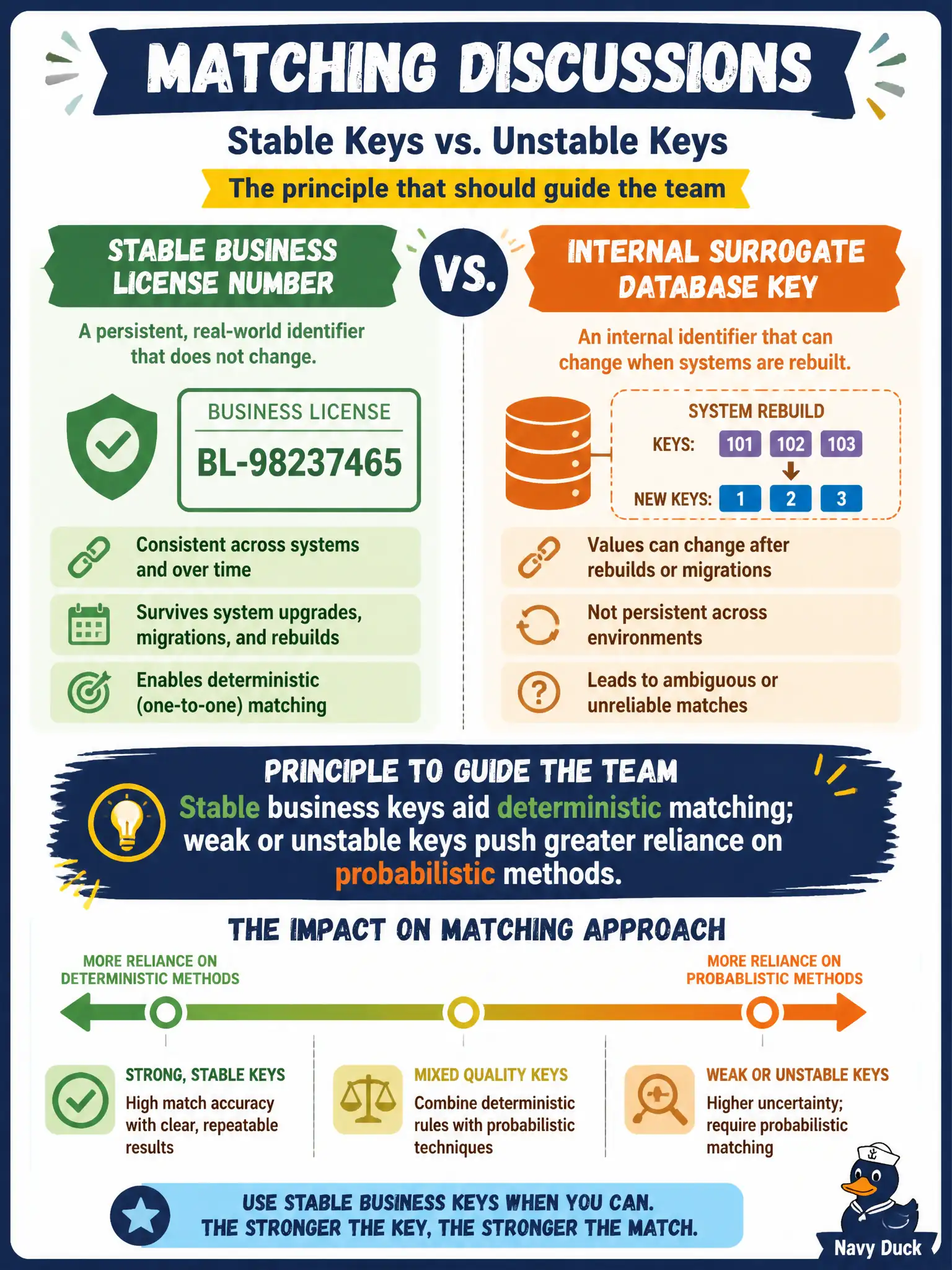
A license number that survives system swaps is a solid handshake; a database ID that dies in a rebuild is a temporary nametag. Strong business keys make deterministic matching easier. Weak keys shove you toward fuzzier, probabilistic evidence.
Full Explanation
Contrasting a stable business license number with an internal surrogate database key that resets when systems are rebuilt should guide teams toward this principle: stable business keys aid deterministic matching, while weak or unstable keys push greater reliance on probabilistic methods. Civic MDM should prefer durable real-world identifiers when they exist. Treating surrogate keys that reset on rebuild as the preferred sole match key fails stability and cross-system durability. Banning business keys because only opaque surrogates are allowed fails useful deterministic matching. Treating any numeric column as a business key regardless of stability or meaning fails key quality assessment. Exam caveat: business key stability vs surrogate fragility drives match method mix. Operational check: inventory candidate business keys for organizations (license, tax ID), assess uniqueness and stability, and design deterministic rules where strong keys exist alongside probabilistic fallbacks. Prohibit reset-prone surrogates as the only municipal match backbone. Keep verification evidence with the municipal runbook so audits can prove the chosen control was applied as designed and that rejected alternatives would have left city services exposed to the failure modes described above.