
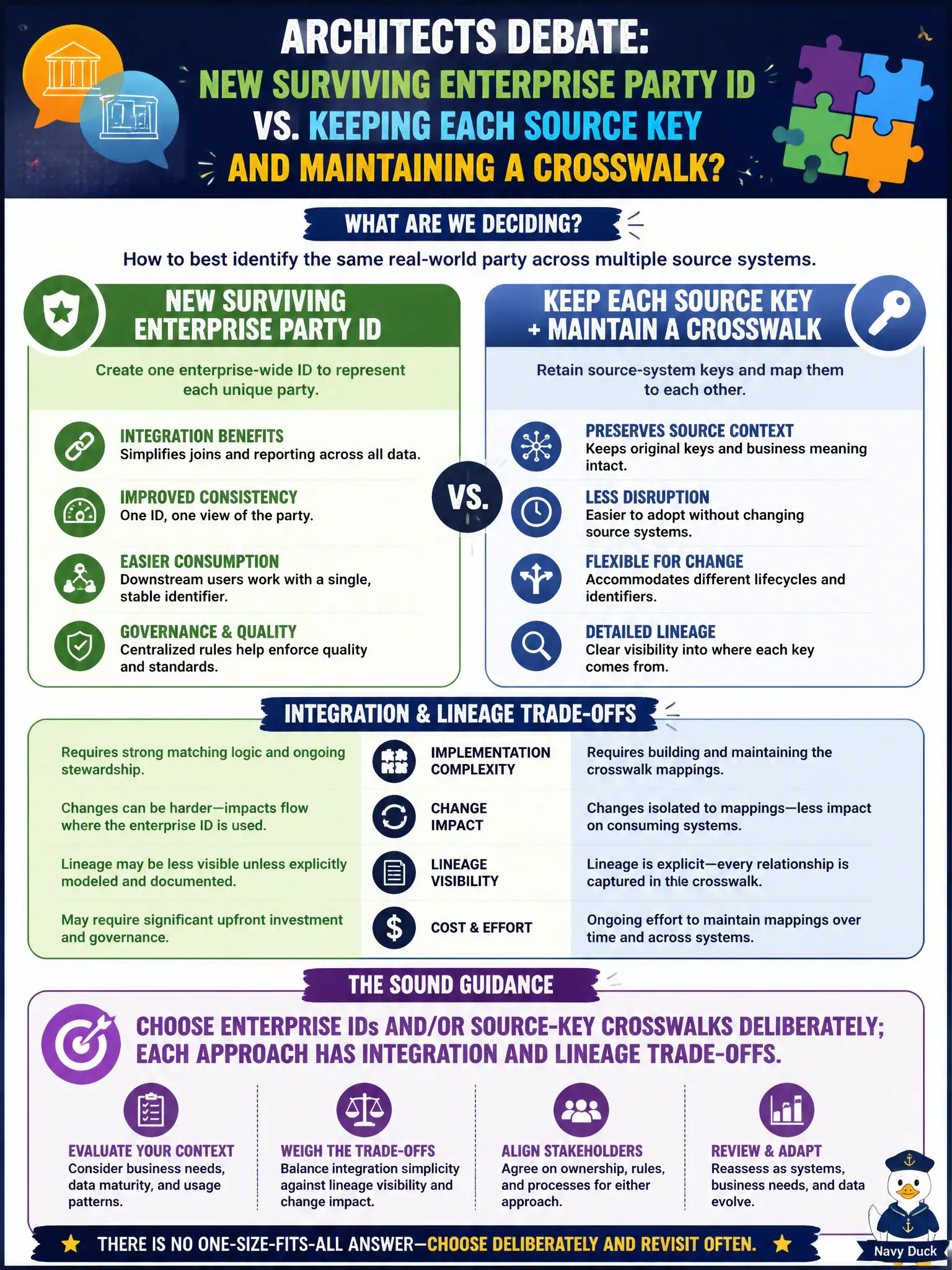
Architects debate issuing a new surviving enterprise party ID versus keeping each source key and maintaining a crosswalk. What is the sound guidance?
Select an answer to reveal the explanation.
Short Explanation
IDs are the name tags on the jackets—you can issue a city-wide tag, keep the old tags with a map between them, or do both on purpose. Blindly burning source keys loses the trail home. Pick the strategy; do not shrug.
Full Explanation
Architects debating a new surviving enterprise party ID versus keeping each source key with a crosswalk should choose enterprise IDs and/or source-key crosswalks deliberately; each approach has integration and lineage trade-offs for civic systems. There is rarely a universal dogma. Always deleting source keys immediately so lineage can never be reconstructed fails operational integration and audit. Never introducing an enterprise ID because source keys alone guarantee global uniqueness fails when source keys collide or reset across systems. Claiming identifier strategy is irrelevant because matching never relies on keys fails; deterministic matching and integration both depend on identifier design. Exam caveat: enterprise ID vs crosswalk is a deliberate MDM architecture choice with trade-offs—not a delete-keys shortcut. Operational check: document the chosen ID strategy, implement crosswalks where legacy keys must resolve, and test end-to-end resolve from each source key to the golden party. Store the decision in the municipal ADR so future replatforming does not casually drop lineage. Keep verification evidence with the municipal runbook so audits can prove the chosen control was applied as designed and that rejected alternatives would have left city services exposed to the failure modes described above.