
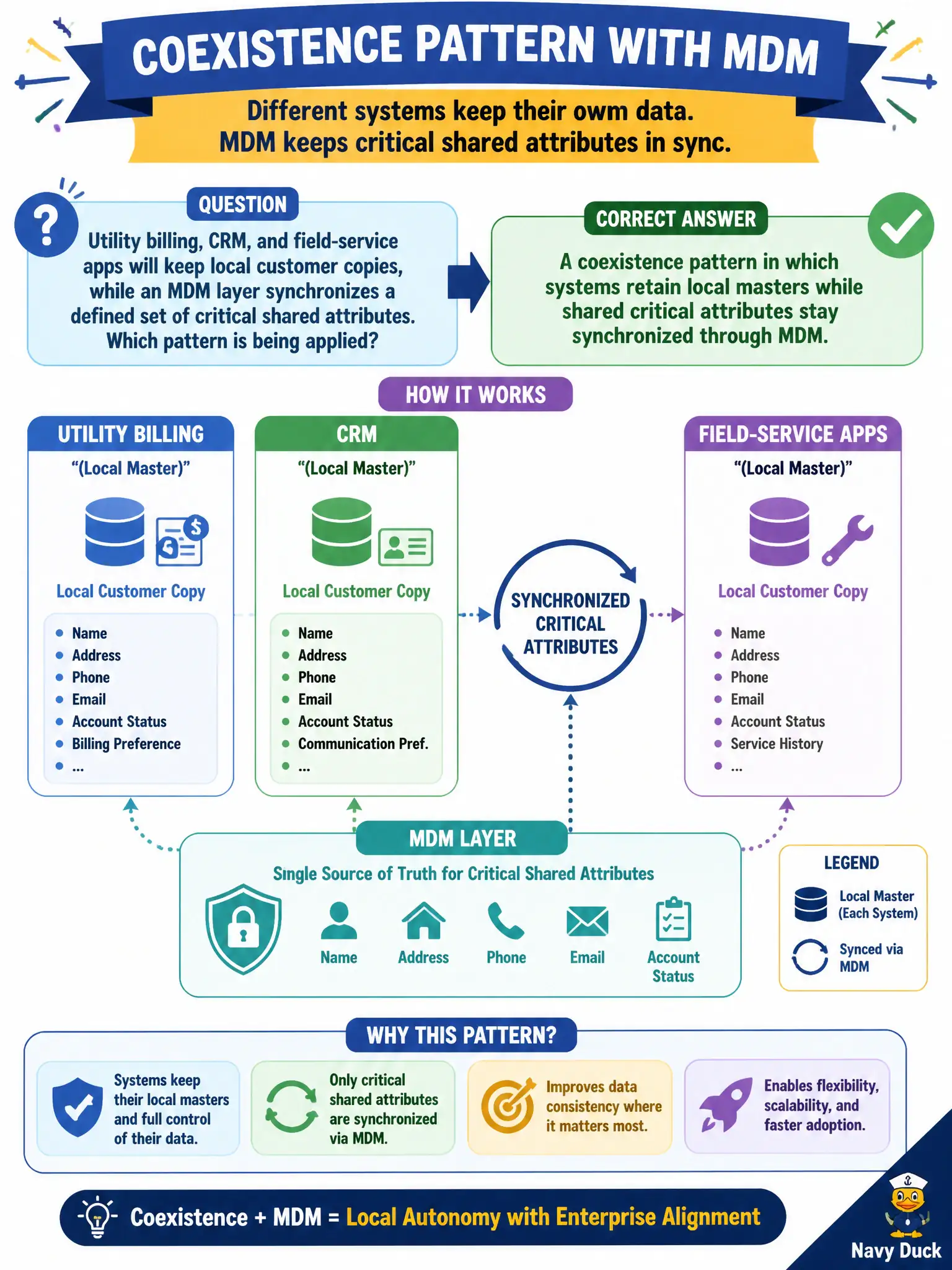
Utility billing, CRM, and field-service apps will keep local customer copies, while an MDM layer synchronizes a defined set of critical shared attributes. Which pattern is being applied?
Select an answer to reveal the explanation.
Short Explanation
Coexistence is the 'everyone keeps their desk copy, but the sticky notes that matter stay in sync' approach. Local apps keep working; MDM keeps the shared critical fields aligned. You are not ripping out every local customer table on day one.
Full Explanation
Utility billing, CRM, and field-service apps that keep local customer copies while an MDM layer synchronizes a defined set of critical shared attributes illustrate a coexistence pattern: systems retain local masters while shared critical attributes stay synchronized through MDM. This fits many civic landscapes where rip-and-replace is impractical. A pure registry with no attribute synchronization fails to describe the active sync of critical attributes among operational copies. A warehouse-only approach that forbids operational systems from holding customer attributes fails operational reality and misstates coexistence. A hard cutover that immediately retires every local customer store on day one describes consolidation/replacement, not coexistence. Exam caveat: coexistence = local copies + synchronized shared critical attributes via MDM. Operational check: publish the critical attribute list, verify sync direction and conflict rules, and sample billing versus CRM for those attributes after a change. Monitor sync exceptions in the municipal MDM operations queue so local drift does not silently reintroduce duplicate civic identities. Keep verification evidence with the municipal runbook so audits can prove the chosen control was applied as designed and that rejected alternatives would have left city services exposed to the failure modes described above.