
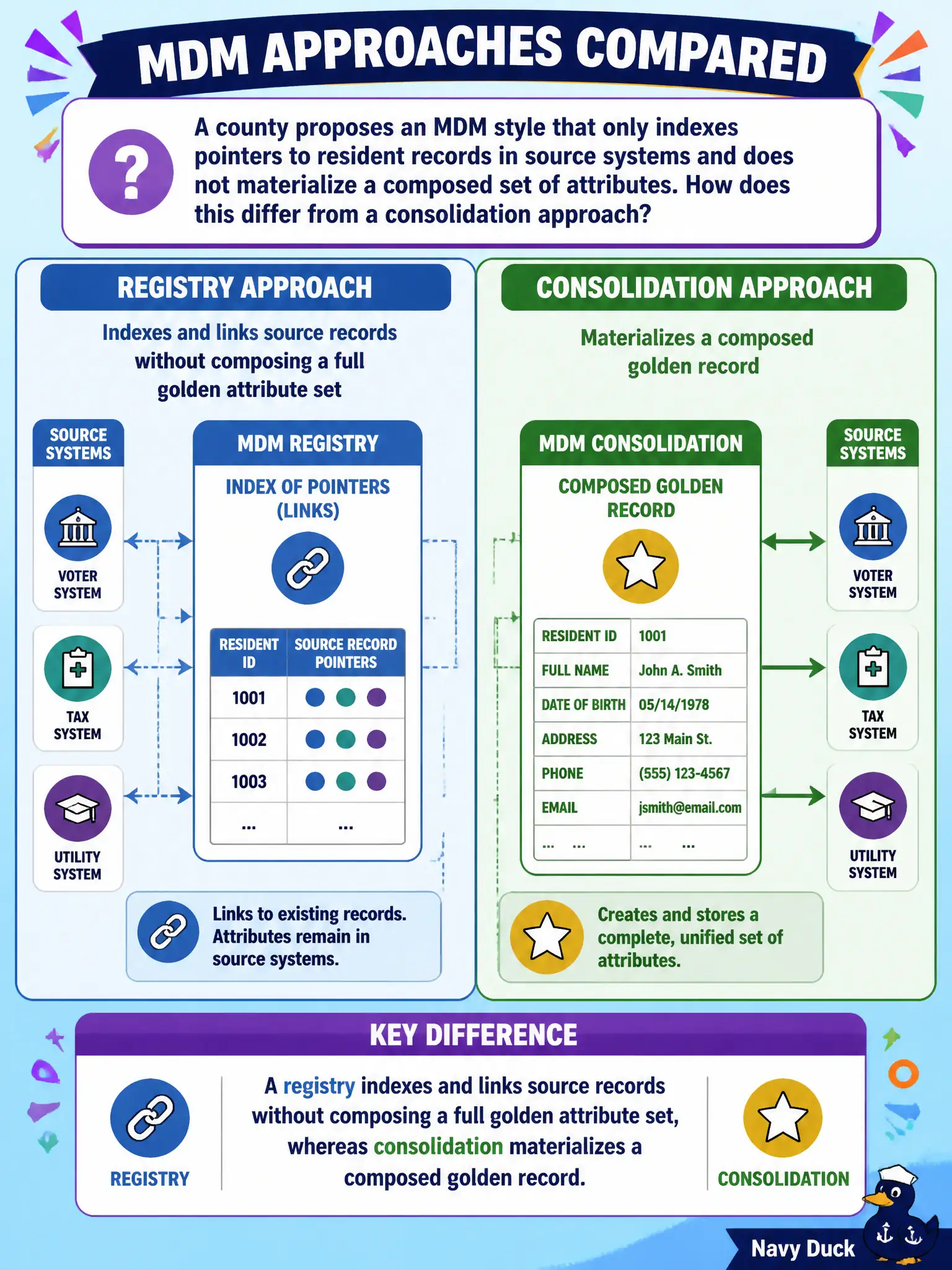
A county proposes an MDM style that only indexes pointers to resident records in source systems and does not materialize a composed set of attributes. How does this differ from a consolidation approach?
Select an answer to reveal the explanation.
Short Explanation
A registry is like a library card catalog—it tells you which shelves hold which books without rewriting the books into one mega-volume. Consolidation actually builds that composed golden record. Pointers alone are not the same as a materialized golden attribute set.
Full Explanation
A county MDM style that only indexes pointers to resident records in source systems without materializing a composed attribute set is a registry approach: it links and indexes sources rather than composing a full golden attribute record, whereas consolidation materializes a composed golden record. Civic architects must pick consciously based on whether consumers need a composed trust view. Claiming a registry always deletes source keys while consolidation never retains lineage fails—both styles typically care about lineage, and registries especially preserve source pointers. Saying registry and consolidation are identical marketing names fails; they differ on whether a composed golden attribute set is stored. Asserting consolidation only works for reference codes while registry is required for party data fails; both patterns can apply to party with different trade-offs. Exam caveat: registry = index/link without full golden composition; consolidation = materialize composed golden attributes. Operational check: if call-center users need one composed resident view, registry alone is insufficient—evaluate consolidation or coexistence; if the need is cross-reference only, registry may suffice. Capture the choice against municipal use cases before vendor selection locks the pattern.