
Multiple municipal systems need read access to a trusted golden customer record, while local updates are reconciled centrally before republishing. Which architecture pattern best fits this requirement at a conceptual level?
Select an answer to reveal the explanation.
Short Explanation
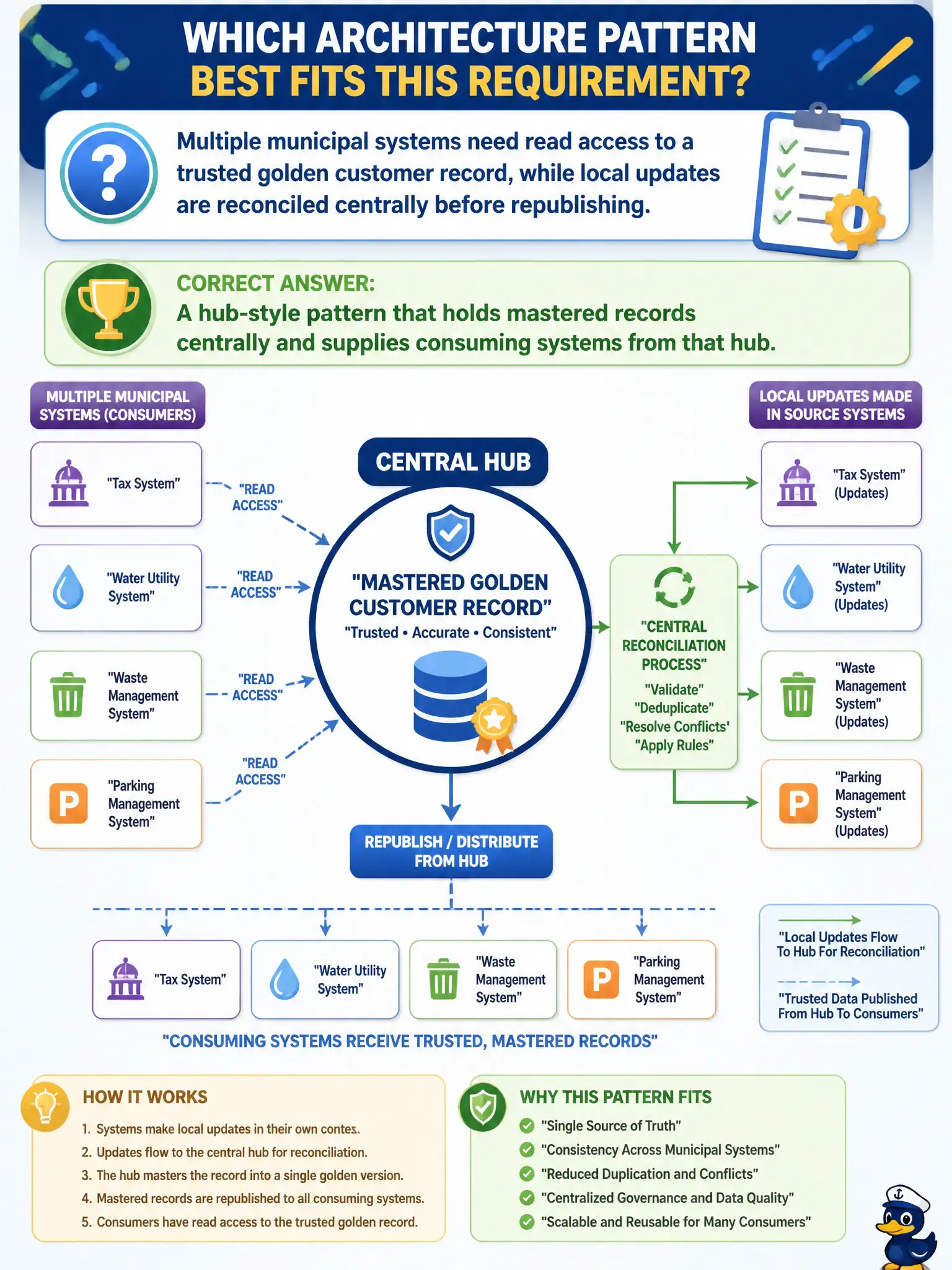
Picture a city hall switchboard that keeps the official resident card and tells every desk what changed. That central switchboard is the MDM hub idea. Systems read the golden record; conflicts get sorted in the middle, not in a tangle of one-off syncs.
Full Explanation
When multiple municipal systems need read access to a trusted golden customer record while local updates are reconciled centrally before republishing, a hub-style pattern that holds mastered records centrally and supplies consuming systems best fits at a conceptual level. The hub becomes the publish point for trusted civic party attributes. A pure file-share where each department overwrites a shared spreadsheet nightly fails as uncontrolled concurrency without survivorship or auditability. An isolated data lake with no operational publish path fails because analytics landing zones do not feed call centers and billing apps with governed golden records. A point-to-point mesh where every system syncs pairwise without a central mastered store fails by exploding integration complexity and preventing a single trusted composition. Exam caveat: recognize hub (central master publish) versus registry, coexistence, and spaghetti pairwise sync at pattern level. Operational check: confirm consumers read from the hub publish interface, route local change requests through reconciliation, and sample whether frontline systems show the same golden attributes after republish. Record the pattern choice in the municipal MDM architecture decision record.