
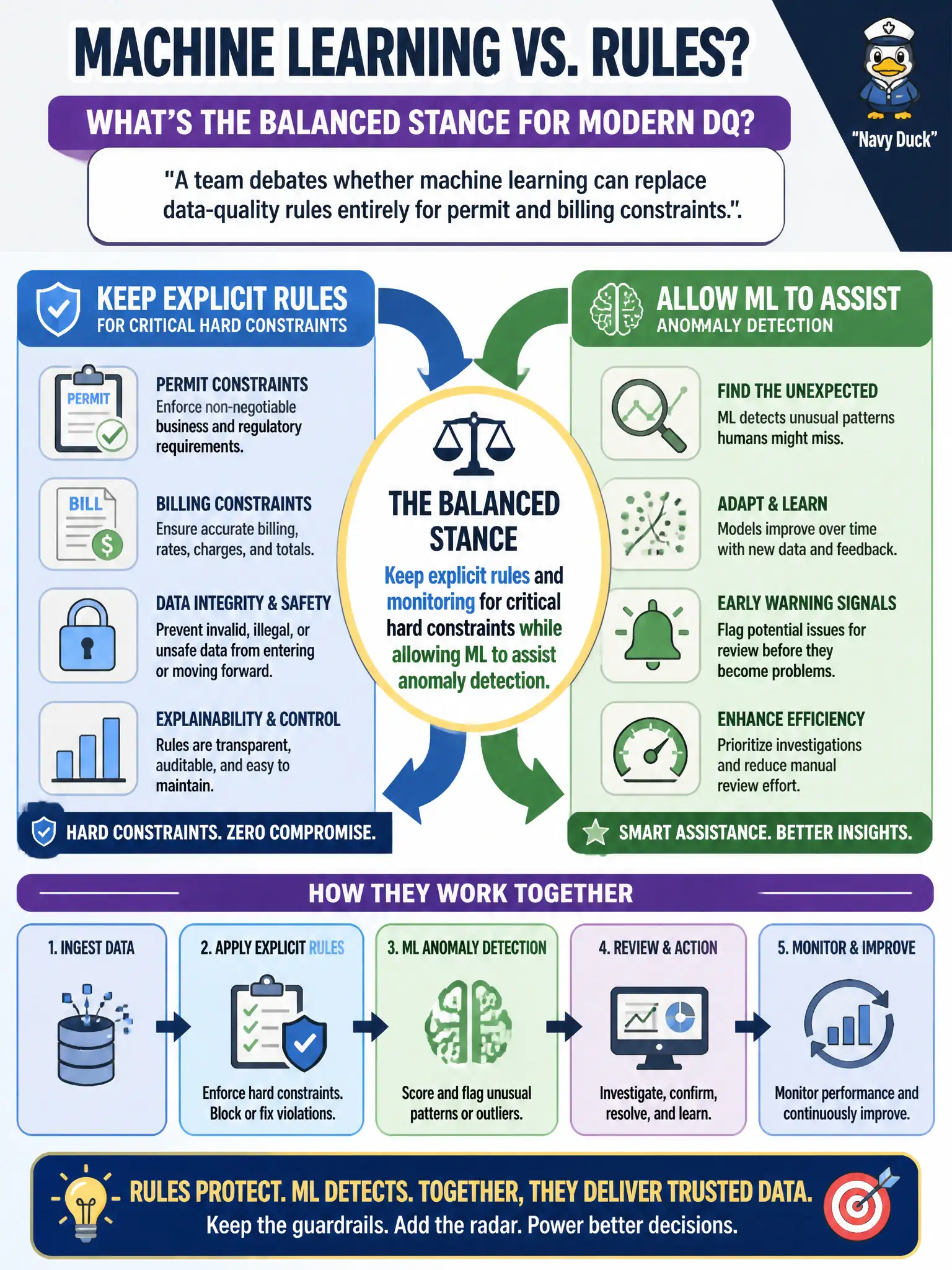
A team debates whether machine learning can replace data-quality rules entirely for permit and billing constraints. What balanced stance fits modern DQ practice?
Select an answer to reveal the explanation.
Short Explanation
Hard billing and permit constraints still need seatbelts—explicit rules—even if ML is a sharp lookout for weird spikes. Keep rules and monitoring for must-pass constraints; let ML assist anomaly detection. Do not pretend models erase DQ management.
Full Explanation
Modern DQ practice keeps explicit rules and monitoring for critical hard constraints while allowing machine learning to assist anomaly detection. When a team debates whether ML can replace data-quality rules entirely for permit and billing constraints, the balanced municipal stance is hybrid: deterministic must-pass rules remain, models help find unusual patterns rules miss. Deleting all explicit rules once any anomaly model is deployed removes auditable acceptance criteria regulators and finance need. Banning ML from DQ work because models never find outliers is false and forgoes useful assistive detection. Using ML alone for regulatory must-pass fields and skipping rule documentation fails explainability and auditability for civic compliance. Exam caveat: models need monitoring for drift and bias; they complement, not silently replace, stewarded business rules on fees, status codes, and statutory fields. Operational check: inventory hard constraints that must remain rule-based, pilot ML anomaly alerts with human review, and keep both control types in the DQ operating model documentation. Permitting and billing owners should approve which fields are rule-gated versus ML-assisted before production use on resident transactions.