
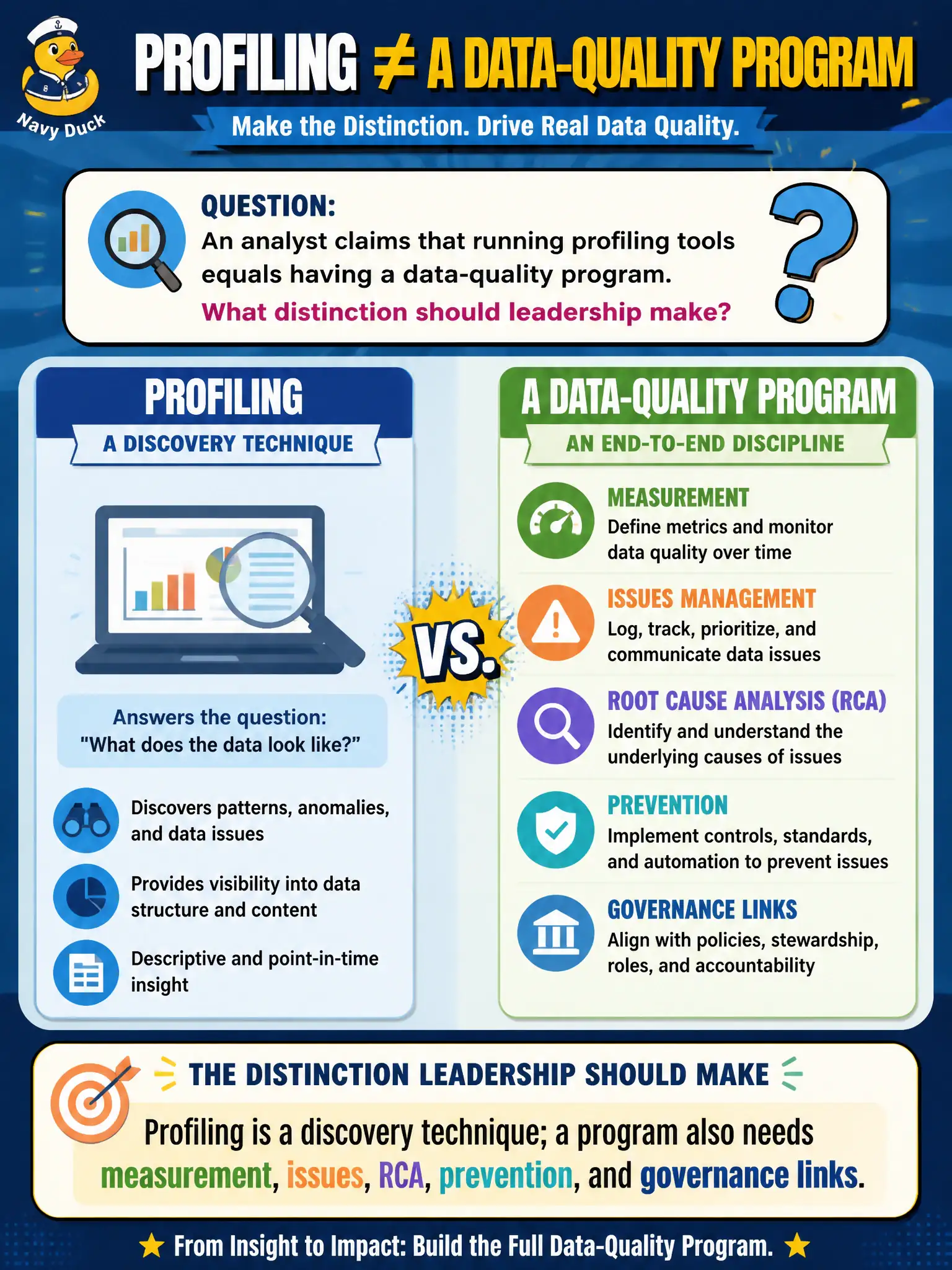
An analyst claims that running profiling tools equals having a data-quality program. What distinction should leadership make?
Select an answer to reveal the explanation.
Short Explanation
Owning a metal detector is not the same as running airport security. Profiling finds patterns; a DQ program also measures, tracks issues, finds causes, prevents defects, and links to governance. Discovery tools alone are not the program.
Full Explanation
Profiling is a discovery technique; a data-quality program also needs ongoing measurement, issue management, root-cause analysis, prevention, and links to governance. When an analyst claims that running profiling tools equals having a DQ program, leadership should reject that equivalence for municipal information management. Colorful monthly charts alone are insufficient if defects lack owners, thresholds, and remediation paths that protect resident-facing processes such as billing and permitting. Treating a DQ program as merely a synonym for installing a profiling product confuses tooling with operating model and accountability across departments. Avoiding profiling so stewards are not biased by statistics discards essential evidence and weakens civic oversight of real defect patterns. Exam caveat: tools accelerate discovery and monitoring, but program maturity is judged by outcomes, ownership, and prevention—not by license counts or chart volume. Operational check: map the program checklist covering CDEs, thresholds, issues, RCA, prevention, and governance escalation; score each element honestly; and fund gaps rather than another profiling dashboard. CIO forums should ask what defects were prevented this quarter for city services, not only how many columns were profiled across the municipal estate.