
A city council asks whether making data more 'accurate' always makes it more 'complete.' What is the sound information-management answer?
Select an answer to reveal the explanation.
Short Explanation
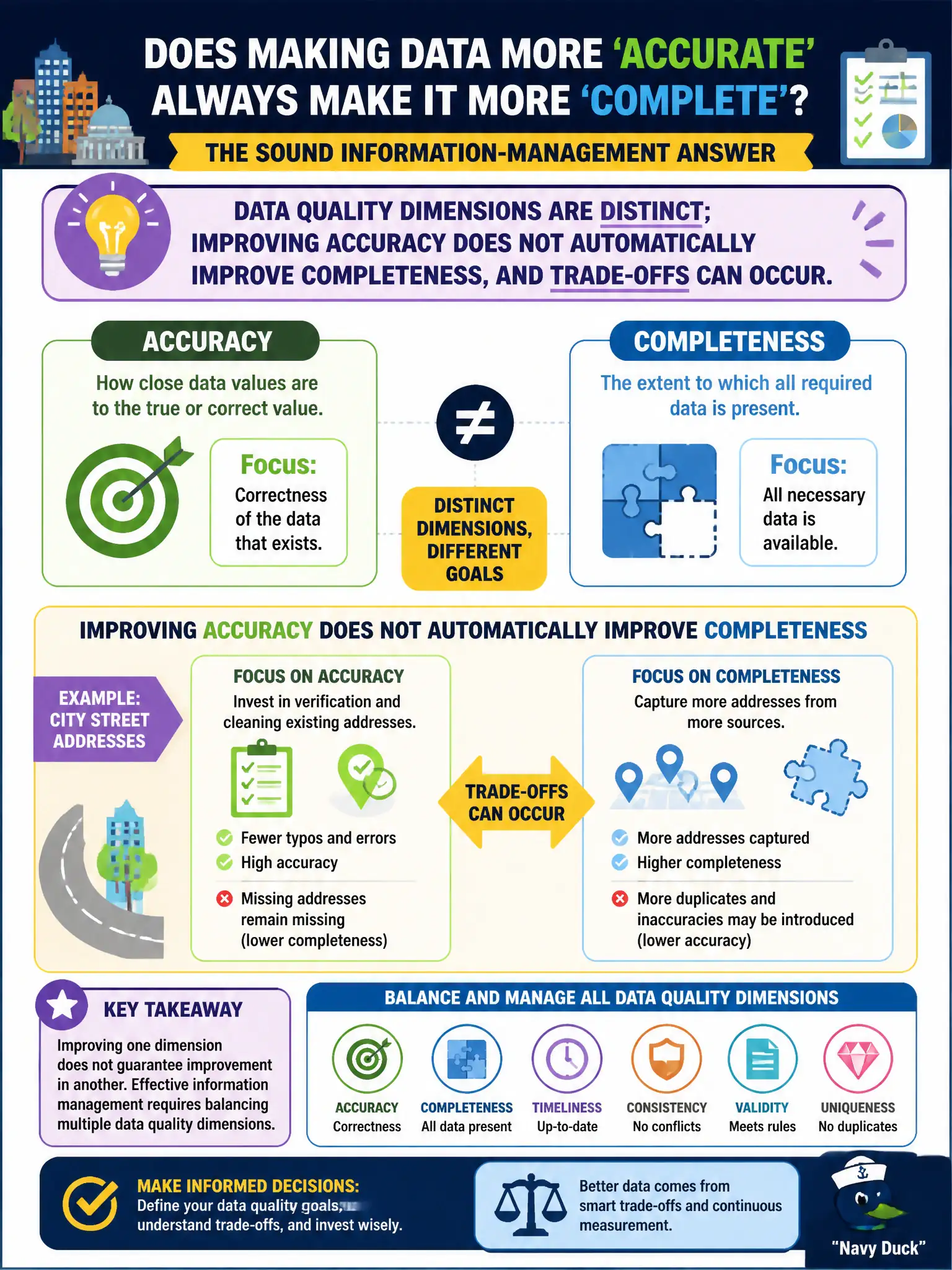
Accurate and complete are siblings, not twins—you can fill every blank with guesses and still be wrong, or leave blanks while the known facts are perfect. Dimensions can move separately and sometimes trade off. Do not assume one lever lifts both.
Full Explanation
Data quality dimensions are distinct; improving accuracy does not automatically improve completeness, and trade-offs can occur. When city council asks whether making data more accurate always makes it more complete, the sound information-management answer is that the dimensions measure different fitness aspects and can move independently. Treating accuracy and completeness as identical dimensions so that improving one always improves the other by definition collapses concepts CIMP practice keeps separate. Assuming completeness always rises when any single incorrect value is corrected confuses correcting content with filling missing content. Claiming dimensions never interact so programs should measure only accuracy forever denies both interactions and the need for multi-dimensional views. Exam caveat: some remediations trade dimensions—for example rejecting incomplete rows can raise accuracy of retained rows while lowering completeness of the population. Operational check: for a critical civic dataset, report accuracy and completeness as separate metrics with owners, and document any policy that prefers one over the other for a named use. Council briefings should show both measures so leaders do not equate a single 'quality up' headline with fitness across uses.