
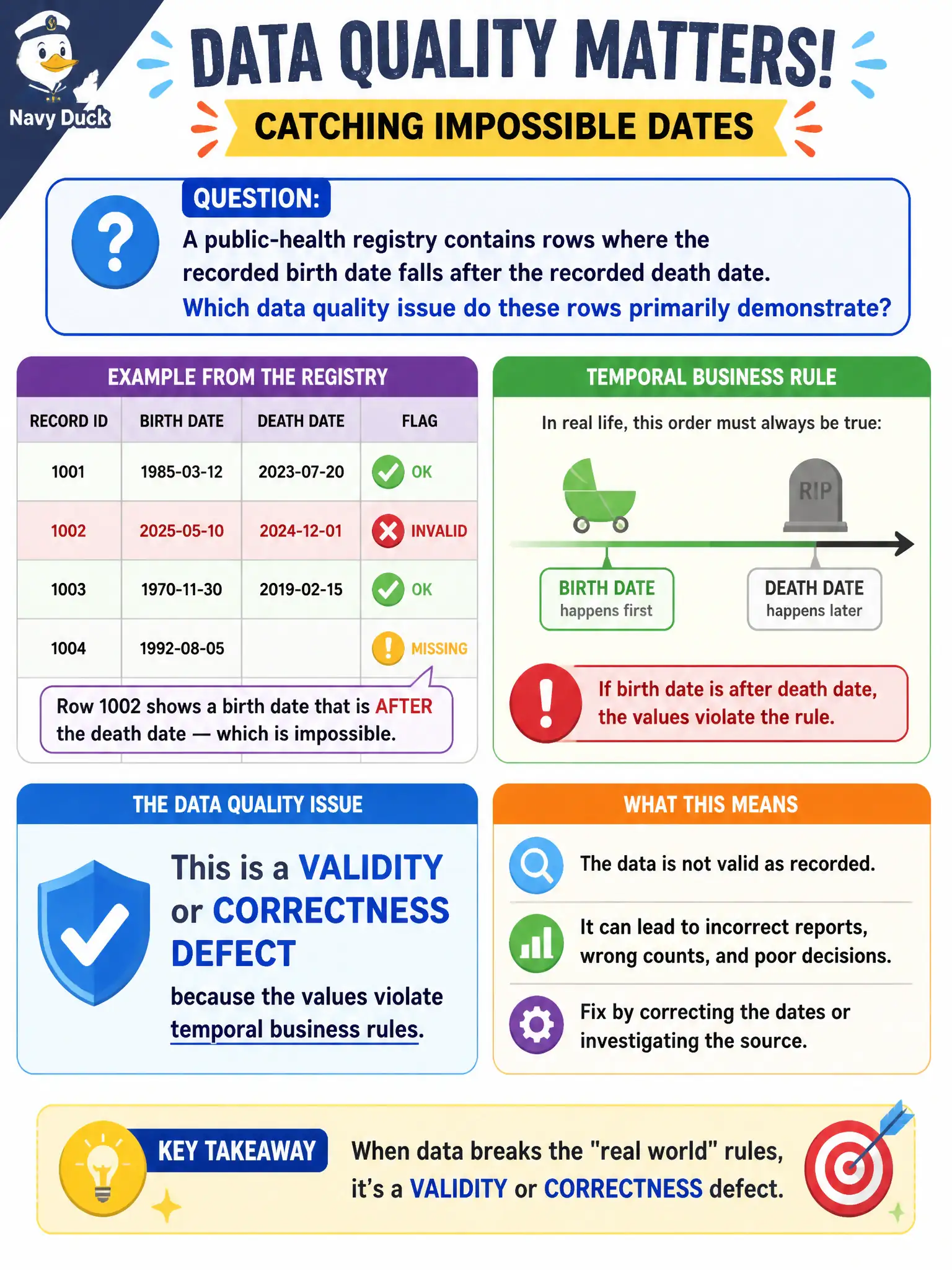
A public-health registry contains rows where the recorded birth date falls after the recorded death date. Which data quality issue do these rows primarily demonstrate?
Select an answer to reveal the explanation.
Short Explanation
A birth date after a death date is like a story that ends before it starts—the values just cannot both be right under the rules. Validity and correctness check values against domain and temporal constraints. Those rows fail the business rule even if every field is filled in.
Full Explanation
Validity and correctness evaluate whether stored values obey domain, format, and business rules that a public-health registry must honor. Rows where recorded birth date falls after recorded death date violate a temporal constraint and therefore demonstrate a validity or correctness defect, even if each field is populated. Treating the case as a uniqueness defect cured by assigning duplicate person IDs confuses identity cardinality with rule-breaking value combinations and can worsen identity quality. Labeling it a timeliness defect because a warehouse load finished after midnight addresses load latency, not impossible date pairs already present in the content. Calling it completeness because optional middle-name fields are blank mixes an unrelated optional attribute with a hard temporal rule failure. Exam caveat: presence of values is not the same as quality; completeness can look fine while correctness fails on cross-field logic. Operational check: implement a cross-field edit that rejects or quarantines birth-after-death combinations at capture or load, report the exception rate to the registry steward, and remediate source coding or transcription paths. Civic health programs should retain an auditable exception log so state reporting and epidemiology users know which rows were held or corrected.