
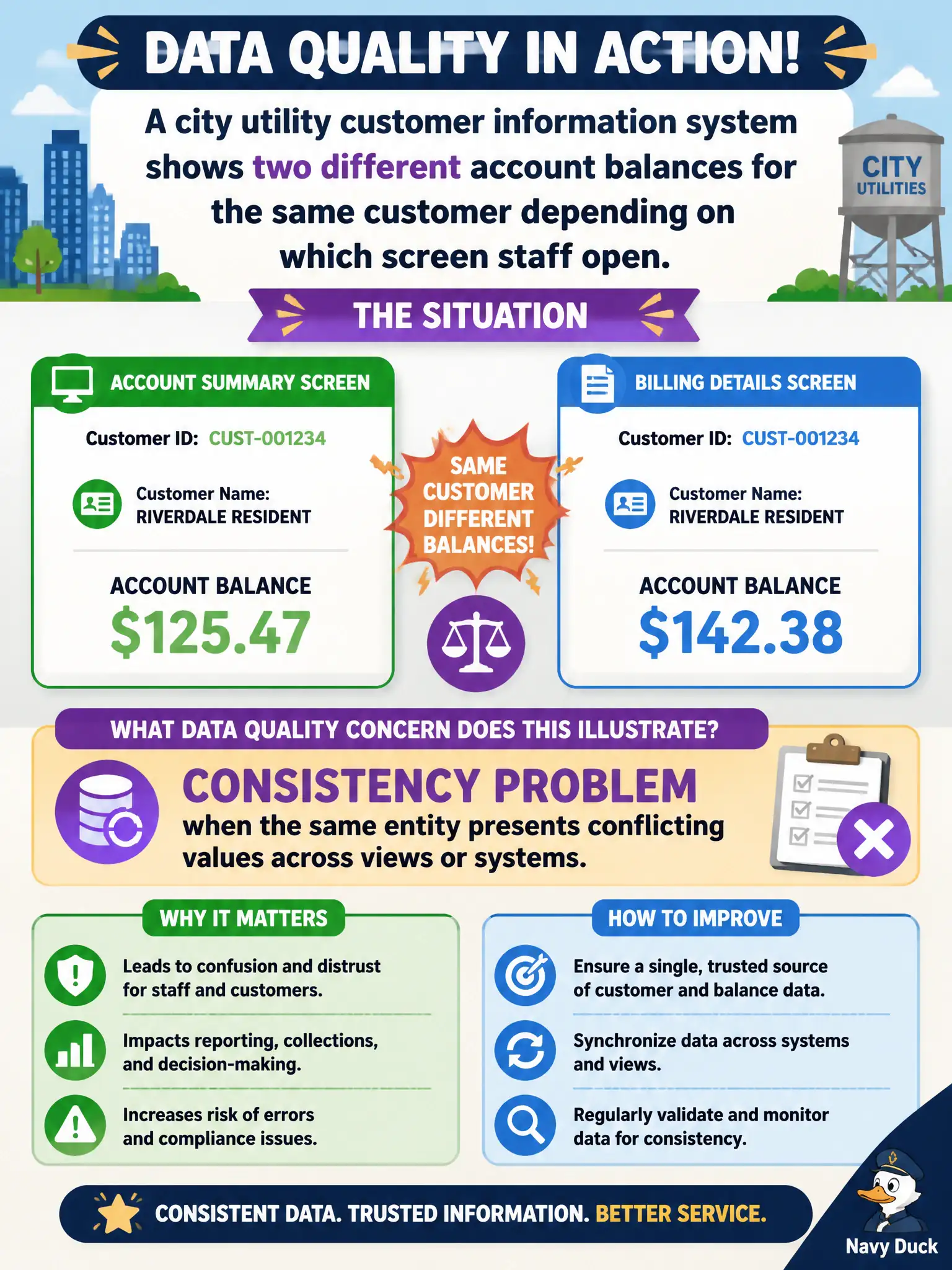
A city utility customer information system shows two different account balances for the same customer depending on which screen staff open. What data quality concern does this primarily illustrate?
Select an answer to reveal the explanation.
Short Explanation
If two screens argue about the same bill, staff stop trusting either one—like two clocks on the wall showing different times. Consistency means the same fact should not collide across views or systems. Different balances for one account are a classic consistency defect.
Full Explanation
Consistency requires that values representing the same real-world fact agree across systems, interfaces, or views that municipal staff rely on. When a city utility customer information system shows conflicting account balances depending on which screen is opened, the primary concern is consistency of the account fact, not typography. A display-font preference problem would not change stored balances; blaming fonts mislabels a data representation defect as cosmetics. Calling the conflict only a timeliness problem fixed by browser cache refresh may help if stale cache is truly involved, but the stem describes systematic disagreement across views, which is the consistency dimension. Creating a fourth account number to chase uniqueness worsens identity sprawl and does not reconcile the two conflicting balance representations. Exam caveat: consistency failures can originate in divergent calculation paths, unsynchronized replicas, or duplicate masters—diagnose the source before assuming a single UI quirk. Operational check: pick one account ID, compare balances across the two screens and the system of record, document which path is authoritative for billing, and open an issue with owner and SLA. Municipal finance and call-center teams should publish which view is trusted for payment arrangements so residents are not quoted contradictory amounts.