
Cleaner parcel-owner addresses cut returned mail and failed foreclosure notices. How should the governance team frame this outcome?
Select an answer to reveal the explanation.
Short Explanation
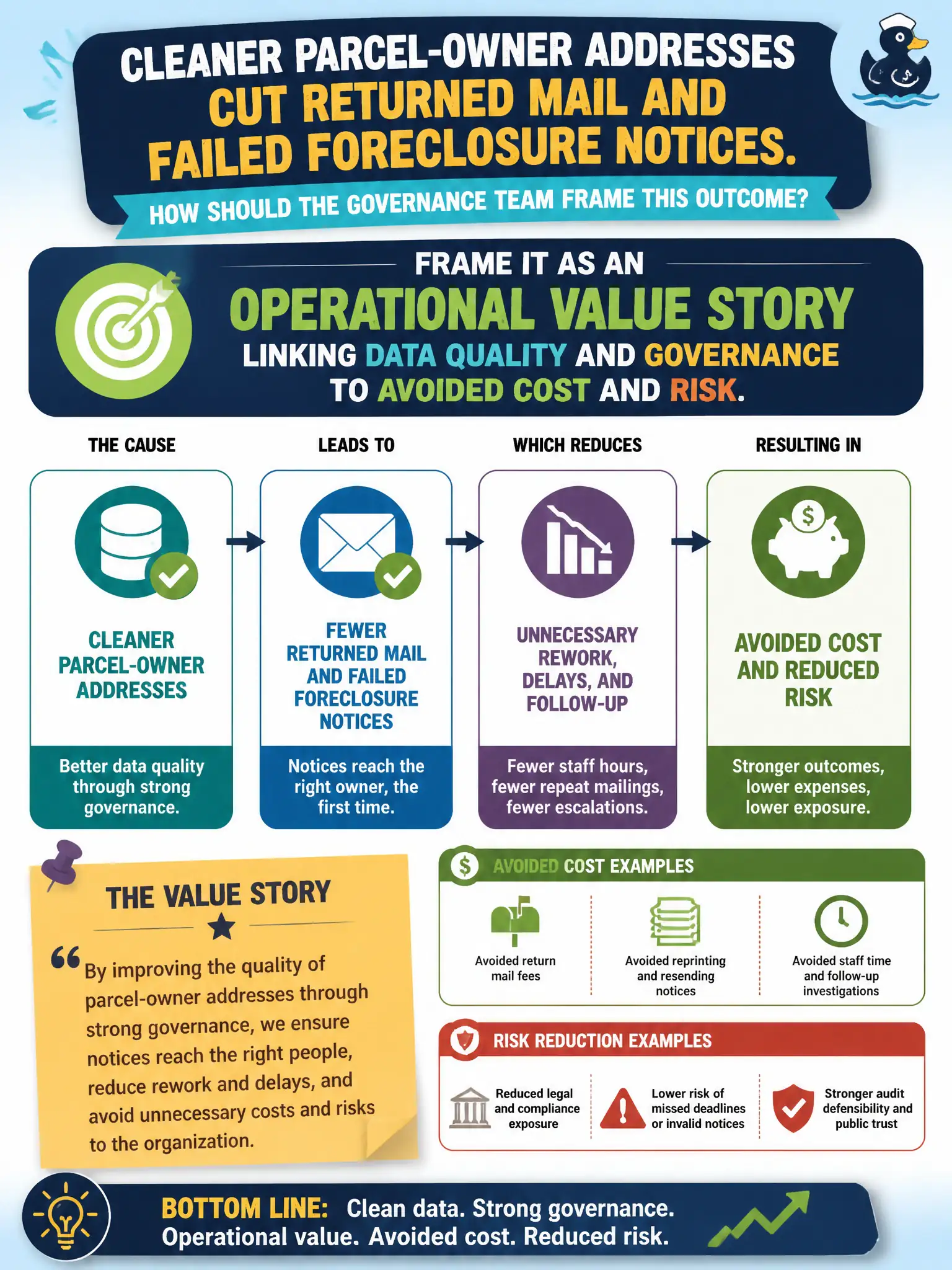
When fewer letters bounce and fewer legal notices miss their mark, that is money and risk you did not burn. Tell that story—governance wins when leaders can see the operational payoff, not just a policy binder.
Full Explanation
Cleaner parcel-owner addresses that cut returned mail and failed foreclosure notices should be framed as an operational value story linking data quality and governance to avoided cost and risk for the city—not as a purely technical rewrite. Civic sponsors fund governance when they see resident-facing and fiscal outcomes, so teams should narrate quality work in those terms. Treating the outcome as a purely technical database rewrite with no business relevance fails by hiding the operational payoff that sustains investment. Framing it as evidence that governance only matters for regulatory checklists fails by narrowing value to compliance theater when real service outcomes improved. Using one success as a reason to stop measuring data quality fails because sustained civic benefit requires ongoing measurement, not a single victory lap. Exam caveat: value stories connect quality metrics to operational or risk outcomes—memorize that linkage for governance exam scenarios. Operational check: quantify returned-mail and failed-notice reductions, attach dollar and risk estimates, and present the story to the data council beside the stewardship actions that produced it. Revisit the metric after the next assessor cycle to show the improvement holds under continued municipal operations.