
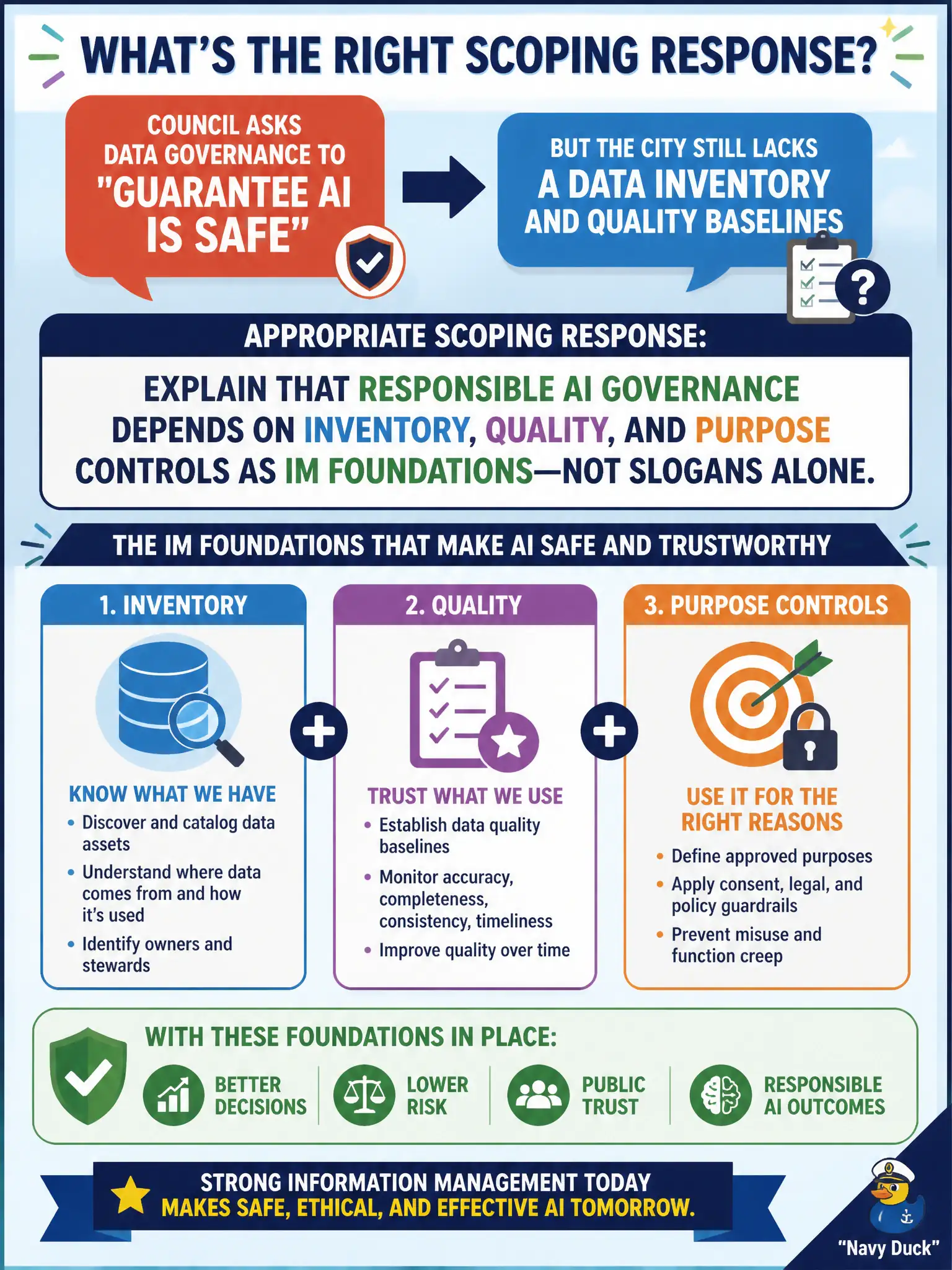
Council asks data governance to 'guarantee AI is safe' while the city still lacks a data inventory and quality baselines. What scoping response is appropriate?
Select an answer to reveal the explanation.
Short Explanation
You cannot swear an AI is 'safe' when you do not even know what data feeds it or whether that data is junk. Inventory, quality, and purpose come first—then responsible AI has something solid to stand on. Foundations before guarantees.
Full Explanation
Responsible AI governance depends on information-management foundations: inventory, quality baselines, and purpose controls—not safety slogans alone. When council asks DG to guarantee AI is safe while the city still lacks a data inventory and quality baselines, the appropriate scoping response is to sequence those foundations before absolute guarantees. Promising absolute AI safety slogans without inventory or quality work creates false assurance about models fed by unknown civic data. Ignoring AI topics entirely and never connecting them to information management leaves a growing risk class unowned. Outsourcing all AI ethics to a single chatbot with no human oversight fails duty of care and accountability. Exam caveat: AI use policies, human oversight, and risk assessments still matter; they build on, rather than replace, core IM controls. Operational check: complete a critical-data inventory and DQ baselines for candidate AI uses, require purpose and quality gates in the AI intake, and report readiness honestly to council before deployment claims. City executives should fund inventory and quality work as prerequisites when they demand trustworthy AI for public services. Present AI readiness as a staged capability model tied to inventory and quality maturity gates.