
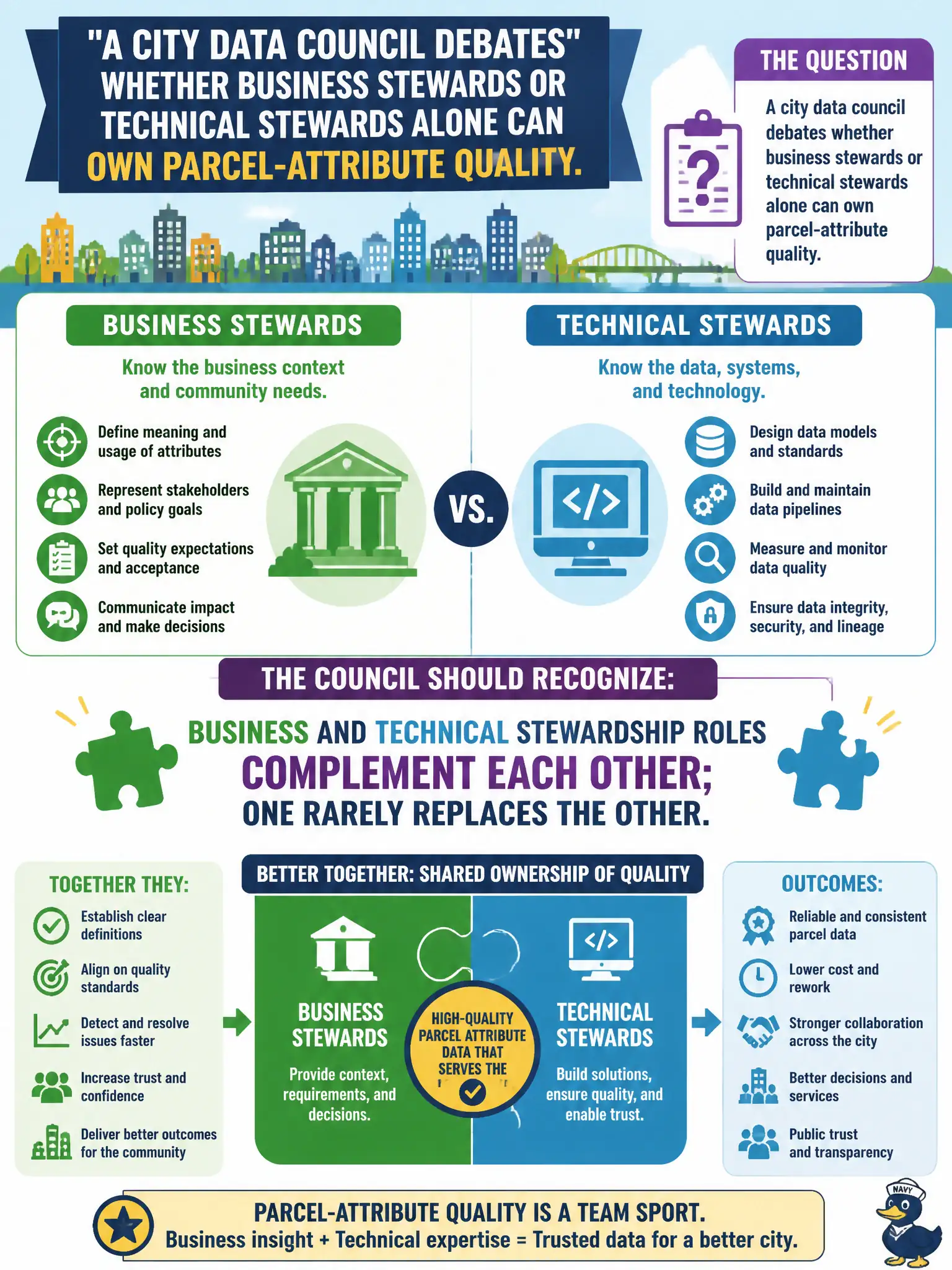
A city data council debates whether business stewards or technical stewards alone can own parcel-attribute quality. What should the council recognize?
Select an answer to reveal the explanation.
Short Explanation
Think of a dual-control safe: the business steward knows what “correct parcel use” means, and the technical steward knows how the field is stored and loaded. You need both keys. Dropping one side usually leaves gaps the other cannot see.
Full Explanation
Municipal parcel-attribute quality depends on complementary stewardship: business stewards own meaning, fitness-for-use, and priority for civic decisions, while technical stewards own lineage, interfaces, schemas, and platform controls that keep those meanings durable across systems. City data councils should treat the two roles as a dual-control model rather than interchangeable job titles. Technical stewards alone cannot replace business stewards once schemas are documented, because documented structure does not encode policy intent, acceptable thresholds, or how assessors and planners actually use parcel fields. Business stewards alone cannot replace technical stewards once dashboards exist, because charts do not maintain pipelines, access paths, or change impact across integrations. Stewardship titles are not optional merely because the warehouse is cloud-hosted; hosting location does not invent accountability for quality. Exam caveat: CIMP-style governance questions often tempt candidates to collapse stewardship into a single technical or single business hero role—pair the complementary accountabilities instead. Operational check: for each critical parcel element, name a business steward and a technical steward, document how they escalate defects, and verify both appear in the operating RACI before the next assessor extract cycle. In civic data programs, record that dual assignment in the governance charter so audits can show who owns meaning versus who owns platform integrity for city land records.