
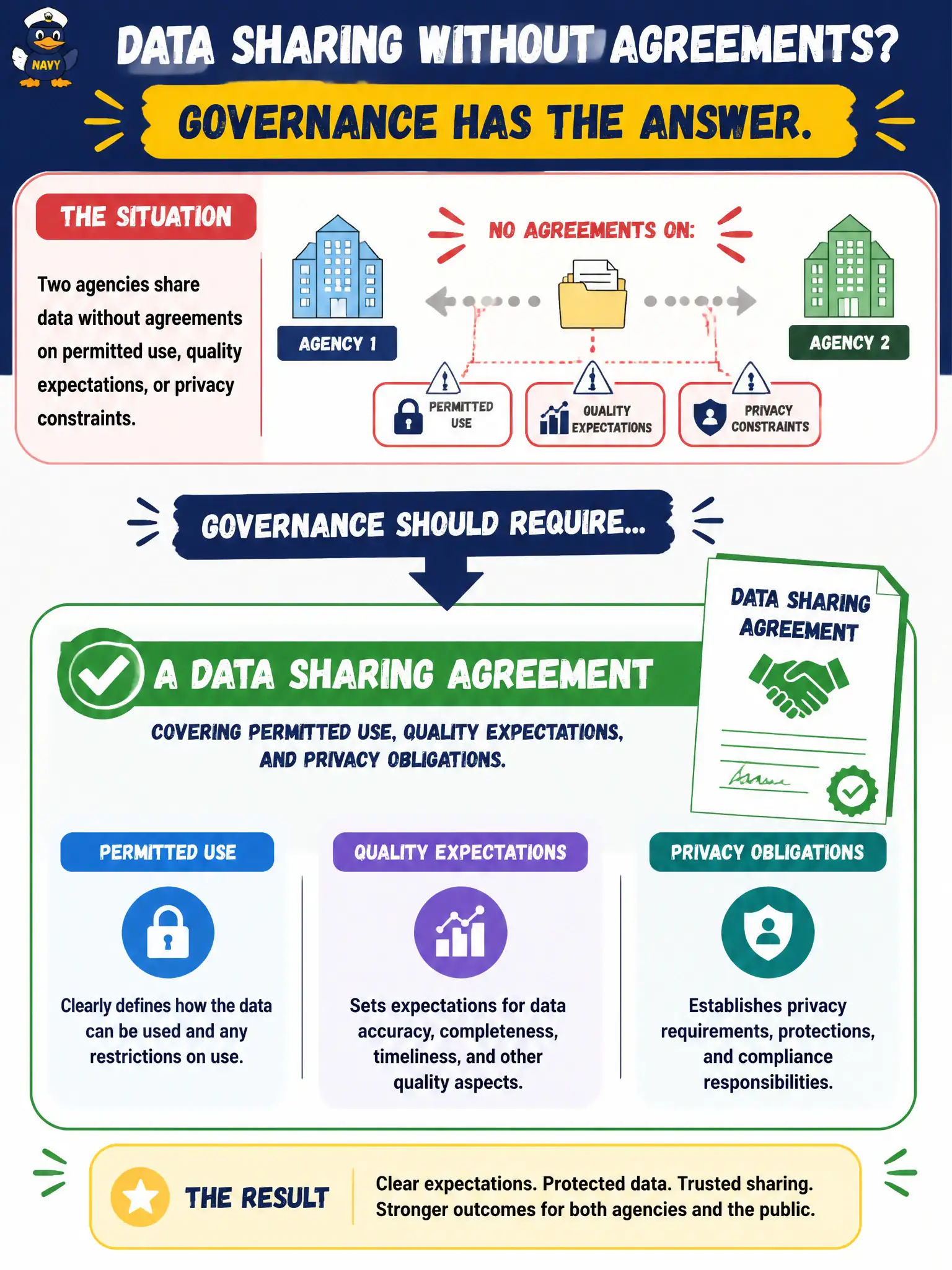
Two agencies share data without agreements on permitted use, quality expectations, or privacy constraints. What artifact should governance require?
Select an answer to reveal the explanation.
Short Explanation
Sharing without a written deal is a handshake over a cliff. Spell out use, quality, and privacy so both agencies know the fence lines. Agreements are governance paperwork that prevent ugly surprises.
Full Explanation
Inter-agency and inter-department shares need explicit agreements stating purpose, permitted use, quality commitments, security and privacy duties, and escalation. When two agencies share data without agreements on permitted use, quality expectations, or privacy constraints, governance should require a data sharing agreement or equivalent MOU before production exchange. Relying on an informal chat thread that can be deleted after the first transfer fails audit and continuity tests. A verbal promise from whichever analyst is free that week cannot bind organizations when staff rotate. Automatic public posting of all shared extracts to maximize transparency without controls ignores minimization and protection obligations. Exam caveat: agreement weight should match sensitivity and volume; lightweight templates can work for low-risk open data, but personal or financial data needs stronger terms. Operational check: block production shares lacking an approved agreement, store agreements in a searchable repository, and review renewals when purpose or systems change. Agency counsels and DG should co-approve templates so civic shares are fast enough to use and strong enough to defend. Sunset informal shares discovered in audits by converting them to agreements or shutting them down.