
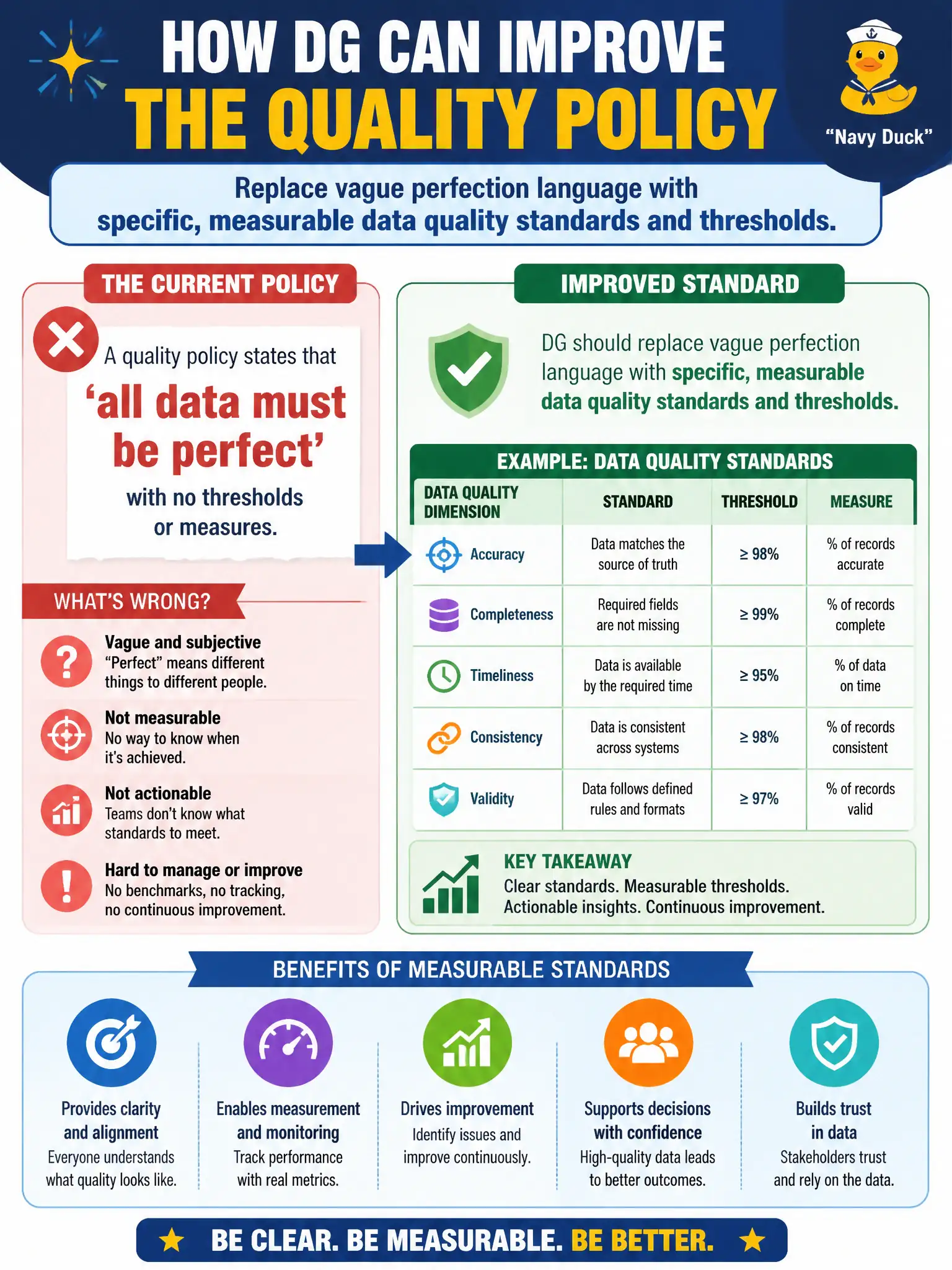
A quality policy states that 'all data must be perfect' with no thresholds or measures. How should DG improve the standard?
Select an answer to reveal the explanation.
Short Explanation
'Be perfect' is a motivational poster, not a quality standard. Teams need dimensions, thresholds, and measures they can actually hit and monitor. Vague perfection guarantees arguments and zero scorecards.
Full Explanation
Governance standards for data quality must be operable: defined dimensions, thresholds, measurement methods, and owners. When a quality policy states that all data must be perfect with no thresholds or measures, DG should replace vague perfection language with specific, measurable standards suitable for municipal operations. Keeping the slogan and forbidding profiling that might show defects creates willful blindness. Declaring perfection achieved when the policy PDF is emailed confuses publication with control effectiveness. Applying the perfect-data rule only to archived printouts leaves production systems ungoverned. Exam caveat: thresholds can be staged (pilot then tighter targets); perfection absolutism is what fails, not ambition. Operational check: pick critical elements, set measurable thresholds by dimension, assign owners, enable profiling, and report breaches with remediation plans. CIO and department sponsors should refuse to endorse unmeasurable perfection pledges that cannot guide stewards or auditors. Link each threshold to a measurement job ID so perfection language cannot return unnoticed. Link each published threshold to a measurement job identifier in the DQ catalog so perfection slogans cannot reappear without an operable control behind them.