
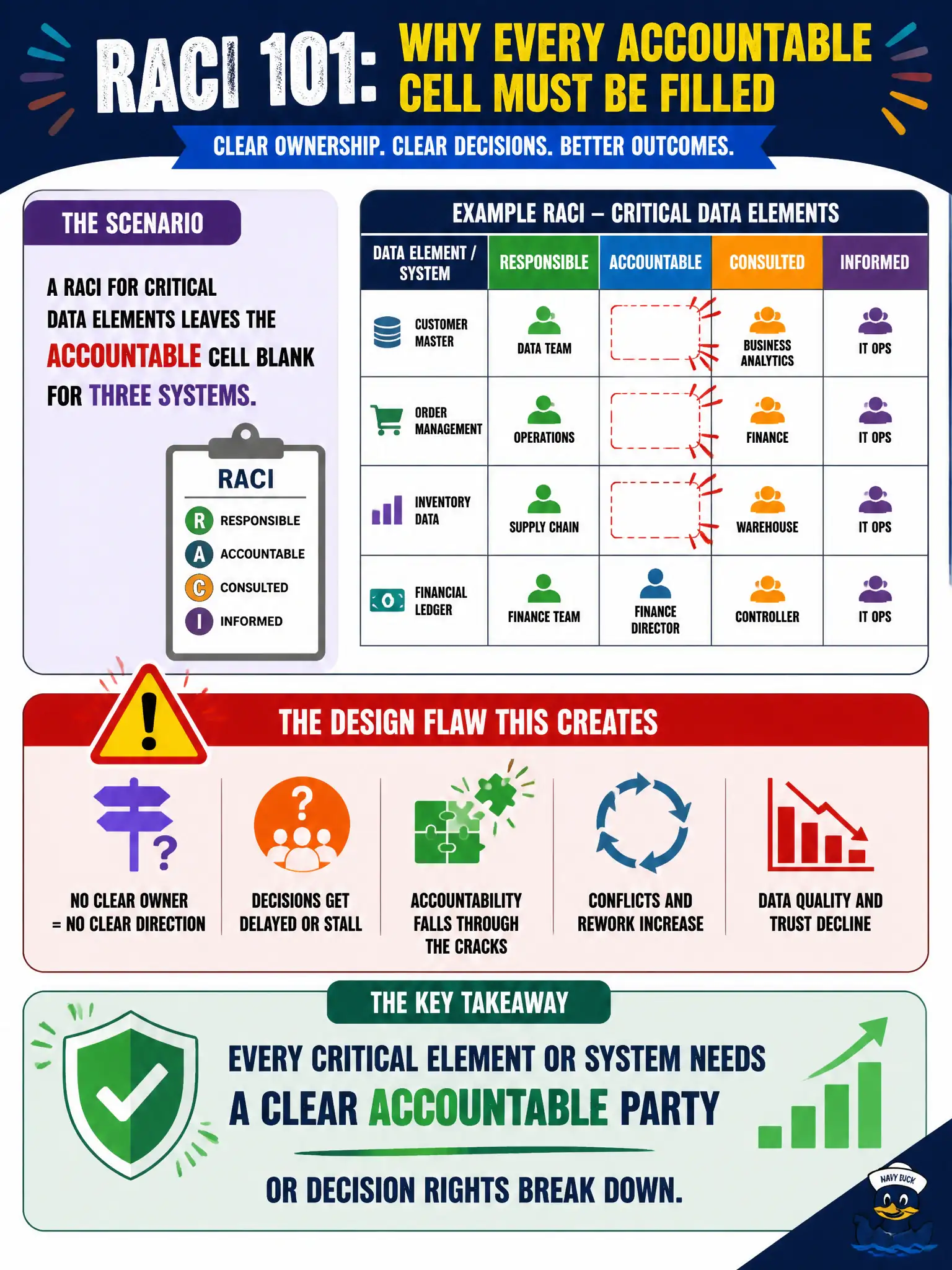
A RACI for critical data elements leaves the Accountable cell blank for three systems. What design flaw does this create?
Select an answer to reveal the explanation.
Short Explanation
RACI without an 'A' is a group project where nobody owns the grade. Responsible folks can do work, but Accountable is who answers when it fails. Fill the A, or issues bounce forever.
Full Explanation
Every critical element or system needs a clear Accountable party or decision rights break down in RACI-based governance designs. When a RACI for critical data elements leaves the Accountable cell blank for three systems, ownership is orphaned and escalation stalls for municipal decisions. Interpreting blank Accountable cells as proof automation replaced human ownership misunderstands RACI and abdicates civic accountability. Treating Accountable as optional decoration while only Responsible parties matter empties the matrix of final answerability. Expecting Consulted and Informed rows to substitute for Accountable forever leaves no one who can decide disputes between departments. Exam caveat: Accountable should be singular for a given decision scope; multiple Accountables without a lead recreates ambiguity. Operational check: reject incomplete RACIs for critical civic assets before stewardship go-live, name Accountable owners with backups, and test escalation on a sample dispute. Governance councils should not approve operating models that show blank Accountable cells for systems touching billing, safety, or personal data. Blank Accountable cells should block go-live checklists for any system in the critical-data register.