
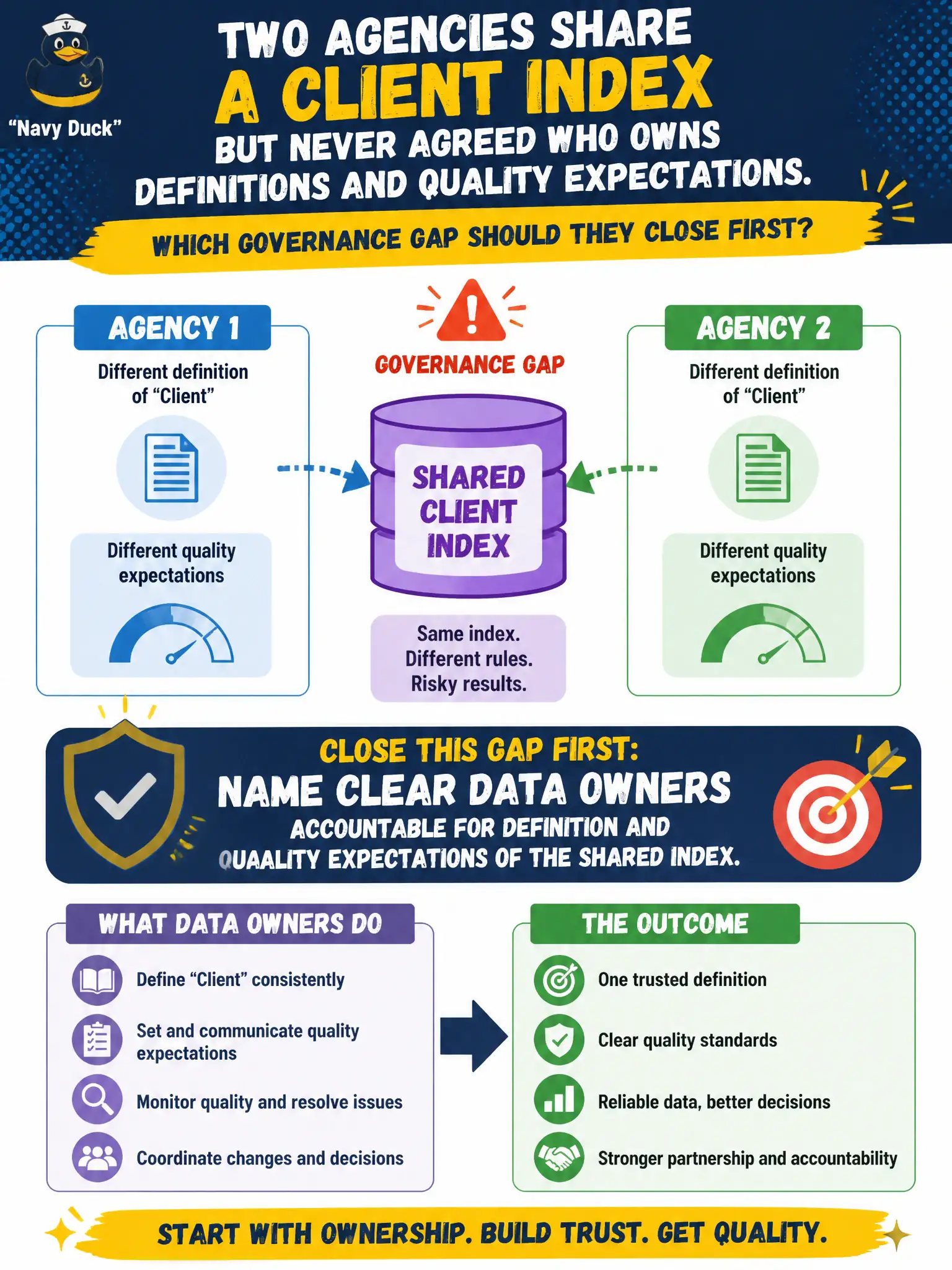
Two agencies share a client index but never agreed who owns definitions and quality expectations. Which governance gap should they close first?
Select an answer to reveal the explanation.
Short Explanation
A shared index with no owner is a potluck where nobody brings the main dish. Someone has to own the definitions and quality bar, or every agency just dumps leftovers into the pile. Name owners first; argue features later.
Full Explanation
Shared indexes need clear data owners accountable for definitions and quality expectations—ownership is a first-order governance gap in multi-agency civic settings. When two agencies share a client index but never agreed who owns definitions and quality rules, naming accountable owners should come before radical reorganization or technical rebuilds. Merging both agencies into one legal entity before any ownership discussion is a disproportionate structural fix for what is fundamentally a decision-rights problem. Deleting the shared index and rebuilding separate lists with no crosswalk increases fragmentation and forces residents to re-prove identity in every office. Handing ownership solely to an overnight ETL job assigns accountability to automation that cannot set business meaning or accept risk on behalf of the public. Exam caveat: ownership can be federated with a lead owner and contributing stewards; ambiguity is the failure mode, not federation itself when roles are written down. Operational check: appoint a named accountable owner for the shared index, document definition and DQ expectations, and require both agencies to escalate conflicts through that owner to a joint forum. Inter-agency civic programs should record ownership in a RACI and catalog entry before expanding who can write to the shared client index.