
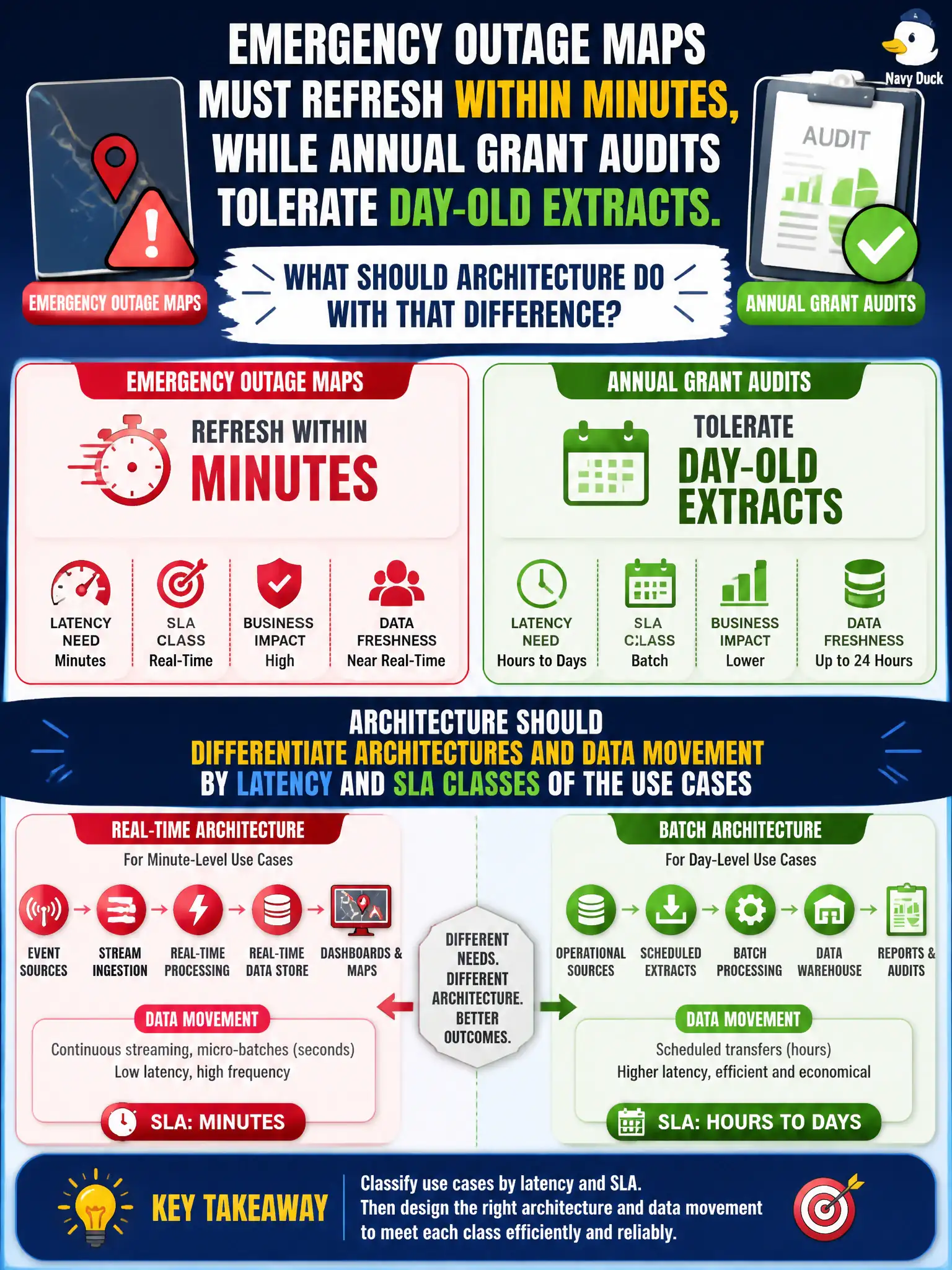
Emergency outage maps must refresh within minutes, while annual grant audits tolerate day-old extracts. What should architecture do with that difference?
Select an answer to reveal the explanation.
Short Explanation
A fire-truck GPS ping and a yearly filing cabinet aren’t the same rush order. Match pipelines and patterns to the latency class—near-real-time for outage maps, batch-friendly for annual audits—instead of one speed for everything.
Full Explanation
Emergency outage maps that must refresh within minutes and annual grant audits that tolerate day-old extracts belong to different latency and SLA classes. Architecture should differentiate data movement and serving patterns accordingly rather than forcing uniformity. Putting every use case on the same near-real-time pipeline wastes cost and complexity. Ignoring latency classes because “storage format determines freshness alone” misunderstands pipelines and SLAs. Applying audit latency to emergency maps to save money endangers operational response. Exam theme: class-based architecture by latency and SLA. Caveat: classification should be explicit in architecture standards so projects do not silently self-assign “real-time” without funding the ops model. Operationally, tag use cases with latency classes, select movement patterns per class, and test that outage maps meet minute-level refresh while audit extracts remain on economical batch paths. Label pipelines with latency class in the architecture inventory and alert when an emergency map feed is misrouted onto an audit-batch schedule. Architecture standards should forbid promoting an emergency feed to “best effort batch” without an explicit risk acceptance from the operational owner of outage maps.