
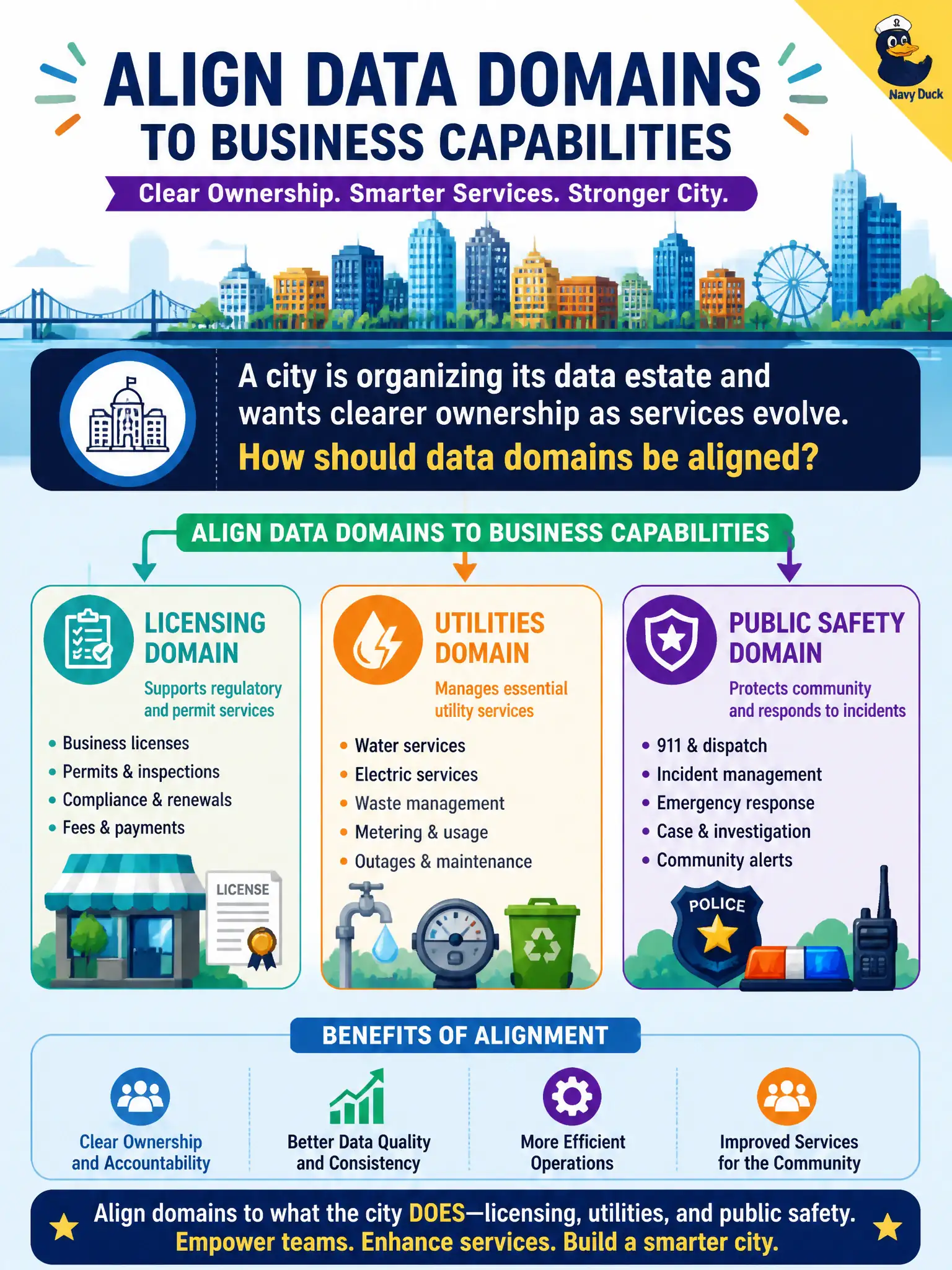
A city is organizing its data estate and wants clearer ownership as services evolve. How should data domains be aligned?
Select an answer to reveal the explanation.
Short Explanation
Name the rooms after what the city actually does—licensing, utilities, public safety—not after which server rack holds the files. Domains that match capabilities make ownership and change paths obvious.
Full Explanation
Clearer ownership as services evolve comes from aligning data domains to business capabilities such as licensing, utilities, and public safety—not to infrastructure topology. Aligning domains only to network subnets and server rooms confuses facilities with information ownership. Aligning domains to individual report templates rather than capabilities fragments stewardship around presentations. Collapsing all domains into one undifferentiated enterprise schema owner creates a bottleneck and blurs accountability. Exam alignment: domains follow capabilities. Caveat: technical platforms may host multiple domains; hosting location does not redefine domain ownership. Operationally, publish a domain-to-capability map with accountable owners, attach priority datasets to domains in the catalog, and route stewardship issues to the capability owner rather than to whichever team owns a server. Route stewardship escalations by capability domain in the catalog so licensing data issues do not land on an unrelated infrastructure team. When a dataset supports multiple capabilities, document a primary domain owner and explicit stewardship agreements rather than leaving ownership ambiguous across utilities and licensing.