
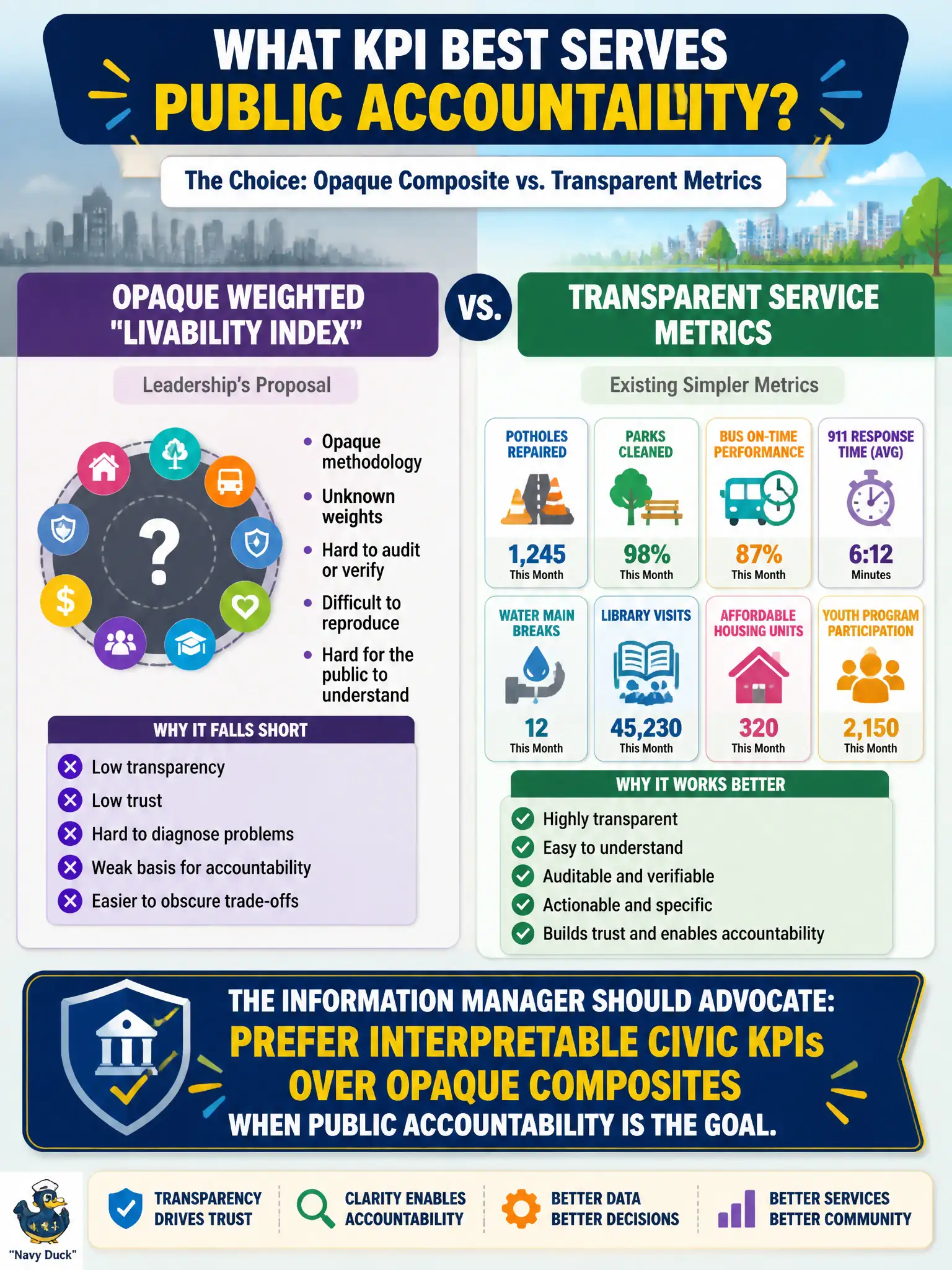
Leadership proposes a opaque weighted 'livability index' as the primary public accountability KPI, though simpler transparent service metrics already exist. What preference should the information manager advocate?
Select an answer to reveal the explanation.
Short Explanation
Opaque indexes can sound sophisticated while leaving residents guessing what improved. When accountability is the point, clearer service metrics usually beat a mysterious blended score. Transparency helps the public—and staff—know what to change.
Full Explanation
When leadership proposes an opaque weighted “livability index” as the primary public accountability KPI while simpler transparent service metrics already exist, prefer interpretable civic KPIs over opaque composites for public accountability. Residents and council need to see which services moved—permits, response times, cleanliness—not a mysterious score whose weights they cannot inspect or contest. Replacing all service metrics with the composite so the public sees only one mysterious score reduces accountability. Keeping weights secret to prevent residents from “gaming” simpler measures treats transparency as a threat and blocks democratic oversight. Publishing the composite without explaining inputs because display simplicity matters most confuses visual simplicity with interpretive honesty. Exam caveat: composites can be secondary communication aids if weights, inputs, and limitations are published; they should not displace transparent service KPIs as the primary accountability layer. Operational check: keep primary public KPIs as interpretable service measures with definitions, if a composite is used publish weights and inputs, and reject secrecy of weights for accountability reporting. In municipal information-management practice, record the rationale so future staff know which failure modes the rejected options would create for city services, and re-validate after the next cycle that the same control still holds.