
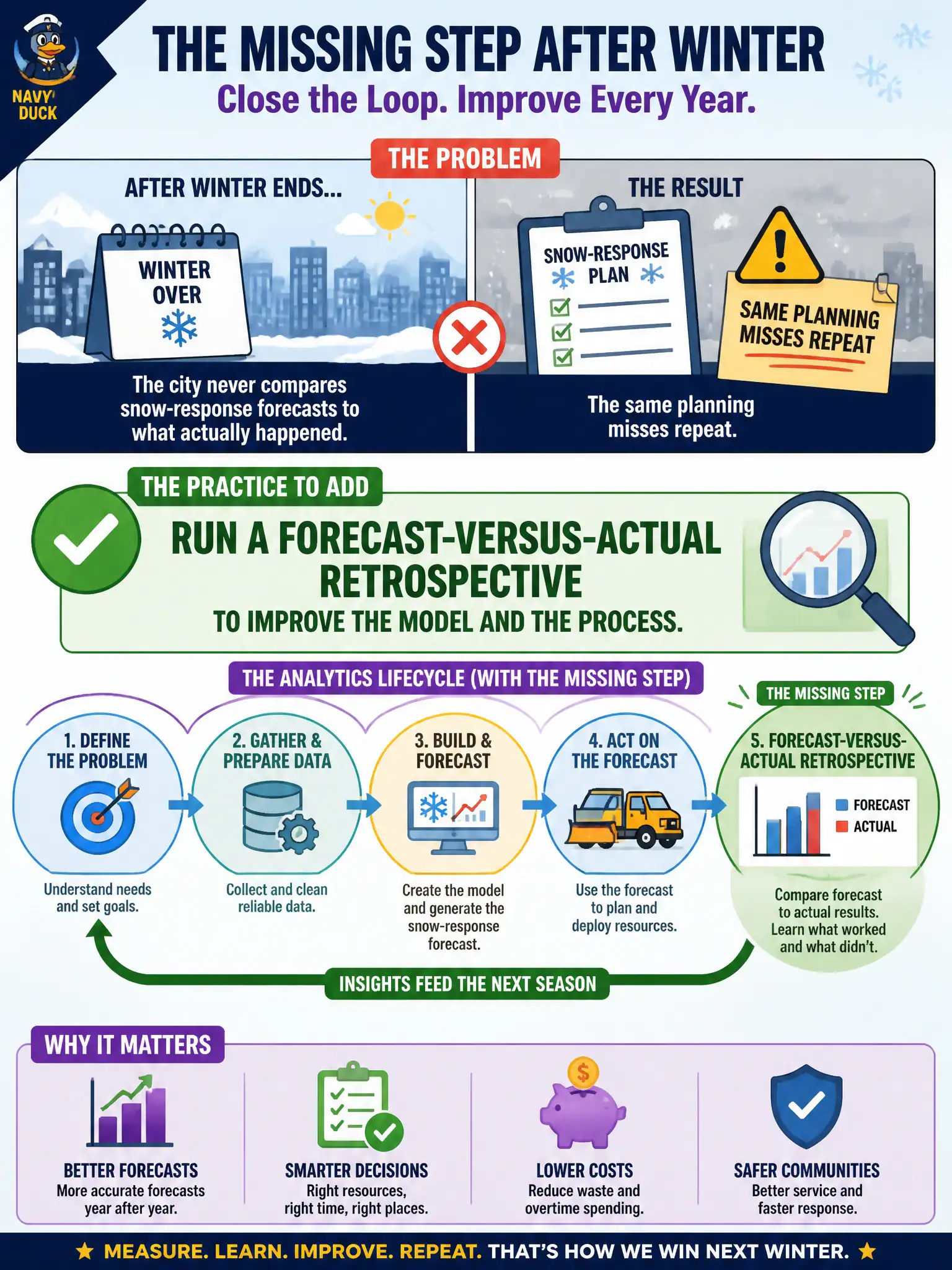
After winter ends, the city never compares snow-response forecasts to what actually happened, and the same planning misses repeat. What analytics-lifecycle practice should be added?
Select an answer to reveal the explanation.
Short Explanation
Skipping forecast-versus-actual is like practicing free throws with your eyes closed and never checking if you hit the rim. Compare what you predicted to what happened, then fix the model or the process. Learning loops beat repeating the same miss every winter.
Full Explanation
When winter ends and the city never compares snow-response forecasts to what actually happened, repeating planning misses are predictable. Add a forecast-versus-actual retrospective to improve both the model and the operating process—error patterns reveal missing drivers, bad assumptions, and process bottlenecks. Archiving forecasts unread so teams are not discouraged by misses abandons learning. Increasing next year’s forecast by a flat 20% without studying error patterns is uncalibrated padding. Stopping forecasting entirely because past misses prove prediction is impossible confuses imperfect prediction with uselessness; many civic operations improve through iterative forecast review. Exam caveat: retrospectives should be blameless and focused on actionable error components (bias, timing, storm severity) rather than humiliation. Operational check: schedule an end-of-season FVA review, segment errors by storm type, update model drivers and playbooks, assign owners to process fixes, and carry lessons into the next winter readiness plan. In municipal information-management practice, record the rationale so future staff know which failure modes the rejected options would create for city services, and re-validate after the next cycle that the same control still holds.