
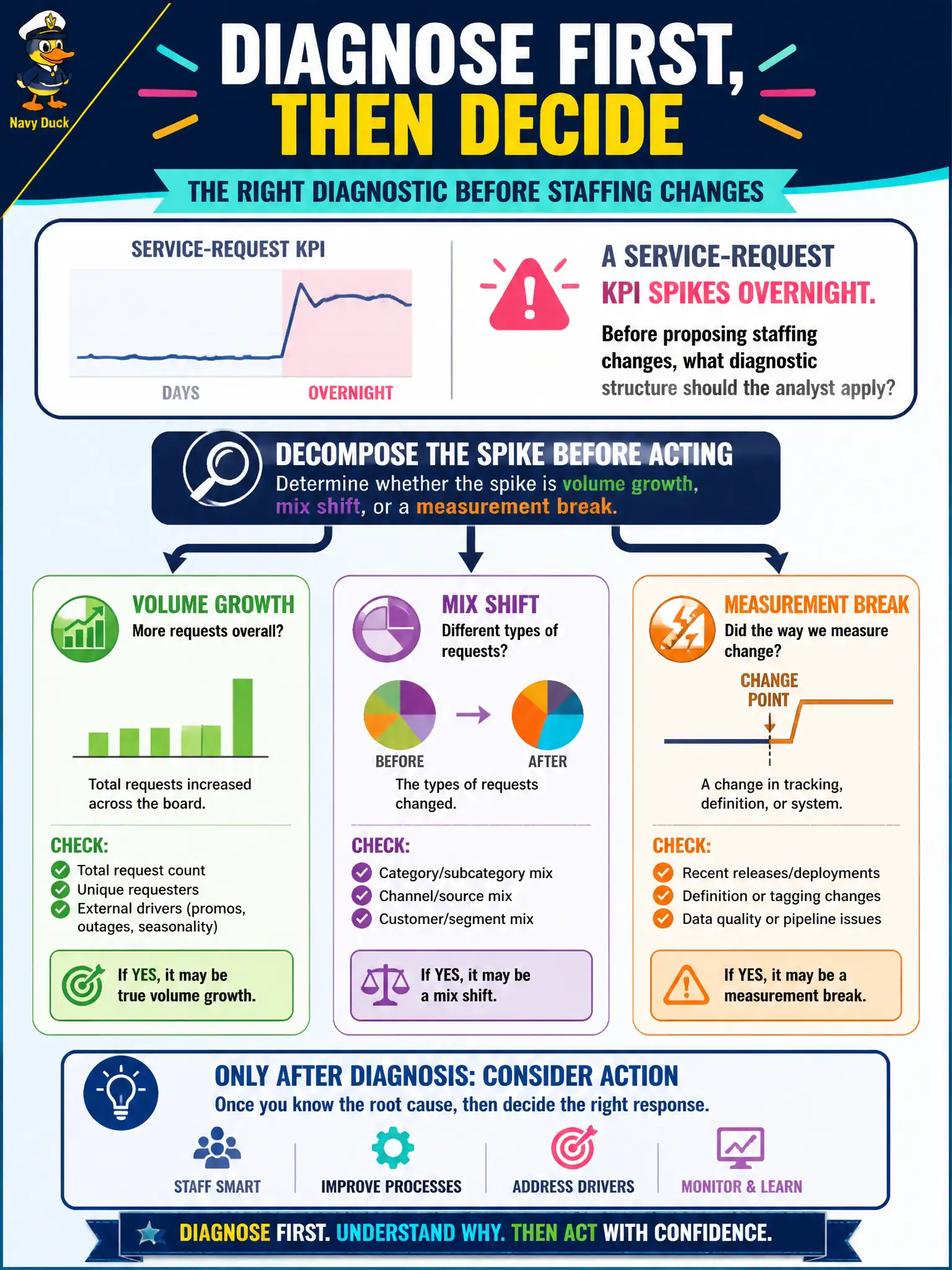
A service-request KPI spikes overnight. Before proposing staffing changes, what diagnostic structure should the analyst apply?
Select an answer to reveal the explanation.
Short Explanation
A sudden spike can mean more work showed up, a different mix of hard cases, or someone changed how you count—three different stories. Walk that diagnostic tree before you rewrite the staffing plan. Fixing a measurement break with overtime is expensive comedy.
Full Explanation
When a service-request KPI spikes overnight, decompose whether the spike is volume growth, mix shift, or a measurement break before proposing staffing changes. Sudden definition changes, duplicate loads, channel shifts, or category recodes often masquerade as demand. Immediately hiring temporary staff proportional to the spike magnitude can waste budget on a measurement artifact. Averaging the spike into the annual trend so it disappears from weekly review hides a signal that may be either real surge or broken pipeline. Attributing every spike to seasonal weather without checking operational data skips diagnosis. Exam caveat: real surges do happen and may need rapid capacity—but decomposition should be fast and evidence-based, not an excuse for endless delay. Operational check: compare volume vs mix vs pipeline/definition changes within hours, inspect load and schema logs, confirm with channel owners, then recommend staffing only if residual volume growth remains after ruling out measurement breaks. In municipal information-management practice, record the rationale so future staff know which failure modes the rejected options would create for city services, and re-validate after the next cycle that the same control still holds. In municipal information-management practice, record the rationale so future staff know which failure modes the rejected options would create for city services, and re-validate after the next cycle that the same control still holds.