
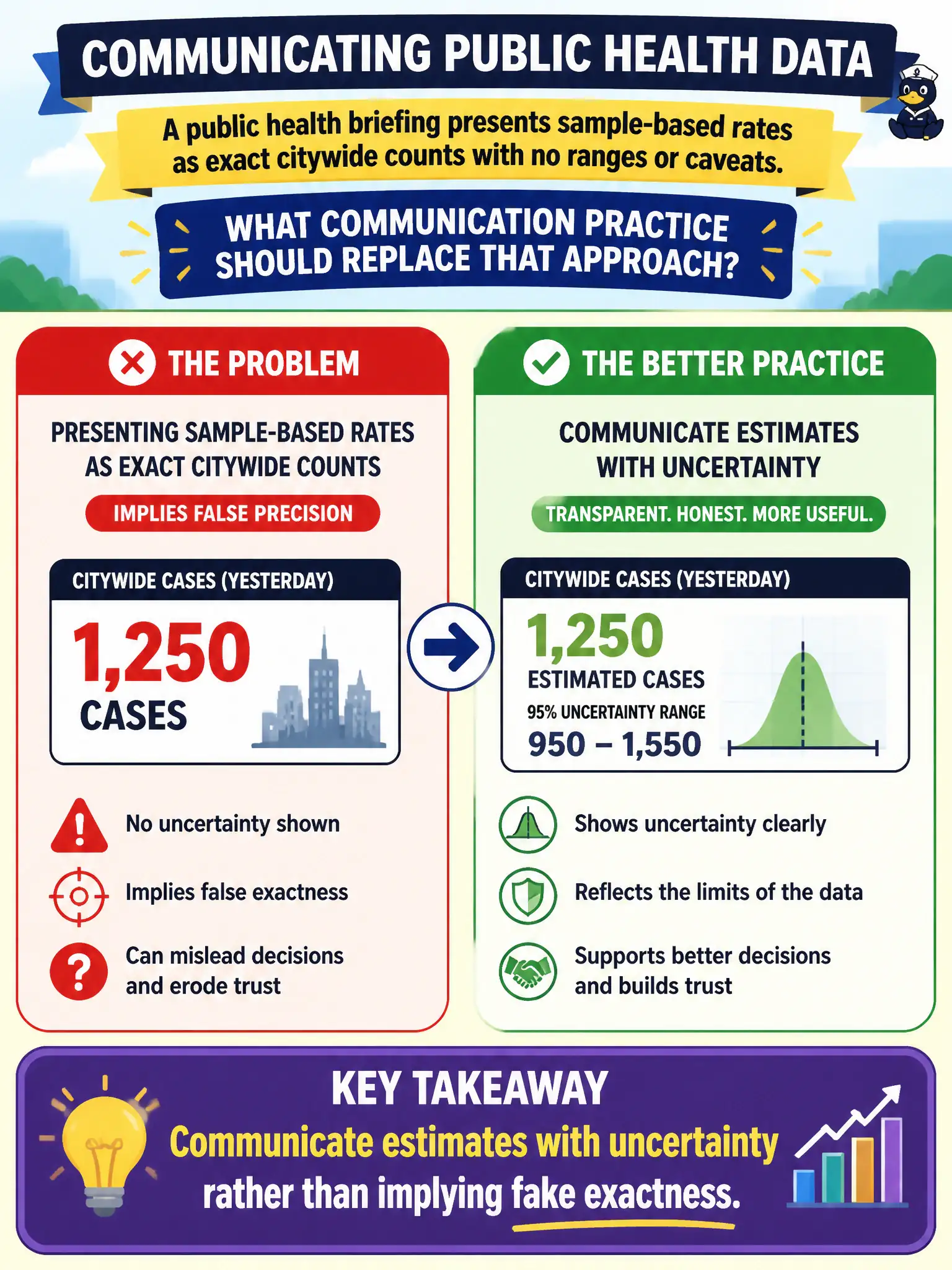
A public health briefing presents sample-based rates as exact citywide counts with no ranges or caveats. What communication practice should replace that approach?
Select an answer to reveal the explanation.
Short Explanation
Sample-based health stats dressed up as exact headcounts are like GPS saying you're 'exactly' on a park bench when the blue circle is a block wide. Say it's an estimate and show the uncertainty. Civic decisions get better when leaders know the fog, not just the headline number.
Full Explanation
Public health briefings that present sample-based rates as exact citywide counts with no ranges or caveats should instead communicate estimates with uncertainty. Fake exactness overstates precision and can drive brittle funding or enforcement decisions. Rounding every estimate to the nearest thousand so uncertainty looks smaller is cosmetic and can still imply false certainty. Stating only the most alarming point estimate to motivate funding selects on narrative rather than honest communication. Omitting methodology notes because they confuse nontechnical audiences removes the context leaders need to interpret strength of evidence; notes can be short and plain-language. Exam caveat: uncertainty communication should be accessible—intervals, qualitative confidence, or margins—without dumping dense statistics that obscure the decision. Operational check: add a plain-language uncertainty note and interval or margin to the rate, cite sample design briefly, avoid exact-count verbs for estimates, and peer-review the briefing for overclaim before release. In municipal information-management practice, record the rationale so future staff know which failure modes the rejected options would create for city services, and re-validate after the next cycle that the same control still holds.