
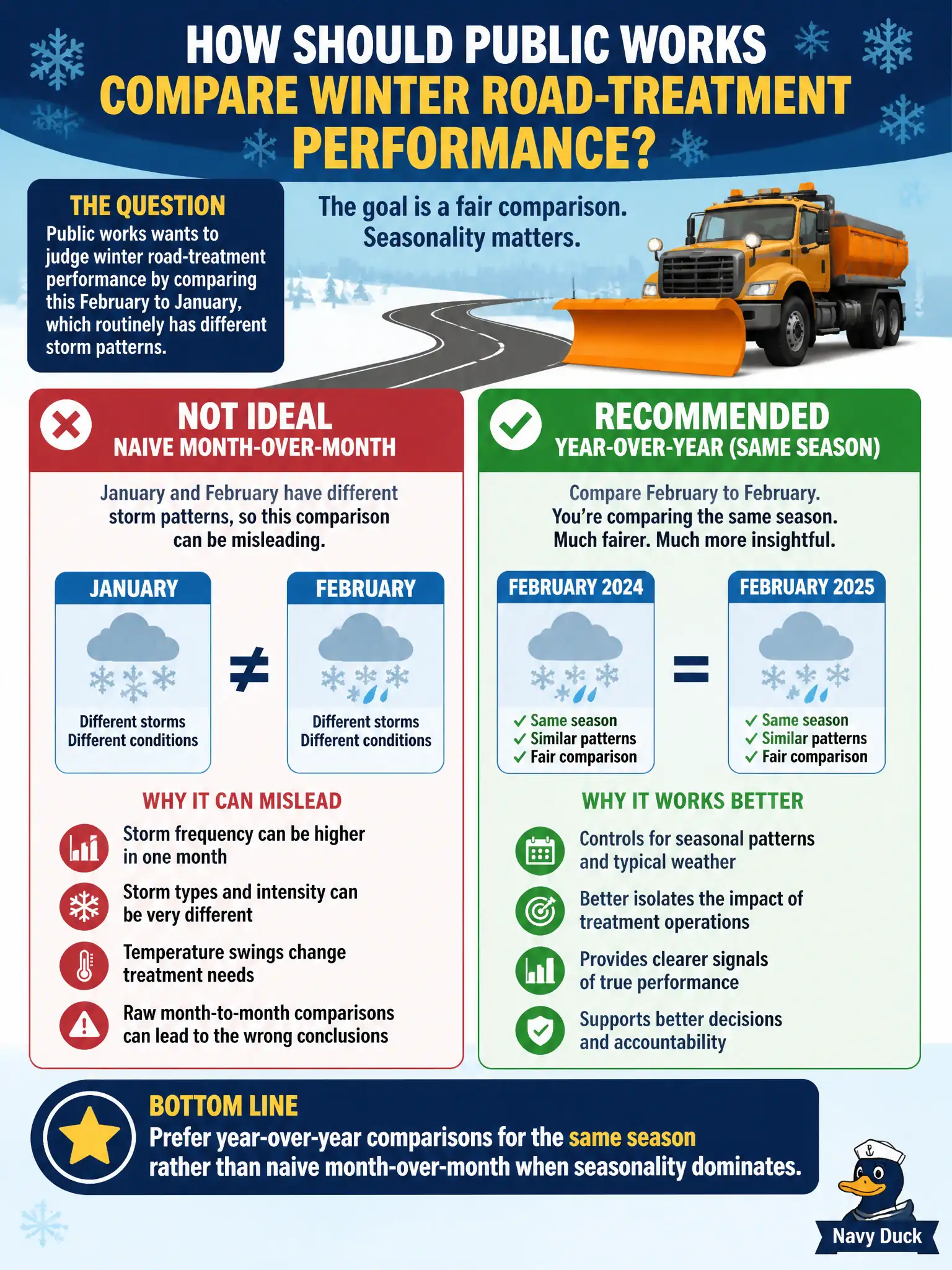
Public works wants to judge winter road-treatment performance by comparing this February to January, which routinely has different storm patterns. What comparison approach should the information manager recommend?
Select an answer to reveal the explanation.
Short Explanation
Comparing February salt runs to January is often like comparing ski tickets to baseball tickets—same year, different season of demand. Winter treatments live on storm patterns, so year-over-year for the same season usually tells a fairer story. Pick comparison windows that respect seasonality.
Full Explanation
Judging winter road-treatment performance by comparing this February to January is often unfair when seasonality and storm patterns dominate. Prefer year-over-year comparisons for the same season—or weather-normalized contrasts—rather than naive month-over-month. Adjacent months are not always the fairest comparison for weather-sensitive services. Comparing only to the single calmest winter month on record cherry-picks a flattering baseline. Dropping weather-sensitive services from all KPI reporting avoids seasonal noise by abandoning accountability. Exam caveat: month-over-month can still help short operational tactics inside a storm season, but strategic performance claims need seasonal alignment or explicit weather adjustment. Operational check: build February-to-February and storm-severity-adjusted views, annotate major weather events, document the comparison rule before briefing, and reject calmest-month baselines for public or executive success claims. In municipal information-management practice, record the rationale so future staff know which failure modes the rejected options would create for city services, and re-validate after the next cycle that the same control still holds. In municipal information-management practice, record the rationale so future staff know which failure modes the rejected options would create for city services, and re-validate after the next cycle that the same control still holds.