
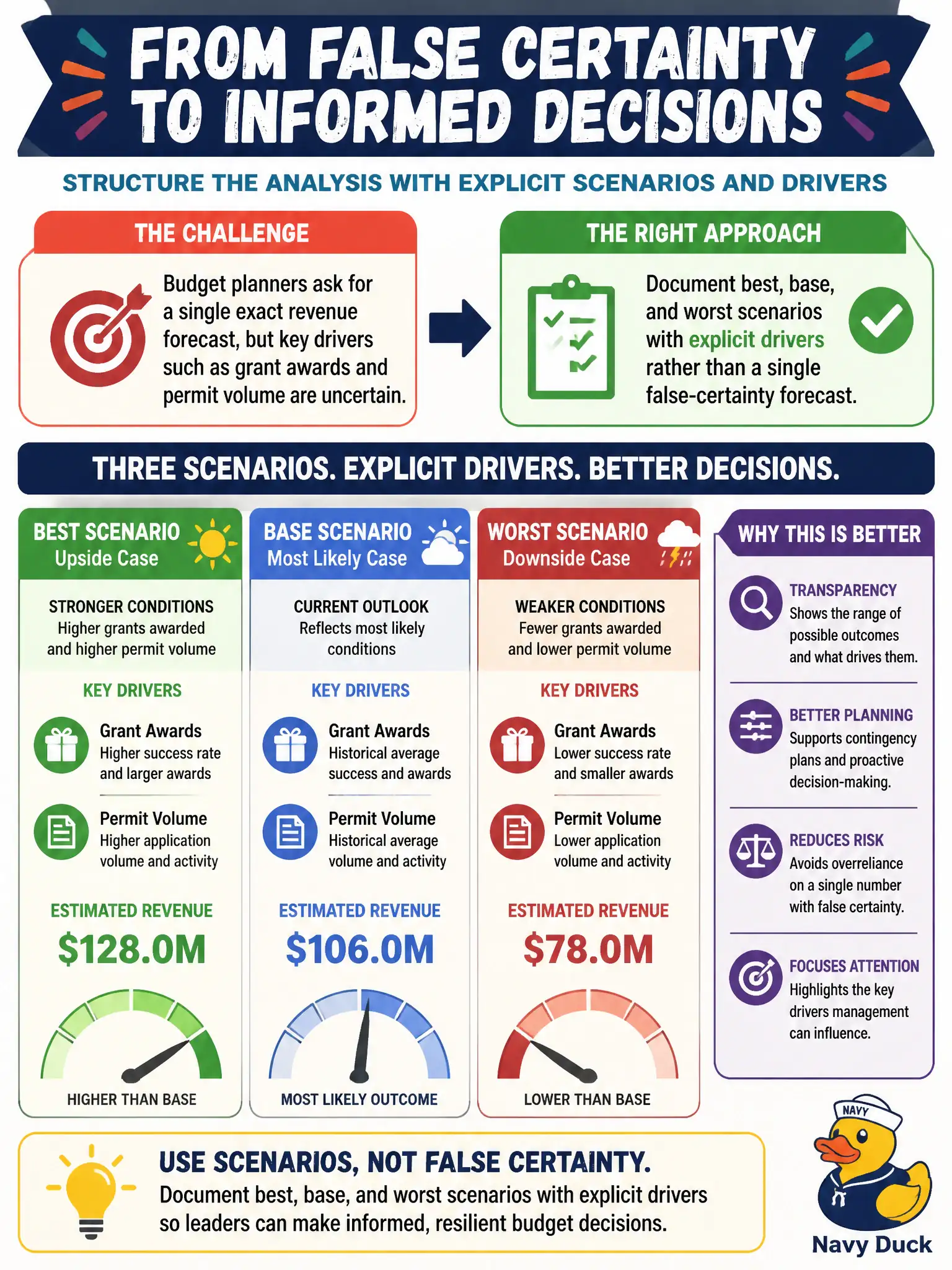
Budget planners ask for a single exact revenue forecast, but key drivers such as grant awards and permit volume are uncertain. How should the information manager structure the analysis?
Select an answer to reveal the explanation.
Short Explanation
A single 'exact' forecast in a messy world is like promising the weather down to the minute next July. Lay out best, base, and worst cases and name the drivers—grants, permits, and the rest—so leaders see the range. Uncertainty documented beats false certainty every budget season.
Full Explanation
When budget planners ask for a single exact revenue forecast while key drivers such as grant awards and permit volume are uncertain, the information manager should structure best, base, and worst scenarios with explicit drivers rather than a single false-certainty number. Scenario ranges communicate uncertainty honestly, support contingency planning, and keep assumptions inspectable. Delivering one hard number with no assumptions listed ends debate by hiding risk until reality diverges. Omitting uncertain drivers and forecasting only from last year’s total as destiny ignores known change factors councils already discuss. Replacing forecasting with a random target chosen to match available headcount reverses analysis—fitting the number to staffing rather than informing resource decisions. Exam caveat: scenarios still need disciplined driver assumptions, ownership, and update cadence; wide arbitrary ranges without rationale are not a substitute for analysis, and point forecasts may appear inside a scenario band if labeled as a planning case. Operational check: document drivers and assumptions for each scenario, show sensitivity of revenue to grant and permit swings, present the range with decision triggers, and refuse to publish a lone point forecast as if certainty existed.