
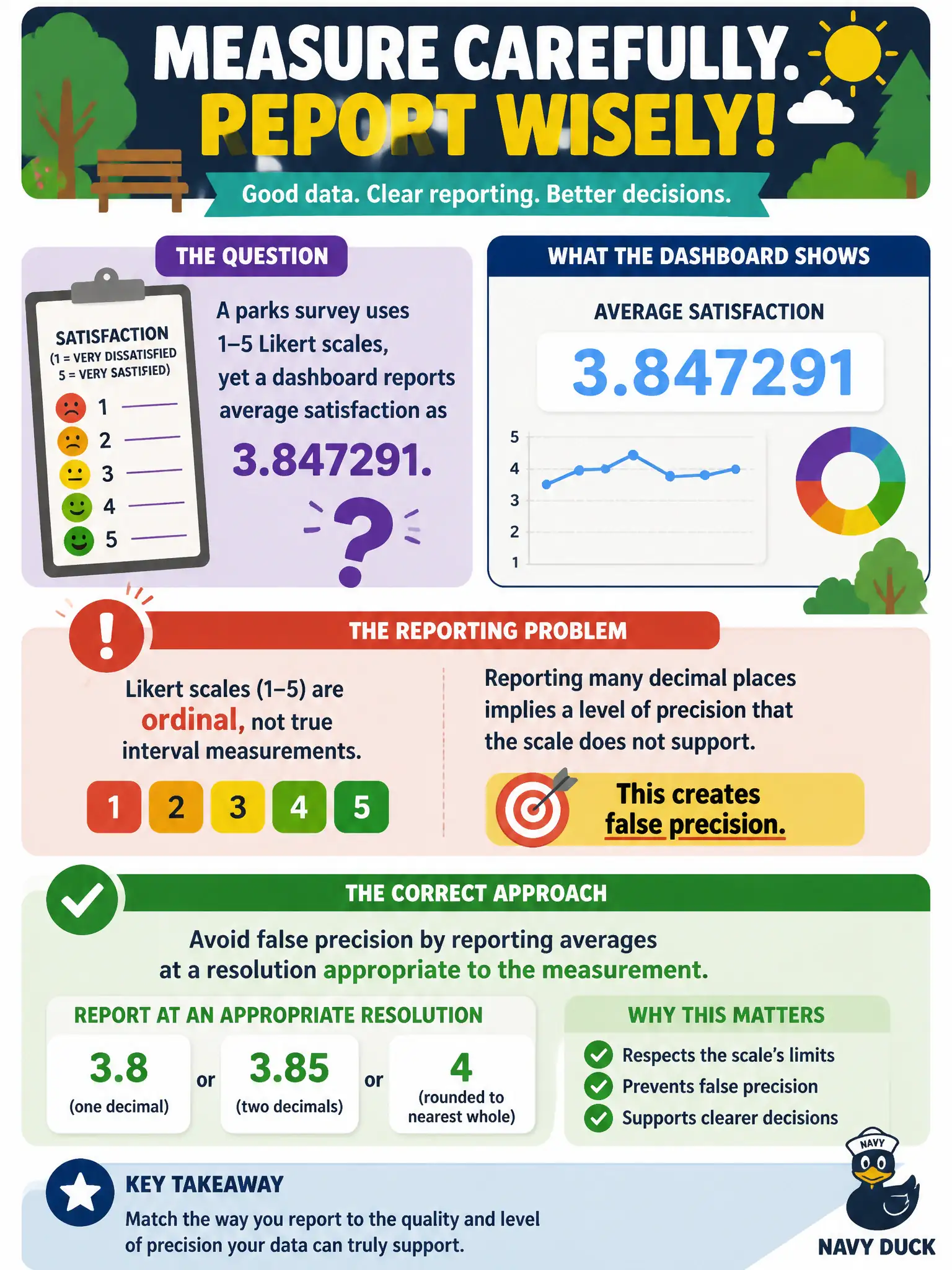
A parks survey uses 1–5 Likert scales, yet a dashboard reports average satisfaction as 3.847291. What reporting problem should the information manager correct?
Select an answer to reveal the explanation.
Short Explanation
Reporting a Likert average to six decimals is like weighing a suitcase on a bathroom scale and claiming it is 23.847291 pounds—the extra digits look smart but they're noise. Match precision to how coarse the measurement really is. Honest reporting beats fake exactness every time.
Full Explanation
Reporting average parks satisfaction as 3.847291 from 1–5 Likert items creates false precision that overstates measurement resolution and can mislead boards into treating sampling noise as actionable signal. Averages should be reported at a resolution appropriate to the instrument and sample—often one decimal place—with response counts and preferably a distribution or uncertainty note. Replacing Likert items with free-text only so averages are never computed throws away useful summary statistics rather than fixing presentation discipline. Adding six more decimal places to look scientific worsens the false-precision problem and trains leaders to over-read tiny deltas. Hiding the survey method so readers focus only on the long decimal score removes the context needed to interpret any average, including mode mix and nonresponse. Exam caveat: more precise computation internally for intermediate steps is fine; the issue is board-facing or public reporting that implies unjustified exactness from coarse ordinal items. Operational check: round board-facing Likert averages appropriately, show n and a simple distribution or interval, document the scale wording, and update the visualization standard to forbid long-decimal theater for coarse survey instruments.