
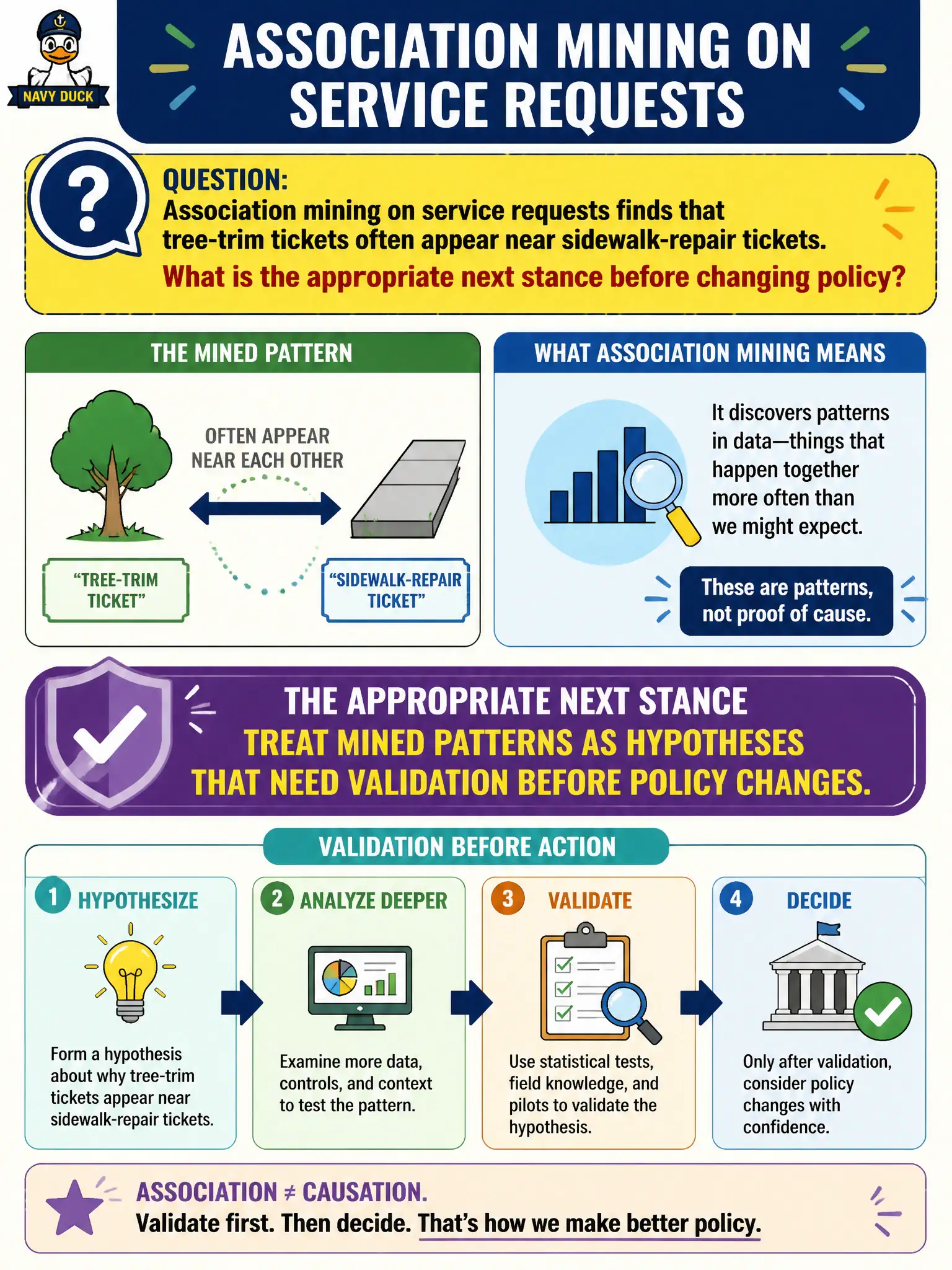
Association mining on service requests finds that tree-trim tickets often appear near sidewalk-repair tickets. What is the appropriate next stance before changing policy?
Select an answer to reveal the explanation.
Short Explanation
An association rule is a breadcrumb, not a city ordinance. Tree-trim near sidewalk repair might be real coupling—or season, or routing quirks. Validate before you rewrite policy.
Full Explanation
Association mining that finds tree-trim tickets often appearing near sidewalk-repair tickets should be treated as a hypothesis that needs validation before policy changes. Co-occurrence can reflect shared neighborhoods, seasonal storm damage, reporting campaigns, routing artifacts, or code-enforcement sweeps rather than a ready-made causal mandate for citywide policy. Enacting a citywide policy overnight based solely on the association rule overfits a pattern, can misallocate crews, and may ignore confounding geography. Deleting the finding because associations can never inform operations wastes a useful exploratory signal that can prioritize field checks. Publishing the rule as proven causation on the public dashboard immediately mislabels evidence strength and risks public challenge when the link fails. Exam caveat: mined associations are valuable for prioritizing investigation and operational review, not for automatic mandate; validation may include spatial confounders, temporal controls, base-rate checks, and supervisor input. Operational check: document the association as a hypothesis with support and confidence metrics, check confounders, consult public-works supervisors, run a limited pilot if warranted, and only then consider policy language with measured outcomes and an owner.