
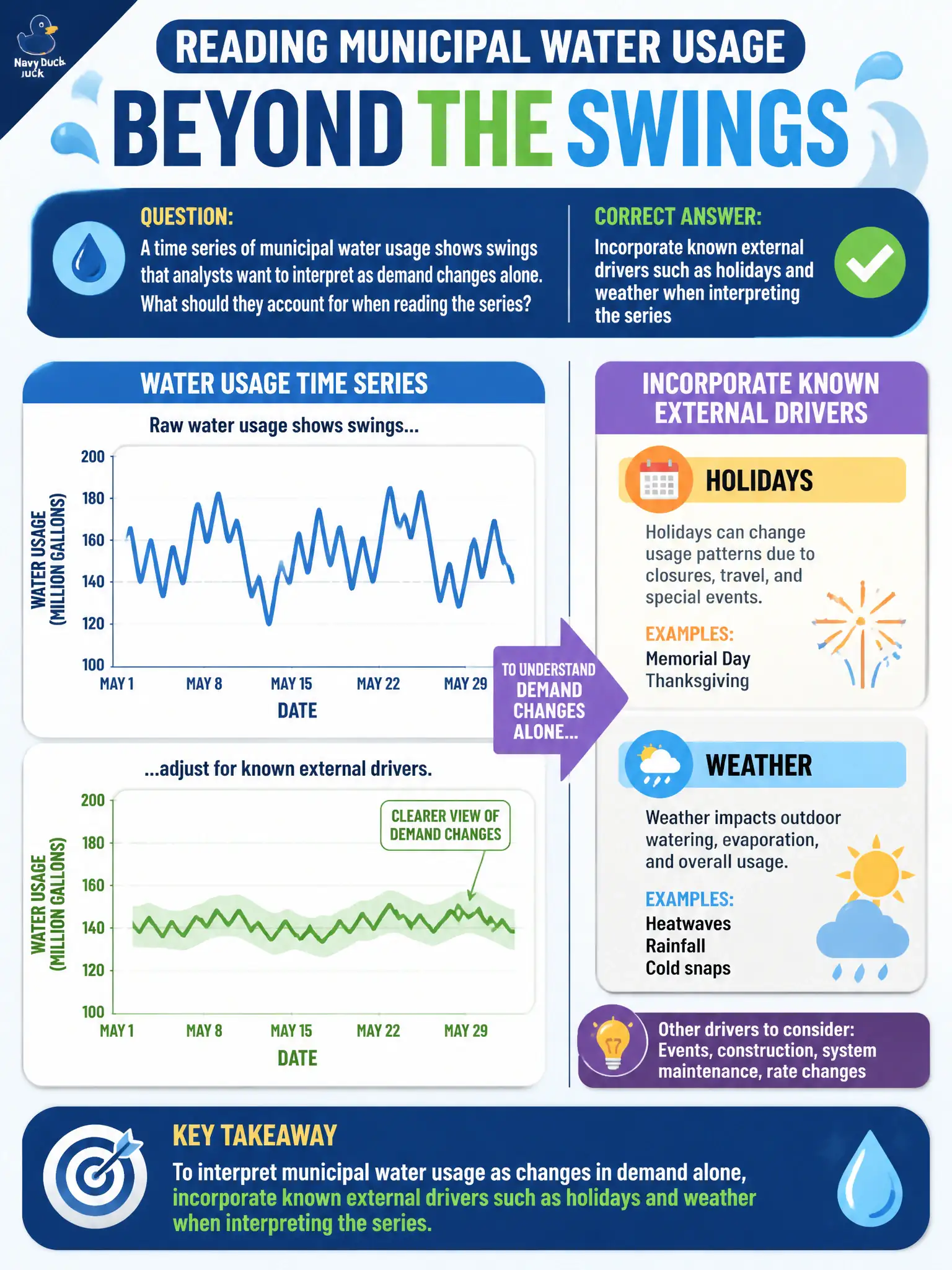
A time series of municipal water usage shows swings that analysts want to interpret as demand changes alone. What should they account for when reading the series?
Select an answer to reveal the explanation.
Short Explanation
Water use dances with weather and holidays, not only with mysterious demand. Read the series with those external drivers in view. Otherwise you invent a story the calendar already explained.
Full Explanation
A time series of municipal water usage with swings that analysts want to interpret as demand changes alone should incorporate known external drivers such as holidays and weather when interpreting the series. Calendar effects, temperature, and similar factors routinely shape utility demand; ignoring them invites false narratives about resident behavior, leakage, or treatment-plant performance. Ignoring holidays and weather because calendar effects never matter for utilities fails against standard utility analytics practice. Smoothing the series until external drivers are invisible fails by erasing the context needed for fair interpretation. Attributing every peak solely to meter theft without external context fails by leaping to a single internal cause before ruling out known drivers. Exam caveat: incorporating external drivers does not automatically prove causation for every swing, but it is required before confident operational stories; residual anomalies can then be investigated with stronger methods. Operational check: overlay weather and holiday indicators on the usage series, compare like-for-like periods, document which swings remain after external adjustment, brief operations with driver-aware interpretation, and avoid policy claims that treat weather-driven peaks as pure behavioral change.