
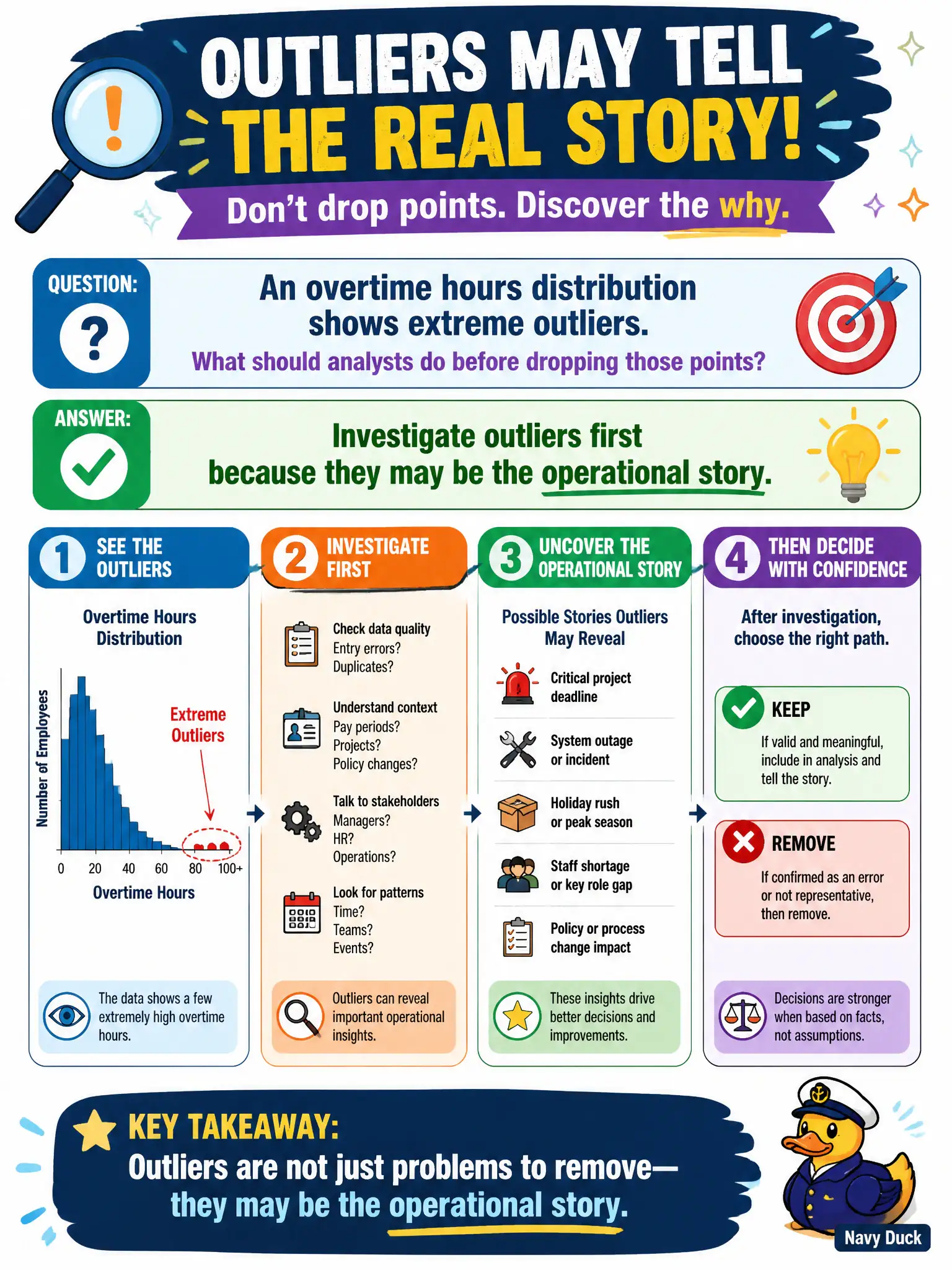
An overtime hours distribution shows extreme outliers. What should analysts do before dropping those points?
Select an answer to reveal the explanation.
Short Explanation
Outliers are suspects, not trash by default—maybe that overtime spike is the whole plot. Investigate before you drop. Sometimes the weird point is the finding.
Full Explanation
When an overtime hours distribution shows extreme outliers, analysts should investigate outliers first because they may be the operational story—data entry errors, rare emergency events, or systemic overtime patterns—before dropping those points. Investigation protects both data quality and operational insight in municipal workforce management and prevents silent loss of signal that supervisors need. Deleting outliers automatically in every pipeline without review fails by discarding potential signal and hiding defects. Winsorizing to the mean of non-outliers and never investigating fails by quietly reshaping reality without understanding causes supervisors must address. Replacing outlier values with social-media engagement scores fails by substituting an unrelated measure that answers a different question entirely. Exam caveat: after investigation, removal or adjustment may be justified for summarization, but the decision and rationale should be documented, and operational owners should still act on confirmed extreme cases. Operational check: list extreme overtime observations, validate against source systems and schedules, interview supervisors for event context, document keep/adjust/drop decisions, remediate systemic data or process causes, and only then recompute summary statistics used in civic workforce briefings.