
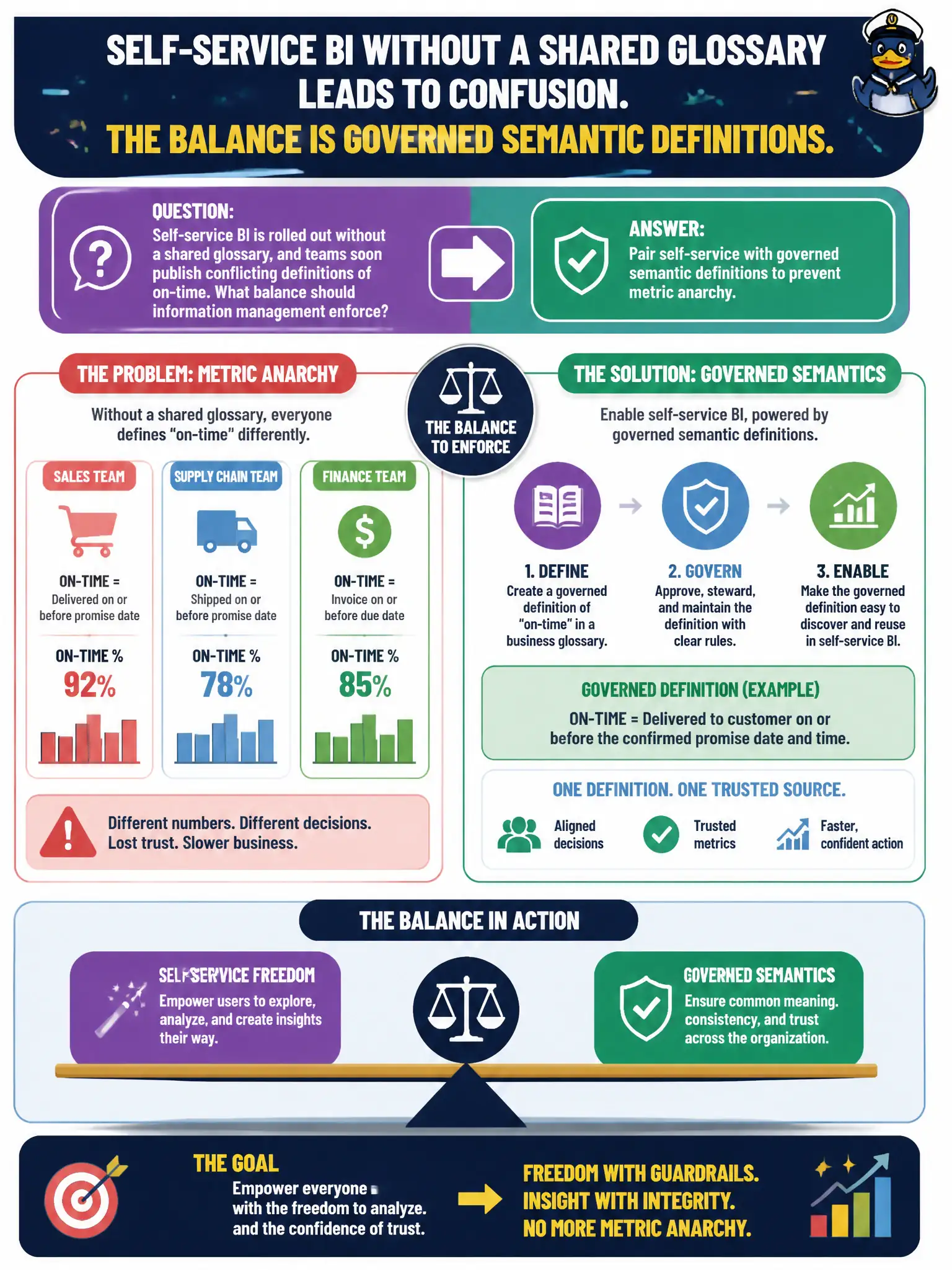
Self-service BI is rolled out without a shared glossary, and teams soon publish conflicting definitions of on-time. What balance should information management enforce?
Select an answer to reveal the explanation.
Short Explanation
Self-service without a glossary is a kitchen where every cook renames salt. People move faster, then nobody agrees what on-time means. Govern the definitions and keep the freedom to explore.
Full Explanation
Self-service BI rolled out without a shared glossary, where teams soon publish conflicting definitions of on-time, requires pairing self-service with governed semantic definitions to prevent metric anarchy. Access without shared meaning multiplies incompatible on-time claims across departments and confuses council packets, public dashboards, and operational huddles. Banning self-service entirely and returning all reporting to monthly PDF packets only fails by overcorrecting and recreating access bottlenecks that starve frontline teams of timely views. Allowing each team to rename core KPIs weekly for creativity fails by accelerating semantic chaos. Hiding the glossary so analysts invent measures from column names alone fails by removing the control that makes self-service safe for civic use. Exam caveat: not every exploratory metric needs certification on day one, but core civic KPIs used in official packets and public dashboards need governed definitions, owners, and calculation logic. Operational check: publish a certified on-time definition with calculation rules, tag certified metrics in the BI tool, require official packets to use certified fields, provide a request path for new certified metrics, and periodically scan for conflicting on-time publications.